
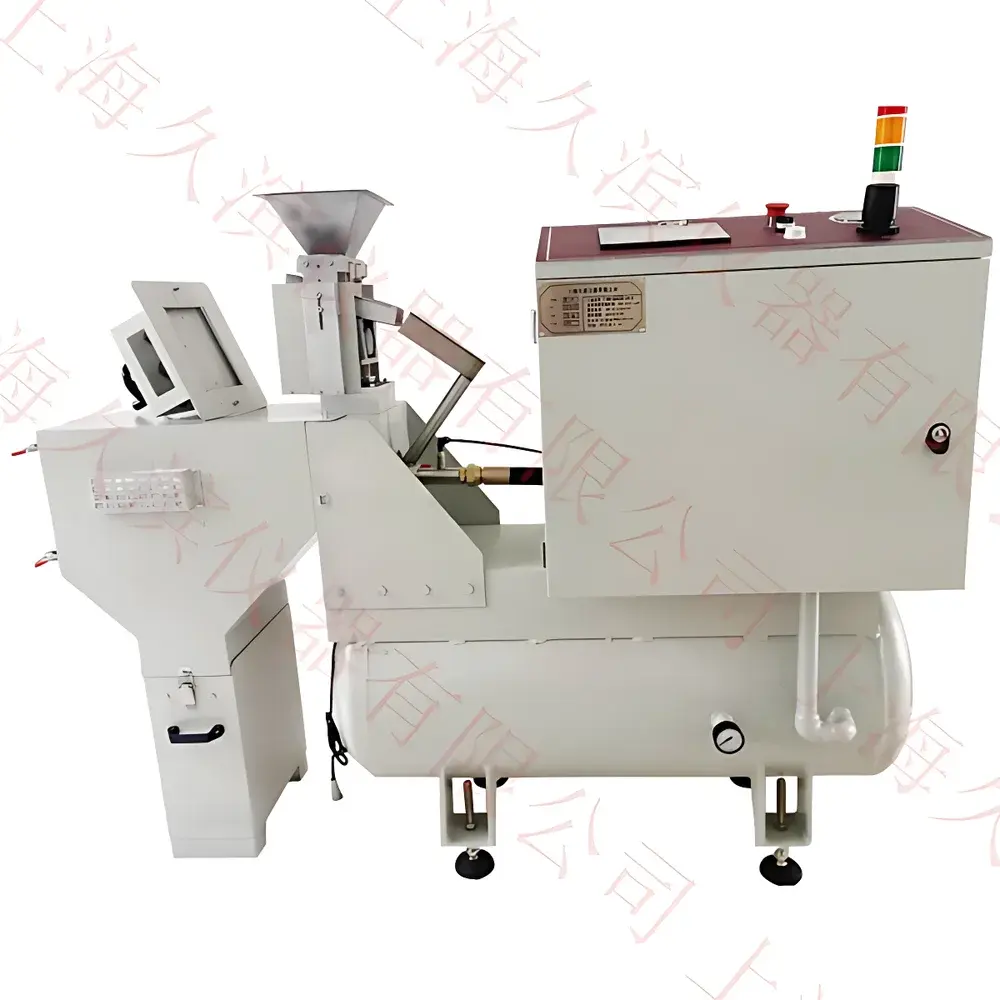
JB-JM5 Lithium Battery Pack Gravel Impact Resistance Tester
| Brand | JByq (JiuBin) |
|---|---|
| Model | JB-JM5 |
| Origin | Shanghai, China |
| Control System | PLC-based |
| Human-Machine Interface | Chinese-language HMI |
| Software | Remotely upgradable firmware |
| Impact Medium | Steel beads, gravel, river pebbles |
| Medium Mass Capacity | 0–10 kg |
| Nozzle Types | 45° and 90° fixed-angle impact nozzles |
| Test Angles | 45°, 54°, 90° for flat specimens |
| Impact Pressure Range | 0–1000 kPa |
| Equivalent Impact Velocity | Up to 120 km/h (calculated per ISO 20567-1 methodology) |
| Impact Area | Fully configurable spray zone |
| Nozzle Orifice | Adjustable aperture |
| Funnel Material | Stainless steel |
| Compliance Standards | SAE J400, ASTM D3170, ISO 20567-1, VDA 238-100, GMW 1407, GMW 14668, TL 211-6, GME 60268, JIS M 0141, Mazda MES MN 601C, Nissan NES M0141, VW PV 3952, Toyota TSC 7001G, Chrysler MS-463PB-39-01 & -52-01, QC/T 1095–2018 |
Overview
The JB-JM5 Lithium Battery Pack Gravel Impact Resistance Tester is an engineered simulation system designed to evaluate the mechanical robustness of electric vehicle (EV) battery enclosures under real-world road-debris impact conditions. It operates on the principle of controlled pneumatic propulsion, accelerating calibrated particulate media—such as steel beads, graded gravel, or river pebbles—toward a stationary battery pack or component at velocities traceable to international automotive durability standards. Unlike generic abrasion testers, the JB-JM5 replicates the stochastic angularity, kinetic energy distribution, and multi-directional incidence typical of high-speed gravel ejection from tires or road surfaces. Its architecture supports both flat-panel validation (e.g., battery top covers, underbody shields) and full-pack 3D assessment using a configurable test chamber, making it suitable for OEMs, Tier-1 suppliers, and third-party certification labs conducting functional safety and IPX-rated enclosure validation per UN GTR 20 and ISO 6469-1.
Key Features
- PLC-based control system with deterministic real-time sequencing for repeatable pressure ramping, dwell timing, and nozzle actuation
- Dual-angle impact nozzles (45° and 90°) fabricated from hardened stainless steel to withstand repeated abrasive loading
- Adjustable orifice design enabling precise regulation of mass flow rate and impact density across the defined test area
- Stainless-steel media funnel rated for 0–10 kg static load, compatible with ISO 8501-1 graded abrasives and customer-supplied gravel per ASTM D3170 Annex A1
- Pressure-controlled propulsion system with 0–1000 kPa digital regulation, correlated to impact velocity via empirical calibration curves compliant with ISO 20567-1 Annex B
- Configurable specimen mounting interface supporting standard battery module dimensions (up to 1.8 m × 1.2 m × 0.3 m) and adjustable tilt mechanisms for 45°, 54°, and 90° incidence angles
- Integrated 3D test chamber option for non-planar battery housings, accommodating curved cooling plates, integrated busbars, and sensor-integrated casings
Sample Compatibility & Compliance
The JB-JM5 accommodates a broad range of EV battery system components, including aluminum or steel enclosures, composite endplates, thermal interface materials (TIMs), gasketed sealing zones, and surface-coated structural brackets. Tested items include but are not limited to: active grille shutters, ADAS camera housings, headlamp bezels, painted body panels, and laminated glazing adjacent to battery mounting zones. The system fully supports test execution per SAE J400 (Chips and Scratches), ASTM D3170 (Gravelometer), ISO 20567-1 (Paint Chipping Resistance), VDA 238-100 (Bending Strength), and OEM-specific procedures such as GMW 14668 Section 3.4.9 (Battery Module Impact Endurance) and VW PV 3952 (Mechanical Load Simulation). All test parameters—including pressure setpoints, exposure duration, media gradation, and impact angle—are logged with timestamped audit trails to support GLP-compliant reporting and internal quality audits.
Software & Data Management
The embedded control software provides a Chinese-language HMI with intuitive parameter configuration, real-time pressure/flow monitoring, and automated test sequence logging. Firmware updates are delivered remotely via secure HTTPS channel without hardware intervention, ensuring alignment with evolving OEM specifications and regulatory amendments. Each test run generates a structured CSV report containing: media type and mass, applied pressure (kPa), calculated velocity (km/h), nozzle angle, exposure time (s), impact area coordinates, and operator ID. Exported data integrates natively with LIMS platforms and satisfies metadata requirements for FDA 21 CFR Part 11–compliant environments when deployed with optional electronic signature modules.
Applications
- Validation of battery pack ingress protection (IP67/IP6K9K) against gravel-induced seal degradation
- Assessment of coating adhesion loss and substrate pitting on aluminum extrusion battery trays
- Functional evaluation of thermal runaway barrier integrity after mechanical pre-damage
- Comparative testing of composite vs. metal enclosure resilience under multi-angle debris impact
- Support for ISO 26262 ASIL-B functional safety analysis of battery housing structural failure modes
- Pre-certification testing for GB/T 31467.3, UN ECE R100, and IEC 62660-2 mechanical abuse protocols
FAQ
Does the JB-JM5 comply with UN GTR 20 requirements for electric powertrain mechanical durability?
Yes—the system’s velocity calibration protocol, media specification controls, and test documentation structure align with the gravel impact verification methodology outlined in UN GTR 20 Annex 5, Clause 6.3.2.
Can the tester accommodate prismatic, pouch, and cylindrical battery modules in a single setup?
Flat-panel tests support standardized module faces; for full-pack geometries, the optional 3D test chamber enables orientation-flexible mounting with six-degree-of-freedom positioning fixtures.
Is traceable calibration available for pressure and velocity parameters?
Third-party NIST-traceable pressure transducer calibration certificates are provided with each unit; velocity correlation is validated per ISO 20567-1 Annex B using certified high-speed photonic sensors.
What media grading standards are supported out of the box?
The system ships with reference steel bead sets conforming to ASTM E11 and ISO 565; gravel sizing follows ASTM D448 Group 2 (4.75–9.5 mm) and JIS A 1407 Class A specifications.
How is test repeatability ensured across multiple operators and shifts?
All critical parameters are locked behind role-based access control; test sequences are saved as encrypted templates with version history, preventing manual deviation during routine operation.



