
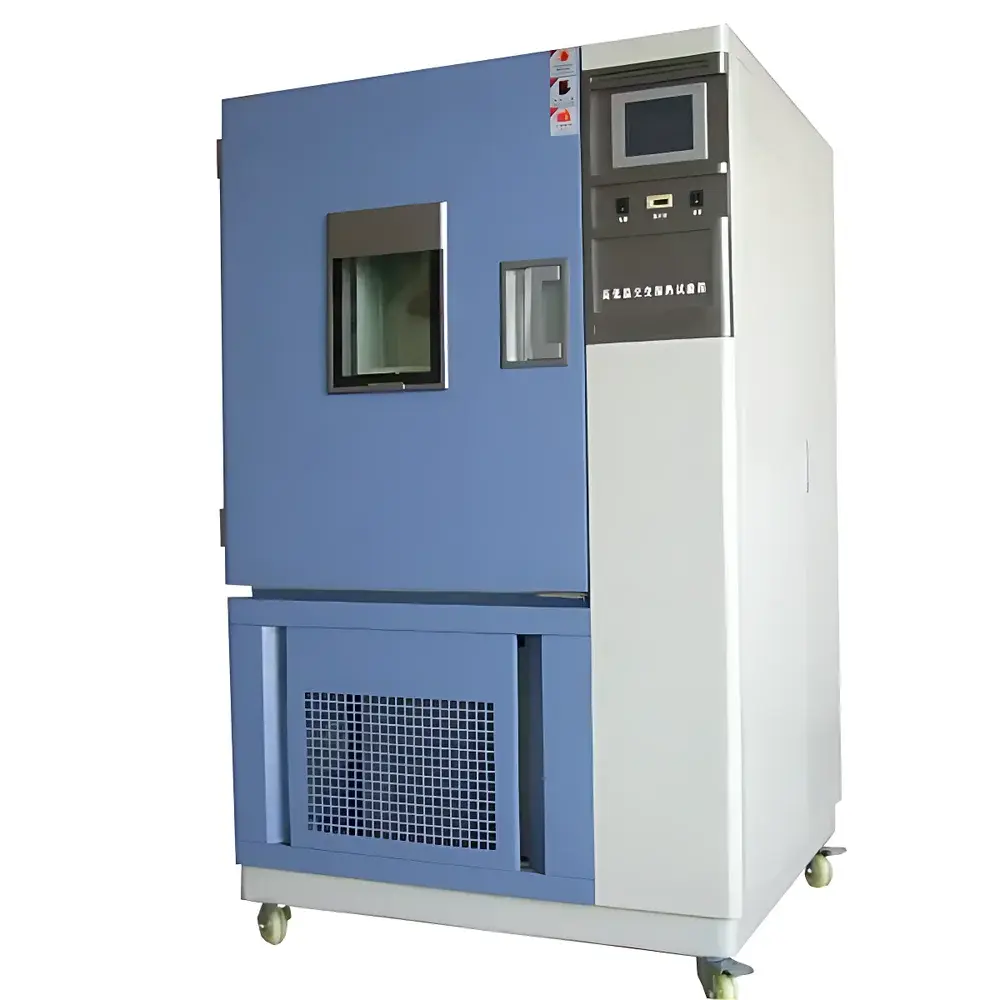
Jiubin Instruments JB-GDWJBSR Environmental Stress Screening Chamber (Temperature & Humidity Cycling Test Chamber)
| Brand | Jiubin Instruments |
|---|---|
| Model | JB-GDWJBSR |
| Temperature Range | −20 °C to +100 °C |
| Humidity Range | 40–95 % RH |
| Temperature Uniformity | ±0.5 °C |
| Internal Chamber Material | SUS304 Mirror-Finish Stainless Steel |
| Insulation | High-Density Ultra-Fine Glass Fiber |
| Control System | Microprocessor-Based PID Controller with Dual Digital Display (Set/Actual) |
| Compressor | Original Tecumseh (France) Hermetic Scroll Compressor |
| Air Circulation | Low-Noise German Imported Axial Fan + Optimized Air Duct Design |
| Standard Test Port | Ø30 mm on Left Side Wall |
| Compliance | GB/T 2423.1–2001, GB/T 2423.2–2001, GB/T 2423.3–1993, GB/T 2423.4–1993, GB 10592–1989 |
| Safety Protections | Compressor Overheat, Fan Overheat, High-Pressure Cut-off, Phase Loss Detection, Overload Protection, Overtemperature Alarm, Low-Water Level Interlock |
| Power Supply | 380 V AC, 50 Hz |
Overview
The Jiubin Instruments JB-GDWJBSR Environmental Stress Screening Chamber is an industrial-grade temperature and humidity cycling test system engineered for rigorous reliability validation of electronic components, automotive modules, aerospace subsystems, and medical device packaging under controlled thermal and hygrothermal stress conditions. It operates on the principle of forced-air convection combined with precision refrigeration (via a hermetically sealed Tecumseh scroll compressor) and steam-based humidification, enabling reproducible simulation of real-world environmental extremes—including rapid transitions between sub-zero cold soak, high-temperature bake, and high-humidity dwell phases. Designed in strict accordance with IEC 60068-2 series test methodologies and aligned with the structural and performance requirements of GB/T 2423.1–2001 (cold), GB/T 2423.2–2001 (dry heat), GB/T 2423.3–1993 (damp heat, steady state), and GB/T 2423.4–1993 (damp heat, cyclic), this chamber supports qualification testing for MIL-STD-810G, JEDEC JESD22-A104, and ISO 16750-4 compliance workflows.
Key Features
- Chamber interior constructed from mirror-finish SUS304 stainless steel with seamless, radius-cornered geometry—ensuring corrosion resistance, ease of cleaning, and uniform thermal reflectivity.
- High-efficiency insulation using multi-layer ultra-fine glass fiber (density ≥48 kg/m³) with vacuum-sealed joints, minimizing thermal bridging and maintaining stable chamber dynamics during rapid ramp rates.
- Microprocessor-based dual-display PID controller with auto-tuning capability; provides real-time monitoring of setpoint vs. measured values for both temperature and relative humidity, with programmable ramp/soak profiles and deviation alarms.
- Optimized air distribution architecture featuring a low-noise, brushless German axial fan and symmetrical baffle-guided airflow path—validated to achieve ≤±0.5 °C temperature uniformity across the full working volume per GB 10592–1989.
- Dedicated Ø30 mm test port on the left chamber wall, fitted with silicone gasket and removable blanking plug—enabling safe integration of external instrumentation, thermocouple feeds, or power leads without compromising seal integrity.
- Comprehensive safety architecture including compressor discharge temperature monitoring, fan motor thermal cut-out, high-pressure switch, phase-loss detection, overload relays, and independent overtemperature and low-water-level interlocks.
Sample Compatibility & Compliance
The JB-GDWJBSR accommodates a broad range of sample geometries—from PCB assemblies and sensor housings to sealed battery packs and polymer-based medical packaging—within its standardized internal volumes (350×320×450 mm up to 700×800×890 mm). Its stainless-steel chamber surface and non-outgassing insulation materials prevent contamination of sensitive samples during extended exposure cycles. All operational parameters—including ramp rate limits, dwell stability tolerances, and humidity recovery time—are traceable to national metrological standards and fully documented to support GLP-compliant test reporting. The system satisfies mechanical and electrical safety requirements per GB 4793.1–2007 (IEC 61010-1) and electromagnetic compatibility per GB/T 18268.1–2010 (IEC 61326-1).
Software & Data Management
While the base configuration includes standalone microcontroller operation with front-panel data logging (up to 100 segments, 999 cycles), optional RS485/Modbus RTU or Ethernet TCP/IP interface enables integration with centralized test management platforms such as NI TestStand, Keysight PathWave, or custom MES/QMS systems. Data export supports CSV format with timestamped temperature/humidity readings, alarm events, and cycle progression metadata. Optional thermal printer module provides hard-copy audit trails compliant with FDA 21 CFR Part 11 requirements when paired with user-defined electronic signatures and access-controlled configuration settings.
Applications
- Accelerated life testing of printed circuit board assemblies (PCBAs) under thermal cycling stress to identify solder joint fatigue or delamination mechanisms.
- Validation of moisture barrier integrity in pharmaceutical blister packaging per USP and ISO 11607-1.
- Environmental screening of automotive ECUs prior to AEC-Q200 qualification.
- Pre-conditioning of lithium-ion battery cells before electrical performance characterization at extreme ambient conditions.
- Stability assessment of optical coatings and MEMS devices exposed to combined thermal shock and humidity ingress.
- Reliability qualification of IoT edge sensors deployed in uncontrolled outdoor infrastructure environments.
FAQ
What is the maximum allowable ramp rate between temperature extremes?
The chamber supports programmable linear ramps from −20 °C to +100 °C at rates up to 5 °C/min (subject to load mass and humidity setpoint); actual achievable ramp speed is determined by thermal mass and must be validated per IEC 60068-3-5.
Does the system support humidity control below 40% RH?
No—the minimum specified humidity range is 40% RH due to condensation control constraints in the steam generator design; dehumidification to lower levels requires optional desiccant-based auxiliary systems.
Can the controller store multiple test programs with different segment configurations?
Yes—the embedded controller supports up to 100 programmable segments across 999 total cycles, with independent settings for temperature, humidity, duration, and ramp rate per segment.
Is calibration documentation provided with shipment?
Each unit ships with a factory calibration certificate covering PT100 sensor accuracy (±0.15 °C at 0 °C, ±0.3 °C at 100 °C) and humidity transducer linearity (±2% RH across 40–95% RH), traceable to CNAS-accredited reference standards.
What maintenance intervals are recommended for long-term operational stability?
Compressor oil and refrigerant charge require verification every 24 months; steam generator tank cleaning and descaling every 6 months; air filter replacement every 3 months under continuous operation; full system performance verification annually per GB/T 5170.2 and GB/T 5170.5.



