
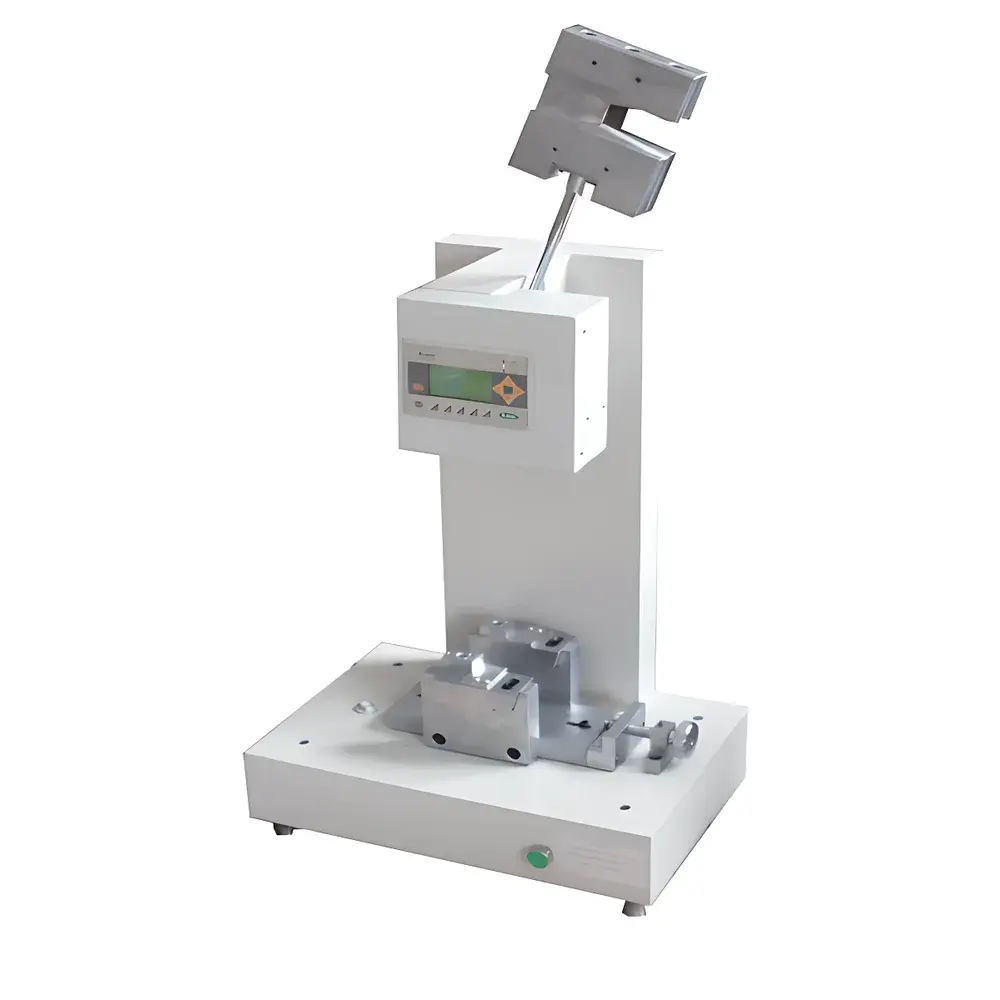
Jiubin Instruments JB/XJJ-50B Digital Charpy Impact Tester
| Brand | Jiubin Instruments |
|---|---|
| Origin | Shanghai, China |
| Model | JB/XJJ-50B |
| Impact Energy | 50 J |
| Impact Velocity | 3.8 m/s |
| Pendulum Radius (Impact Constant) | R = 2 ± 0.5 mm |
| Specimen Support Span | 40, 60, 62, 70, or 95 mm (adjustable) |
| Pendulum Angle | 160° |
| Hammer Blade Radius | R = 2 ± 0.5 mm |
| Anvil Radius | R = 1 ± 0.1 mm |
| Hammer Blade Angle | 30 ± 1° |
| Energy Loss (Empty Swing) | ≤2% (for 0.5–1 J), ≤1% (for 2 J), ≤0.5% (for 4–5 J) |
| Max Lift Height | 95 mm |
Overview
The Jiubin Instruments JB/XJJ-50B Digital Charpy Impact Tester is a precision-engineered pendulum-type impact testing system designed for standardized determination of the impact resistance and notch sensitivity of rigid thermoplastics, thermosets, fiber-reinforced composites (e.g., glass fiber reinforced plastics), and engineering polymers. It operates on the principle of gravitational potential energy conversion: a calibrated pendulum is raised to a defined height, released, and allowed to strike a notched specimen supported in a three-point bending configuration (simply supported beam). The energy absorbed by fracture is calculated from the difference between initial and residual pendulum heights—measured via high-resolution angular encoder—and displayed digitally with traceable resolution. Compliant with ISO 179-1 (Plastics — Determination of Charpy impact properties), GB/T 1043.1 (Chinese national standard equivalent), ASTM D6110 (Standard Test Method for Determining the Charpy Impact Resistance of Plastics), and JB/T 8762 (Chinese mechanical industry standard for pendulum impact testers), this instrument delivers repeatable, metrologically sound data essential for material qualification, quality control, and R&D validation in regulated manufacturing environments.
Key Features
- Digitally calibrated energy readout with automatic zero compensation and real-time display of absorbed energy (J), impact velocity (m/s), and pendulum angle (°)
- Modular pendulum system supporting interchangeable hammers for multiple nominal energies (7.5 J, 15 J, 25 J, and 50 J), enabling full-range Charpy testing without hardware replacement
- Precision-machined anvil and hammer blade assemblies conforming to ISO 179 geometry tolerances: blade radius R = 2.0 ± 0.5 mm, anvil radius R = 1.0 ± 0.1 mm, blade angle 30° ± 1°
- Adjustable support span (40 mm, 60 mm, 62 mm, 70 mm, 95 mm) accommodates diverse specimen geometries per ISO and GB standards
- Low-energy-loss pendulum architecture: verified empty-swing energy loss ≤0.5% for ≥4 J impacts, ensuring high measurement fidelity and long-term calibration stability
- Ergonomic, fully enclosed safety guard with interlocked door switch meeting CE machinery directive requirements (EN ISO 13857)
Sample Compatibility & Compliance
The JB/XJJ-50B accepts rectangular bar specimens (typically 80 × 10 × 4 mm per ISO 179) with standardized U- or V-notches. It is validated for use with rigid plastics including ABS, PC, POM, PA6/66, GF-PP, and epoxy-based composites. All mechanical dimensions—including support span, notch depth, and blade alignment—are traceable to national metrology institutes and certified against ISO/IEC 17025-accredited calibration procedures. The instrument satisfies mandatory compliance requirements for materials testing in ISO 9001-certified labs and supports audit-ready documentation for GLP and GMP-regulated sectors, including medical device polymer qualification and automotive component validation.
Software & Data Management
While the JB/XJJ-50B operates as a standalone digital tester, its RS-232 interface enables optional integration with laboratory information management systems (LIMS) or custom data acquisition software. Exported datasets include timestamp, operator ID, specimen ID, energy absorption (J), calculated impact strength (kJ/m²), failure mode annotation (brittle/ductile), and environmental conditions (if externally logged). Audit trail functionality—including user login, parameter change history, and calibration event logging—is available when paired with compliant third-party software satisfying FDA 21 CFR Part 11 requirements for electronic records and signatures.
Applications
- Quality assurance of injection-molded plastic housings in consumer electronics and automotive interiors
- Batch release testing of thermoset composites used in wind turbine blades and aerospace secondary structures
- Comparative evaluation of polymer toughening agents (e.g., elastomer modifiers, nano-fillers) during formulation development
- Regulatory submission support for ISO 10993 biocompatibility assessments requiring mechanical property documentation
- Failure analysis of brittle fracture events in polymer components subjected to low-temperature service conditions
FAQ
What standards does the JB/XJJ-50B comply with?
ISO 179-1, GB/T 1043.1, ASTM D6110, GB/T 2612, JB/T 8762, and GB 4742.
Can the same machine test both 5 J and 50 J specimens?
Yes—by swapping pendulum hammers and adjusting support span and notch geometry per standard requirements.
Is calibration certification included with shipment?
A factory calibration report (traceable to CNAS-accredited reference standards) is provided; users must perform periodic verification per ISO/IEC 17025 guidelines.
Does the instrument meet safety requirements for CE marking?
Yes—the integrated safety guard, emergency stop circuit, and interlocked access door comply with EN ISO 13857 and the EU Machinery Directive 2006/42/EC.
What maintenance is required for long-term accuracy?
Biannual verification of pendulum moment of inertia, blade/anvil geometry, and encoder linearity; annual full recalibration recommended under ISO 17025 conditions.
Related Products



