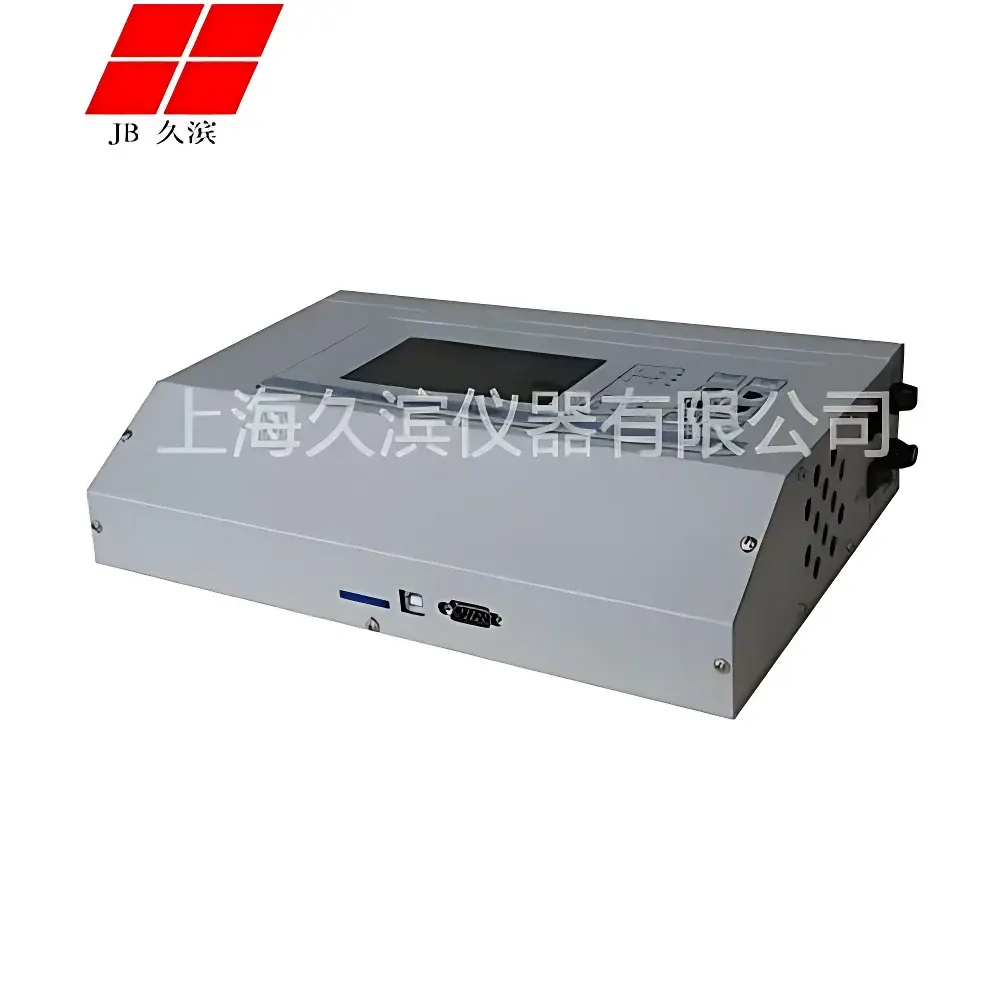
Jiubin JB-820 Non-Contact Multifunctional Vehicle Performance Analyzer
| Brand | Jiubin |
|---|---|
| Model | JB-820 |
| Origin | Shanghai, China |
| Power Consumption | <3 W (1 W standby) |
| Built-in Power | 9.6 V DC (8 × 1.2 V / 800 mAh Ni-MH batteries) |
| External Power Input | 12 V DC / 5 A |
| Dimensions | 330 × 220 × 75 mm |
| Weight | 2.0 kg (including battery) |
| Operating Temperature | −20 °C to +45 °C |
| Relative Humidity | 30–80 % RH |
| Speed Resolution | 0.01 km/h |
| Display | 240 × 128 dot-matrix LCD with Chinese UI |
| Data Storage | SD card (FAT32 formatted, up to 32 GB) + USB interface |
| Output Interface | 1 × analog voltage output (0–5 V, scalable), optional Bluetooth module |
| Printing | Integrated thermal printer |
| Sensor Options | GPS-based speed sensor, non-contact optical speed sensor |
Overview
The Jiubin JB-820 Non-Contact Multifunctional Vehicle Performance Analyzer is an embedded, portable instrumentation system engineered for objective, real-time evaluation of dynamic vehicle performance parameters under field conditions. Unlike contact-based tachometric or wheel-sensor methods, the JB-820 employs non-contact velocity measurement—primarily via high-update-rate GPS receivers or optoelectronic Doppler sensors—to acquire speed, acceleration, distance, and time data without mechanical coupling or calibration drift associated with drivetrain interfaces. Its architecture follows ISO 8855 and SAE J2252 principles for road vehicle dynamics testing, supporting standardized test protocols required by national motor vehicle inspection authorities, automotive R&D labs, and traffic safety research institutes. Designed for operational robustness in mobile environments, the unit integrates signal conditioning, embedded data logging, real-time visualization, and post-test analysis readiness within a single compact chassis.
Key Features
- Non-contact speed acquisition with 0.01 km/h resolution, minimizing installation complexity and eliminating slippage-induced error in braking or acceleration tests.
- 240 × 128 monochrome LCD with localized Chinese interface and contextual on-screen prompts—enabling intuitive operation by field technicians without specialized software training.
- Embedded dual-storage architecture: SD card (FAT32, up to 32 GB) for long-duration continuous recording; USB 2.0 host port for direct file transfer to Windows/Linux workstations.
- Integrated thermal printer supports immediate hardcopy generation of test reports—including raw time-series traces, summary statistics, and annotated event markers (e.g., brake initiation, gear shift points).
- Configurable analog output (0–5 V, factory-scaled per user-defined engineering units) enables synchronization with external DAQ systems, chassis dynamometers, or vehicle CAN bus gateways.
- Optional Bluetooth 4.2 module permits wireless telemetry to tablets or laptops running custom Python/Matlab analysis scripts—supporting remote monitoring during extended road trials.
- Low-power design (8 hours of continuous operation on internal Ni-MH battery pack; compatible with standard 12 V vehicle power systems via regulated input.
Sample Compatibility & Compliance
The JB-820 is validated for use across passenger cars, light commercial vehicles, motorcycles, and low-speed electric mobility platforms (e.g., micro-EVs, urban delivery trikes). It does not require vehicle-specific mounting hardware or OBD-II integration, making it suitable for unmodified fleet vehicles and prototype test mules. Test methodologies align with national standards including GB/T 12544–2012 (Automotive Braking Performance Test Methods), GB/T 12543–2009 (Acceleration Performance), and GB/T 12534–1990 (Coasting Performance). While not certified to ISO/IEC 17025 as a standalone metrological instrument, its measurement traceability derives from NIST-traceable GPS timing signals and calibrated optical sensor response curves documented in manufacturer technical annexes. Data files comply with CSV and plain-text formats compatible with GLP-compliant audit trails when used with timestamped SD card logs.
Software & Data Management
Raw test data is stored in human-readable ASCII format (.TXT), containing synchronized timestamps (ms resolution), speed (km/h), acceleration (m/s²), distance (m), and discrete event flags (e.g., “brake_on”, “gear_up”). No proprietary binary encoding is used—ensuring full interoperability with third-party analysis tools such as MATLAB, Python Pandas, or Excel-based statistical dashboards. The device retains up to 100 test configurations (sensor type, trigger logic, scaling factors) in non-volatile memory with automatic power-loss recovery. Firmware updates are delivered via SD card image files, requiring no PC connection. Optional desktop utility (Windows only, provided separately) enables batch export, curve overlay, MFDD calculation per UN Regulation No. 13-H, and PDF report generation with customizable headers and institutional branding.
Applications
- Regulatory compliance testing: Brake efficiency verification (MFDD ≥ 0.85g for passenger vehicles per GB 7258), coast-down coefficient derivation, and acceleration benchmarking against homologation requirements.
- Fleet maintenance optimization: Trend analysis of deceleration consistency across brake pad life cycles; detection of asymmetric braking forces via left/right wheel speed differential inference.
- Traffic safety research: Long-term speed profile logging on urban arterials or rural highways to support infrastructure redesign, speed limit justification, or ADAS validation studies.
- Automotive engineering education: Real-world kinematic data acquisition for undergraduate dynamics labs—demonstrating Newtonian motion, energy dissipation, and control-loop response in open-road environments.
- Electric vehicle characterization: Regenerative braking quantification through signed acceleration profiles and state-of-charge correlation using auxiliary CAN bus adapters.
FAQ
What speed measurement technologies does the JB-820 support?
It natively supports GPS-based velocity computation and optional non-contact optical Doppler sensors. Both modalities provide independent speed estimates without wheel contact.
Can test data be exported in machine-readable format for automated processing?
Yes—CSV-compatible ASCII text files are written directly to SD card, containing millisecond timestamps, physical units, and event metadata without encryption or obfuscation.
Is the internal battery replaceable by the end user?
Yes—the eight AA-size Ni-MH cells are accessible via a service panel and may be replaced with commercially available 1.2 V / 800 mAh rechargeables.
Does the JB-820 meet electromagnetic compatibility (EMC) requirements for vehicular use?
It complies with GB/T 18655–2018 (equivalent to CISPR 25 Class 3) for conducted and radiated emissions in automotive environments.
How is calibration maintained over time and temperature variation?
GPS-derived speed requires no periodic recalibration; optical sensor gain is factory-trimmed and stored in EEPROM. Thermal drift compensation is applied algorithmically across the −20 °C to +45 °C operating range.