
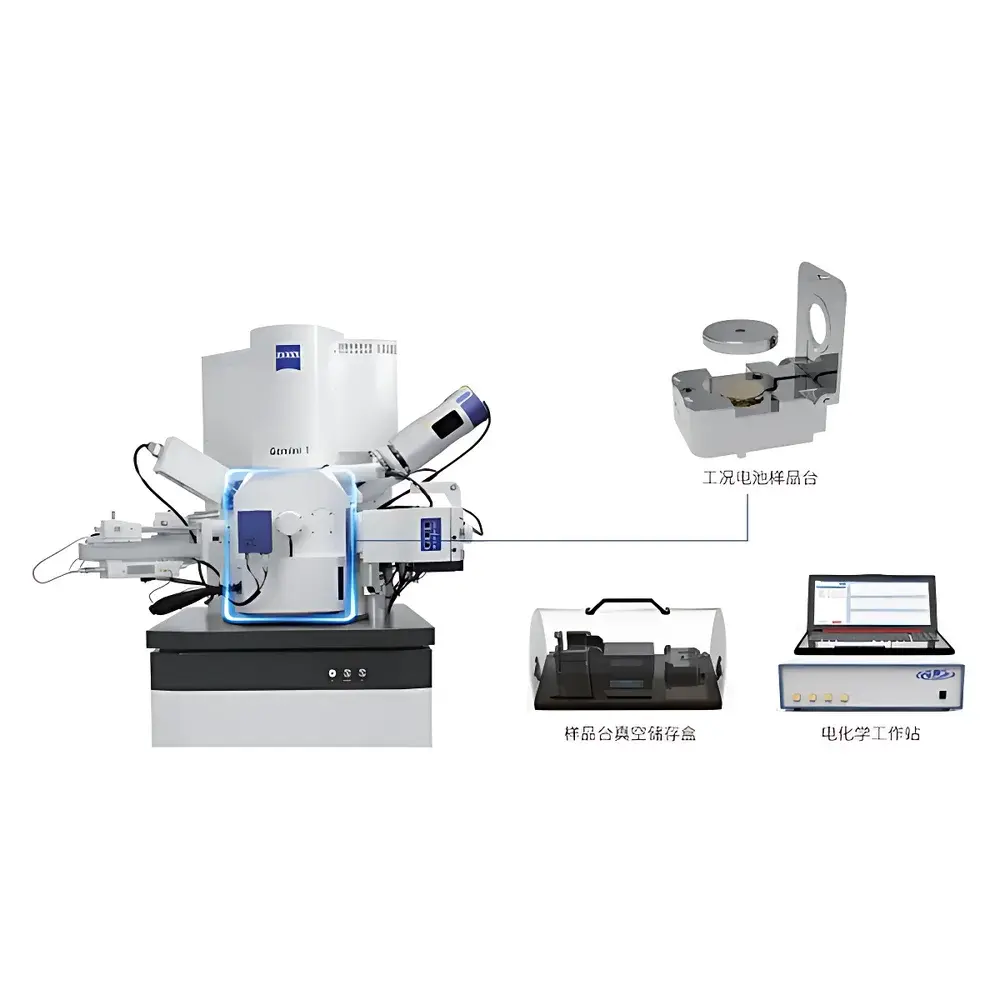
ZEISS In Situ Liquid Electrochemistry Solution for SEM
| Brand | ZEISS |
|---|---|
| Origin | Germany |
| Model | In Situ Liquid Electrochemistry Solution |
| Application | Real-time, high-resolution SEM imaging and multimodal analysis of electrochemical cells under operational conditions |
| Key Components | MEMS-based liquid cell chip, custom in situ battery stage, integrated electrical feedthroughs, 10 nm electron-transparent SiN window |
| Compatibility | Standard ZEISS GeminiSEM and SIGMA SEM platforms |
| Compliance | Designed for GLP-compliant workflows |
Overview
The ZEISS In Situ Liquid Electrochemistry Solution is an engineered platform for real-time, high-resolution scanning electron microscopy (SEM) observation of electrochemical processes within liquid-phase battery systems. Unlike conventional ex situ or vacuum-compatible dry-cell approaches, this solution enables true operando characterization by integrating a microelectromechanical systems (MEMS)-fabricated liquid cell into a fully sealed, electrically isolated in situ stage. The core innovation lies in its dual-beam compatible architecture: a 10 nm-thick silicon nitride (SiN) membrane serves as both an electron-transparent window and a hermetic barrier between the electrolyte environment and the high-vacuum SEM chamber. This design permits uninterrupted electron beam transmission while maintaining stable electrochemical potential control—enabling direct correlation between structural evolution, elemental redistribution, and electrochemical response during galvanostatic or potentiostatic cycling.
Key Features
- MEMS-integrated liquid cell platform: Custom-fabricated SiN membrane chips with precise electrode patterning and electrolyte reservoir geometry, optimized for ZEISS GeminiSEM and SIGMA series column optics.
- Operando electrical interfacing: Integrated coaxial feedthroughs support simultaneous current/voltage application via external potentiostat (e.g., BioLogic VSP-300 or Metrohm Autolab PGSTAT302N) without signal degradation or arcing risk.
- Sub-10 nm resolution capability: Leverages ZEISS’s Gemini II electron optical column with in-lens detection and beam deceleration to preserve surface-sensitive contrast at low kV (<5 kV), critical for minimizing beam-induced electrolyte decomposition.
- Multi-modal correlative acquisition: Native synchronization between SEM imaging, energy-dispersive X-ray spectroscopy (EDS), and optional Raman spectroscopy (via external fiber-coupled probe) ensures spatially registered chemical, morphological, and crystalline data.
- Vacuum-tight mechanical stage: Precision-machined aluminum alloy housing with metal-sealed O-rings and differential pumping compatibility maintains chamber base pressure 4 h).
Sample Compatibility & Compliance
The solution supports standard 2032-type coin cells filled with common non-aqueous electrolytes (e.g., 1 M LiPF₆ in EC:DMC), aqueous alkaline media (e.g., 1 M KOH), and ionic liquid systems. Sample mounting follows ASTM E2981-21 guidelines for in situ electrochemical SEM cell validation. All hardware components are manufactured in Germany under ISO 9001-certified processes. System documentation includes traceable calibration records for window thickness uniformity (±0.5 nm), electrical leakage current (<1 pA at ±5 V), and thermal drift compensation (≤0.8 nm/min at 25°C). Fully compatible with FDA 21 CFR Part 11–compliant data acquisition software for audit-ready experiment logs.
Software & Data Management
Control and acquisition are coordinated through ZEISS SMART-SEM software v7.10+, which supports time-stamped trigger synchronization across SEM frame capture, EDS spectrum accumulation, and external potentiostat voltage/current logging. Raw datasets are stored in open-format HDF5 containers with embedded metadata (including applied potential, current density, timestamp, and detector gain settings). Automated batch processing pipelines enable quantitative tracking of particle coarsening, crack propagation velocity, and elemental intensity ratios (e.g., F/K or O/Li) over >1000 image frames. Export modules comply with MIAME and FAIR data principles for integration into institutional LIMS or ELN platforms.
Applications
- Dynamic investigation of solid-electrolyte interphase (SEI) and cathode-electrolyte interphase (CEI) formation on LiCoO₂, NMC, and silicon anodes.
- In situ monitoring of dendrite nucleation and growth kinetics in lithium-metal and sodium-metal batteries.
- Corrosion mechanism studies of passive film breakdown on stainless steels and aluminum alloys in chloride-containing electrolytes.
- Real-time evaluation of electrodeposition uniformity and grain orientation evolution during pulse-reverse electroplating of Cu, Ni, and Co films.
- Multiscale degradation analysis in redox-flow battery electrodes under varying current densities and flow rates.
FAQ
Can this solution be used with non-ZEISS SEM platforms?
Yes—mechanical and electrical interfaces follow SEM industry standards (e.g., JEOL JSM and Thermo Scientific Apreo stages), though optimal performance requires ZEISS-specific beam alignment and detector calibration.
What is the maximum operating temperature range for the liquid cell?
The standard configuration supports ambient to 60°C; high-temp variants with Peltier-controlled stage (−20°C to 120°C) are available upon request.
Is EDS quantification reliable under liquid cell conditions?
Quantitative EDS is achievable using thin-window SDD detectors and Monte Carlo-based absorption correction models (e.g., DTSA-II), provided beam energy is maintained ≤10 kV to minimize substrate fluorescence interference.
How is electrolyte evaporation mitigated during long-duration imaging?
The MEMS chip incorporates micro-reservoir geometry and capillary confinement, limiting evaporation rate to <0.3 µL/h under continuous 5 kV beam exposure—validated via gravimetric mass loss measurement per ISO 11357-3.
Does the system support automated experiment sequencing?
Yes—SMART-SEM scripting engine enables programmable cycles of potential steps, dwell times, and image acquisition intervals, with conditional triggers based on current threshold crossing or time elapsed.





