
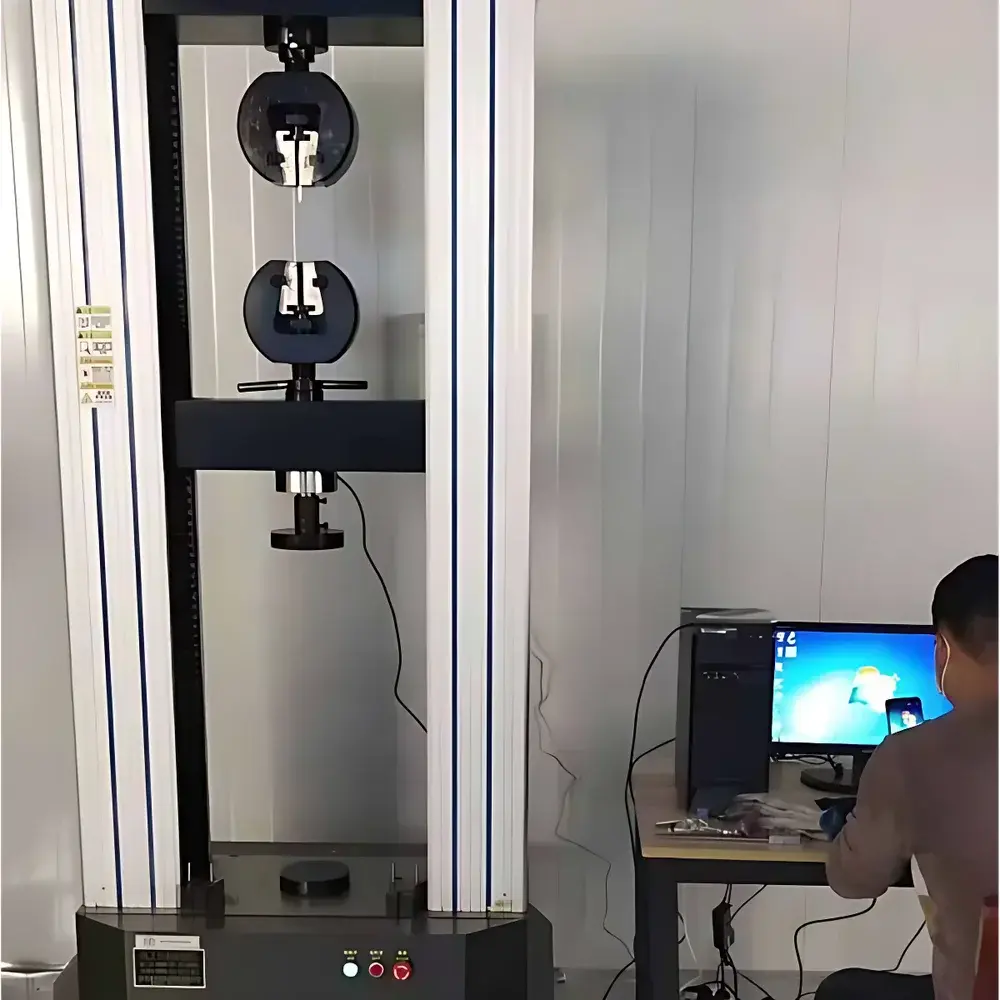
Jiubin JB-121 Aluminum Foil Tensile Tester
| Brand | Jiubin / JByq |
|---|---|
| Origin | Shanghai, China |
| Manufacturer Type | Authorized Distributor |
| Country of Origin | China |
| Model | JB-121 |
| Price | Upon Request |
| Max Test Load | 5000 N |
| Force Accuracy | ±1.0% FS |
| Force Resolution | 0.1 N |
| Crosshead Travel | 500 mm (extendable) |
| Displacement Resolution | 0.01 mm |
| Speed Range | 1–500 mm/min |
| Speed Accuracy | ±1.0% |
| Test Space | 0–500 mm |
| Display | LCD with real-time force/displacement/peak/status/speed |
| Compliance | GB, ISO, ASTM, JIS, DIN, YB, QB, YY, USP, FDA 21 CFR Part 11 (with optional software module) |
| Weight | 160 kg |
| Dimensions (W×D×H) | 550 × 270 × 1620 mm |
Overview
The Jiubin JB-121 Aluminum Foil Tensile Tester is a precision universal testing machine engineered for static mechanical characterization of thin metallic foils—particularly aluminum foil—and other flexible sheet materials. It operates on the fundamental principle of uniaxial tensile loading, where controlled axial force is applied to a standardized specimen using a motor-driven crosshead and high-resolution load cell. The system conforms to standard test methodologies defined in ISO 6892-1 (metallic materials – tensile testing), ASTM E8/E8M, GB/T 228.1, and ISO 1183 (for non-metallic sheet materials), enabling quantification of key mechanical properties including ultimate tensile strength (UTS), yield strength (0.2% offset), elongation at break, modulus of elasticity, and fracture behavior. Designed for laboratory and QC environments, the JB-121 integrates a robust dual-column frame, precision ball-screw actuation, and digital closed-loop speed control to ensure high reproducibility across repeated tests—even at low-force regimes typical of ultra-thin foil specimens (e.g., 6–20 µm thickness). Its modular architecture supports interchangeable fixtures for tensile, peel, puncture, tear, bend, and compression configurations, making it suitable not only for aluminum foil but also for laminates, polymer films, pharmaceutical blister packs, food packaging, and composite substrates.
Key Features
- High-accuracy load measurement with ±1.0% full-scale error and 0.1 N resolution, certified to Class 1 accuracy per ISO 7500-1.
- Adjustable crosshead speed from 1 to 500 mm/min, maintained within ±1.0% tolerance via servo-controlled DC motor and planetary gear reducer—ensuring minimal vibration and acoustic noise during low-speed creep or high-speed rupture testing.
- Large 500 mm vertical test space with rapid coarse/fine positioning—facilitating quick specimen mounting and alignment without tooling.
- Backlit LCD interface with intuitive menu navigation: method selection, parameter configuration (preload, test speed, break detection threshold), real-time curve plotting (force vs. displacement), and summary results display.
- Integrated overload protection, emergency stop, and automatic return-to-start functionality to safeguard both operator and equipment integrity.
- Standard RS232 and optional USB interfaces for seamless integration with Windows-based PC control software—enabling automated test sequencing, multi-curve overlay, statistical batch reporting, and audit-trail-enabled data export compliant with GLP/GMP requirements.
Sample Compatibility & Compliance
The JB-121 accommodates specimens ranging from 10 mm to 50 mm wide and up to 300 mm gauge length, with specialized pneumatic or screw-action grips optimized for low-stiffness, high-slip materials like annealed aluminum foil (e.g., 8011, 8079 alloys). Optional accessories include peel fixtures (90°/180°), puncture probes (Φ1.0 mm hemispherical tip), trouser-tear clamps, and three-point bending jigs. All test procedures align with internationally recognized standards—including ISO 1183-2 (plastics), ASTM F88 (seal strength), ISO 8510-2 (peel adhesion), and YY/T 0681.4 (sterile barrier systems)—and support traceable calibration per ISO/IEC 17025 when used with accredited force and displacement transducers. When paired with validated software, the system meets data integrity requirements of FDA 21 CFR Part 11, including electronic signatures, change history, and user-level access control.
Software & Data Management
The optional PC-based control suite provides full instrument automation, including programmable ramp-hold-step profiles, real-time data streaming at ≥100 Hz sampling rate, and auto-detection of yield point, UTS, and fracture onset via slope-based algorithms. Raw data files are saved in CSV and proprietary .jbt formats, supporting direct import into MATLAB, Excel, or LIMS platforms. Reports comply with ISO/IEC 17025 documentation standards: each test record includes timestamp, operator ID, environmental conditions (temperature/humidity metadata), calibration certificate IDs, raw curve plots, and calculated parameters with uncertainty estimates. Audit trails log all user actions—including parameter edits, result overrides, and report generation—with immutable timestamps and digital signature fields.
Applications
- Quality assurance of rolled aluminum foil used in pharmaceutical blister packaging, capacitor anodes, food wrapping, and lithium-ion battery current collectors.
- Evaluation of interlayer adhesion in laminated foils (e.g., Al/PET/PE composites) via T-peel or 90° peel testing.
- Mechanical screening of heat-treated or cold-rolled foil batches for consistency in tensile strength and ductility.
- R&D validation of surface coatings (e.g., lacquers, PVDC) affecting foil stiffness and tear resistance.
- Comparative analysis of foil embrittlement after sterilization (EO, gamma) or accelerated aging per ISO 11607.
- Support for ISO 10993-12 extractables testing by verifying container closure integrity under simulated transport stress.
FAQ
What is the maximum specimen thickness this tester can accommodate?
The standard configuration supports specimens up to 3 mm thick; with custom jaw inserts, thickness capacity extends to 10 mm for composite laminates.
Does the system support automatic calculation of Young’s modulus?
Yes—the software calculates initial tangent modulus from the linear region of the stress–strain curve, provided extensometer input is enabled (optional clip-on or video-based extensometer required for high-precision strain measurement).
Is calibration documentation included with shipment?
Each unit ships with a factory calibration certificate traceable to NIM (China National Institute of Metrology), covering load cell and displacement encoder performance across the full 500–5000 N range.
Can the JB-121 be integrated into an existing MES or QMS platform?
Via OPC UA or REST API (available in advanced software license), enabling bidirectional data exchange with SAP QM, TrackWise, or Qualio for automated nonconformance logging and SPC charting.
What maintenance intervals are recommended for long-term accuracy?
Biannual verification of force and displacement accuracy is advised; annual lubrication of the ball screw and inspection of grip serrations are required per the maintenance logbook supplied with the instrument.



