
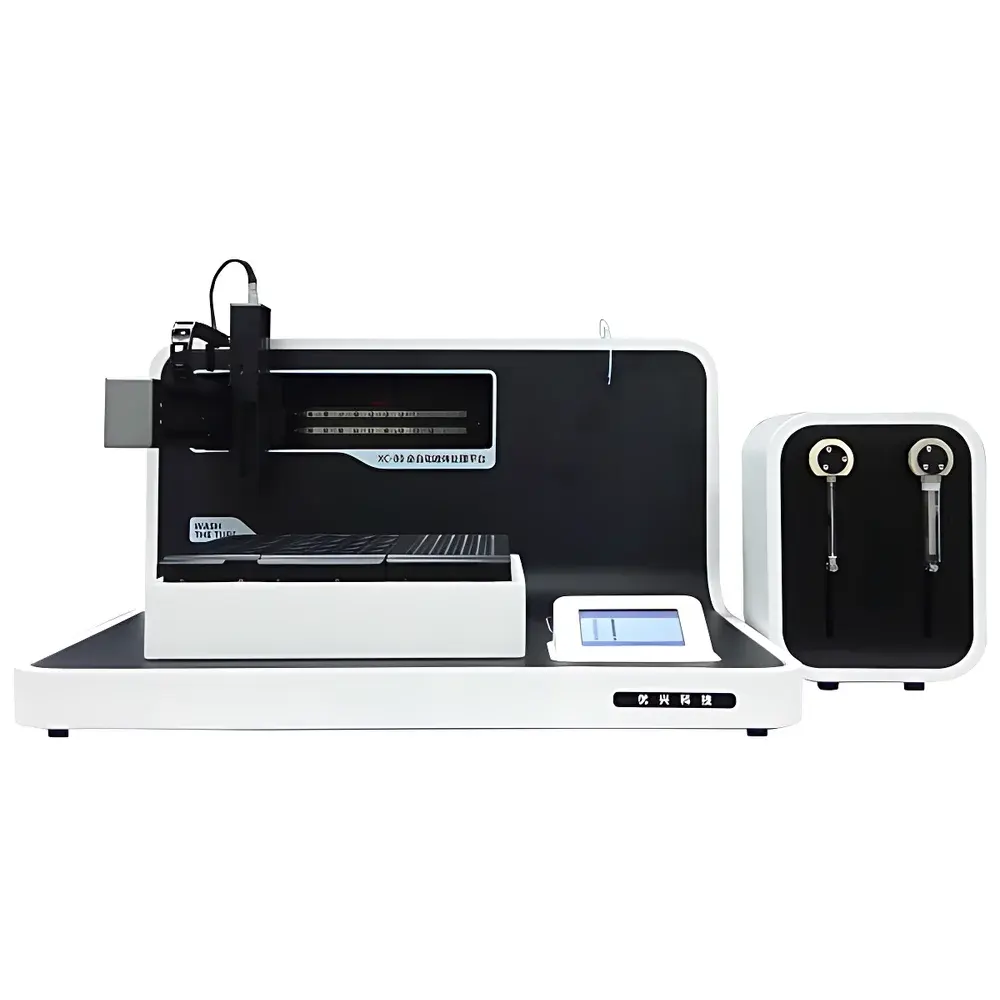
XC80 Fully Automated Liquid Handling Workstation
| Brand | UXS |
|---|---|
| Origin | Beijing, China |
| Manufacturer | UXS Instrument Co., Ltd. |
| Model | XC80 |
| Deck Capacity | 100 × 3 positions |
| Pipetting Accuracy | ±1 µL |
| Pipetting Range | 10–10,000 µL |
| Sample Throughput | 1 sample per run |
| Dimensions (W×D×H) | 500 × 300 × 300 mm |
| Standard Configuration | Dual syringe pumps |
| Vessel Compatibility | Round-bottom tubes (2–100 mL), flat-bottom headspace vials, standard screw-cap/sample bottles |
Overview
The XC80 Fully Automated Liquid Handling Workstation is an integrated benchtop platform engineered for precision liquid transfer, dilution, and reformatting in analytical, quality control, and method development laboratories. Built on a dual-syringe pump architecture, it operates via positive displacement fluidics—ensuring high reproducibility across variable viscosity and volatile solvent conditions without reliance on air displacement or tip-based calibration drift. Its modular deck design supports up to 300 standardized labware positions (100 × 3), enabling flexible configuration for multi-step workflows including serial dilution, standard preparation, spike recovery, and plate-to-tube transfers. The system is designed for unattended operation under ISO/IEC 17025-aligned environments and meets foundational requirements for GLP-compliant documentation when paired with validated software protocols.
Key Features
- Dual independent syringe pumps with programmable stroke volume, pressure monitoring, and real-time flow rate control—optimized for both low-volume (10–200 µL) and high-volume (1–10 mL) dispensing tasks.
- Universal deck layout accommodating ANSI/SLAS-compliant microplates (96-/384-well), conical tubes (2–100 mL), headspace vials, and custom rack configurations—including mixed-format setups within a single method.
- Flexible transfer logic engine supporting symmetric point-to-point, asymmetric point-to-multipoint, multipoint-to-point, and combinatorial distribution patterns—each configurable via coordinate mapping or barcode-driven labware recognition.
- Linear, logarithmic, and volumetric gradient dispensing modes—including equidistant, proportional, and equal-volume transfer sequences—with user-defined step intervals and repeat cycles.
- Method-centric workflow architecture: Each protocol can embed unlimited instances of aspiration, dispense, mix, delay, wash, and purge steps—enabling end-to-end automation of complex multi-reagent assays without intermediate manual intervention.
- Real-time status dashboard with LED indicators, on-screen progress bar, and event-logged timestamps—providing full traceability for operational audits and troubleshooting.
Sample Compatibility & Compliance
The XC80 accommodates a broad spectrum of container geometries and materials, including polypropylene and glass round-bottom tubes (2 mL, 4 mL, 10 mL, 15 mL, 20 mL, 40 mL, 60 mL, 100 mL), flat-bottom headspace vials (10–22 mm diameter), and threaded sample bottles compliant with ASTM D4057 and ISO 5555 standards. Rack adaptors support 100 µL PCR tubes, 1 mL cryovials, 10 mL conical tubes, and 25 mL graduated cylinders—allowing heterogeneous labware integration without mechanical reconfiguration. All fluid path components are chemically resistant to common organic solvents (acetonitrile, methanol, dichloromethane), aqueous buffers, and weak acids/bases. The system adheres to IEC 61000-6-2 (immunity) and IEC 61000-6-3 (emission) electromagnetic compatibility standards, and its mechanical design conforms to ISO 13857 safety clearance guidelines.
Software & Data Management
Controlled via UXS LiquidStudio™ v3.x—a Windows-based application certified for FDA 21 CFR Part 11 compliance when deployed with electronic signature modules and audit trail activation. The software provides role-based access control (administrator, operator, reviewer), method versioning with SHA-256 hash logging, and exportable CSV/Excel reports containing timestamped execution logs, error codes, and volumetric deviation metrics. Raw method files (.uxsml) are digitally signed and encrypted; instrument firmware updates require cryptographic verification prior to installation. Data integrity safeguards include automatic backup to network drives, checksum validation upon file load, and optional integration with LIMS via HL7 or RESTful API endpoints.
Applications
- Preparative standard curve generation for HPLC, GC, and ICP-MS quantitation—supporting single-point, multi-point, and internal standard calibration strategies.
- Automated sample spiking and matrix-matched calibration for environmental and food safety testing (e.g., EPA Method 525.3, AOAC 2012.01).
- Reformatting of biobanked specimens into assay-ready plates while preserving cold chain integrity through timed refrigerated deck integration (optional).
- QC/QA batch processing for pharmaceutical dissolution testing, where precise volumetric addition of dissolution media and analyte stock solutions is required per USP .
- High-fidelity dilution series for ELISA, qPCR, and cell culture media preparation—minimizing inter-run variability and operator-dependent pipetting errors.
FAQ
Does the XC80 support third-party labware with non-standard dimensions?
Yes—custom coordinate mapping and user-defined labware templates allow precise positioning for proprietary or non-ANSI containers, provided physical clearance and gripper compatibility are verified.
Can methods be exported and shared across multiple XC80 units?
Yes—method files (.uxsml) are portable across identical hardware revisions and retain all positional, volumetric, and timing parameters when loaded onto another XC80 workstation.
Is the system compatible with robotic arm integration for walk-away automation?
The XC80 features RS-232, USB CDC, and Ethernet interfaces with open command protocol documentation, enabling synchronization with external robotic handlers or conveyor systems via TTL triggers or Modbus TCP.
What maintenance routines are recommended for long-term syringe pump accuracy?
UXS recommends quarterly calibration verification using gravimetric assessment per ISO 8655-6, along with routine cleaning of pump seals and tubing using isopropanol followed by deionized water flush.
How is data integrity ensured during power interruption?
The system writes checkpoint logs every 5 seconds to non-volatile memory; upon restart, it resumes from the last confirmed step, with all intermediate liquid handling events preserved in the audit trail.
Related Products



