
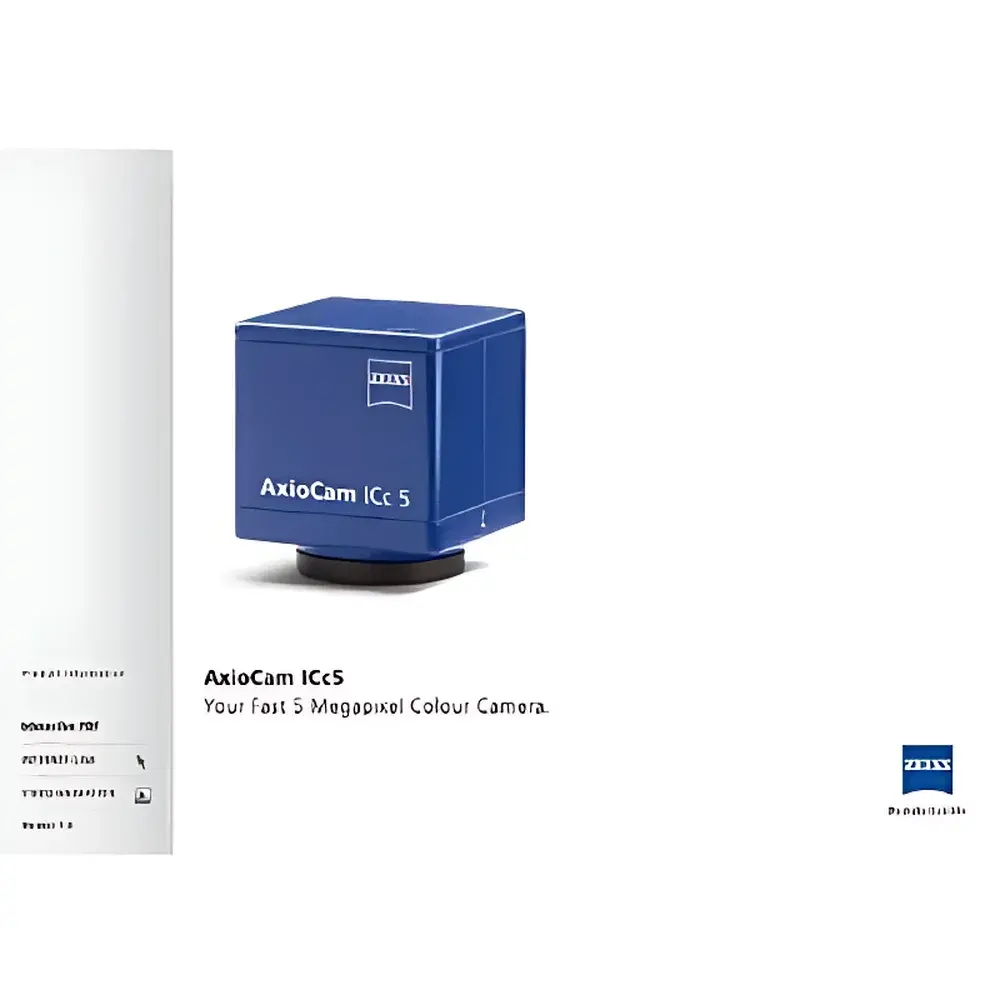
ZEISS AxioCam Series CCD Cameras
| Brand | ZEISS |
|---|---|
| Origin | Germany |
| Model | AxioCam ERc 5s / HRc / HRm / MRc / MRm / HSc / HSm / MRc5 / ICm1 / ICc3 / ICc1 |
| Sensor Type | CCD (monochrome) & CMOS (IC series) |
| Max Resolution | 6164 × 3120 (13 MP) |
| Pixel Size | 2.2–9.9 µm |
| Sensor Format | 1/2.5″ to 2/3″ |
| Bit Depth | 8–14 bit |
| Frame Rate | up to 60 fps (ROI-dependent) |
| Cooling | Peltier-cooled (HR/HRm/MR/MRm/HSc/HSm/MRc5) |
| Interface | FireWire (IEEE 1394), USB, Analog/Digital |
| Exposure Range | 0.25 ms – several minutes |
| Optical Mount | C-mount |
| Read Noise | <6.8 e⁻ |
| Dark Current | as low as 0.7 e⁻/pixel/s |
| Dynamic Range | up to >2500:1 |
Overview
The ZEISS AxioCam Series represents a family of high-performance scientific CCD and CMOS cameras engineered for integration with ZEISS upright and inverted microscopes. Designed specifically for quantitative optical microscopy, these cameras operate on the principle of photon-to-electron conversion via charge-coupled device (CCD) or complementary metal-oxide-semiconductor (CMOS) sensor architectures—optimized for either high-sensitivity monochrome imaging or true-color RGB acquisition. The AxioCam platform supports dual operational modes: color mode for brightfield, phase contrast, and routine histology documentation; and monochrome mode for low-light applications including fluorescence, FISH, DAPI staining, and time-lapse confocal-compatible imaging. Each model is calibrated to meet the stringent linearity, uniformity, and quantum efficiency requirements of life science and materials research laboratories operating under GLP or ISO 17025 frameworks.
Key Features
- Multi-sensor architecture spanning resolutions from 0.3 MP (AxioCam HSc) to 13 MP (AxioCam HRc), enabling selection based on field-of-view, signal-to-noise ratio, and pixel binning needs.
- Peltier-based thermoelectric cooling (down to −20 °C below ambient) on HR, MR, HSc, HSm, and MRc5 models—reducing dark current by up to two orders of magnitude versus uncooled sensors.
- High dynamic range performance (>2500:1) and low read noise (<6.8 e⁻) ensure accurate intensity quantification across weak and saturated signals—critical for ratiometric analysis and co-localization studies.
- Hardware-level exposure control with sub-millisecond precision (as low as 0.25 ms on HRm/MRm) supports rapid kinetic imaging and synchronization with external triggers (e.g., shutter, laser pulse, stage movement).
- C-mount mechanical interface ensures mechanical compatibility with all ZEISS microscope ports and third-party adapters meeting DIN ISO 10933 standards.
- Firmware-upgradable architecture allows future protocol expansion—including support for ZEISS ZEN Blue/Black software environments and compliance-ready metadata embedding.
Sample Compatibility & Compliance
The AxioCam Series is validated for use with fixed and live biological specimens, polymer thin films, semiconductor wafers, and metallurgical cross-sections. All monochrome variants comply with ISO 15775:2006 (microscopy — specification of digital image capture systems) and support audit-trail generation per FDA 21 CFR Part 11 when used in conjunction with ZEISS AxioVision or ZEN software configured for electronic signature workflows. Color models adhere to sRGB and Adobe RGB color space profiles traceable to NIST SRM 2211 calibration standards. CE marking confirms conformity with EU Directive 2014/30/EU (EMC) and 2014/35/EU (LVD).
Software & Data Management
Native operation is enabled through ZEISS AxioVision (legacy) and ZEN software suites—providing synchronized multi-channel acquisition, real-time background subtraction, flat-field correction, and TIFF/OME-TIFF export with embedded EXIF and OME-XML metadata. Time-series datasets are automatically timestamped and indexed for FAIR (Findable, Accessible, Interoperable, Reusable) compliance. Batch processing pipelines support batch deconvolution, spectral unmixing (for multicolor fluorescence), and ROI-based intensity profiling—all exportable to CSV or HDF5 for downstream MATLAB, Python (scikit-image, napari), or ImageJ/Fiji analysis.
Applications
- Quantitative fluorescence microscopy: DAPI/Hoechst nuclear counterstaining, GFP/RFP reporter expression kinetics, Ca²⁺ flux imaging using ratiometric dyes.
- High-content screening: Automated cell morphology classification, mitotic index quantification, and colony formation assays in 96-/384-well plates.
- Materials characterization: Grain boundary mapping in polycrystalline alloys, defect detection in photovoltaic layers, and phase distribution analysis in composite resins.
- Pathology digitization: Whole-slide scanning preparation at 20×–40× magnification with consistent color fidelity and focus stacking capability.
- Educational microscopy: Real-time classroom projection with annotation tools and student-accessible measurement overlays aligned to ISO 10934-1 standards.
FAQ
Which AxioCam model is recommended for low-light fluorescence imaging?
AxioCam HRm and MRm are optimized for monochrome fluorescence work due to their large 6.45 µm pixels, Peltier cooling, and >2200:1 dynamic range—ideal for single-molecule localization and long-exposure confocal acquisitions.
Can AxioCam cameras be used with non-ZEISS microscopes?
Yes—via C-mount adapter and third-party drivers (e.g., Thorlabs DCx SDK, Andor Solis); however, full hardware-trigger synchronization and ZEISS-specific features (e.g., ApoTome.2 structured illumination control) require native ZEISS microscope integration.
Is raw data export supported for custom image processing?
All models support lossless 12–14-bit linear TIFF export with full metadata, including exposure time, gain, sensor temperature, and objective magnification—enabling reproducible reprocessing in open-source platforms.
Does the AxioCam IC series support scientific-grade quantification?
The ICm1 and ICc3 models feature 12-bit digitization and calibrated gain/offset tables, but lack active cooling; they are suitable for routine brightfield documentation and teaching labs where thermal stability is less critical than cost-efficiency.
How is firmware updated and validated?
Firmware updates are distributed via ZEISS Support Portal and require validation against ZEISS’ internal release notes; each update includes revision-controlled changelogs and regression test reports compliant with IEC 62304 Class B software lifecycle requirements.





