
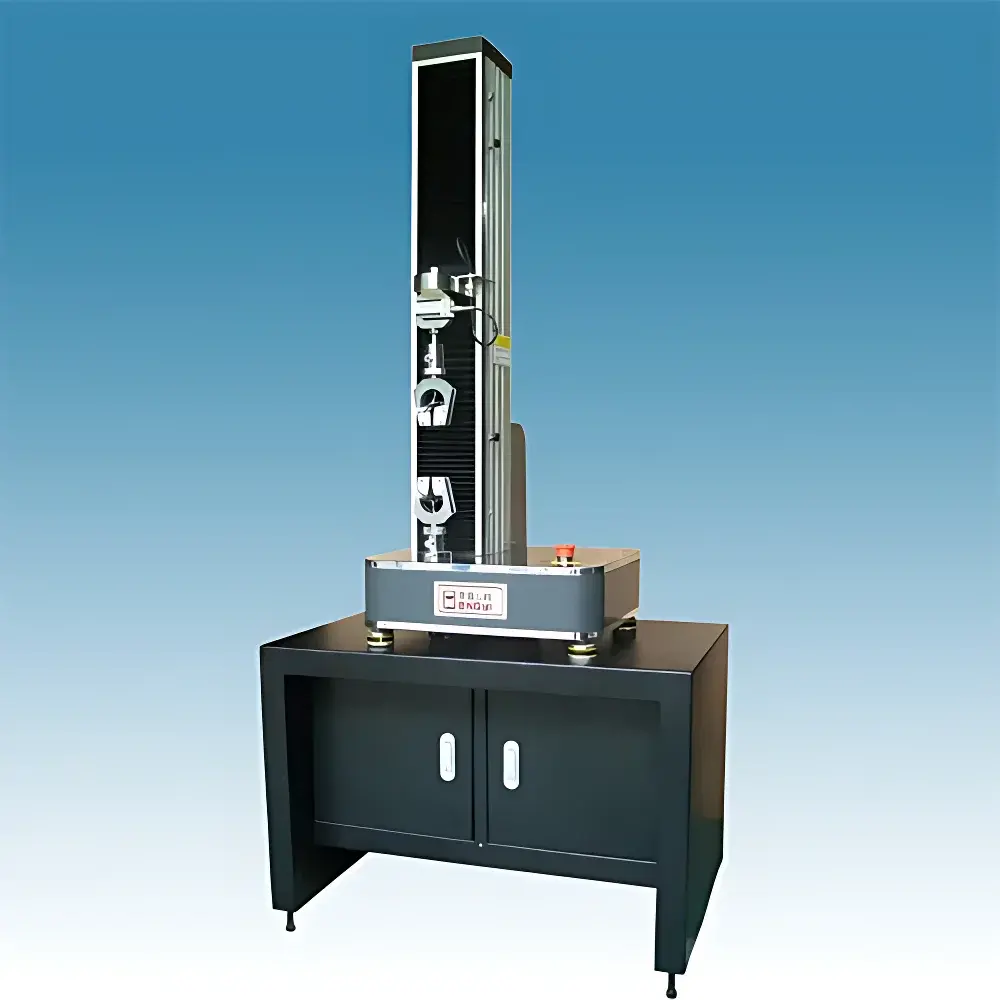
Hengyi HY-0580(DN) Universal Testing Machine for Hydrogel Mechanical Characterization
| Brand | Hengyi |
|---|---|
| Origin | Shanghai, China |
| Manufacturer Type | Direct Manufacturer |
| Product Category | Domestic |
| Model | HY-0580(DN) |
| Instrument Type | Electromechanical Universal Testing Machine |
| Load Capacity Options | 1 N to 5000 N (interchangeable load cells) |
| Accuracy Class | ≤ 0.5% |
| Effective Test Width | 120 mm |
| Effective Vertical Travel | 800 mm |
| Speed Range | 0.001–500 mm/min |
| Speed Accuracy | ±0.5% of indicated value |
| Displacement Measurement Accuracy | ±0.5% of indicated value |
| Strain Measurement Accuracy | ±0.5% of indicated value |
| Stress Control Rate Range | 0.005–6 %FS/s |
| Strain Control Rate Range | 0.002–6 %FS/s |
| Data Resolution | ±500000 counts at full scale,不分档 (no range switching) |
| Power Supply | 220 V AC, 750 W |
| Dimensions (W×D×H) | 470 × 400 × 1510 mm |
| Weight | 95 kg |
Overview
The Hengyi HY-0580(DN) Universal Testing Machine is an electromechanical static mechanical testing system engineered for high-fidelity tensile, compressive, flexural, shear, peel, tear, cyclic loading, and relaxation characterization of soft biomaterials—particularly hydrogels—as well as metals, polymers, composites, elastomers, and thin films. Built upon a rigid dual-column frame with precision-ground ball screws and preloaded linear guides, the system delivers exceptional axial alignment stability and minimal compliance (<0.05 mm under 5 kN), essential for accurate modulus and strength determination in low-stiffness, high-strain hydrogel specimens. Its force measurement architecture employs interchangeable, factory-calibrated S-type or cantilever load cells (1 N to 5000 N), each traceable to national metrological standards and certified to ISO 7500-1 Class 0.5 accuracy. The machine operates on a closed-loop digital control platform integrating real-time adaptive algorithms for seamless transitions among force-, displacement-, and strain-controlled test modes—enabling precise execution of ASTM D412, ISO 37, ISO 527-1, GB/T 1040, USP , and ISO 15197-compliant protocols for hydrogel mechanical validation.
Key Features
- Triple-closed-loop digital control system based on neural-adaptive algorithm architecture, supporting automatic, bumpless switching between force, displacement, and strain regulation modes.
- High-speed data acquisition platform with ≥1 kHz sampling rate, 24-bit ADC resolution, and ±500,000-count full-scale encoding—ensuring consistent resolution across entire force range without auto-ranging artifacts.
- Real-time synchronized display of load, displacement, and extensometer-derived strain; dynamic plotting of up to 8 parametric curves (e.g., stress–strain, load–time, strain–time) with customizable color mapping and overlay capability.
- Automated calculation of standardized mechanical parameters including ReH (upper yield strength), ReL (lower yield strength), Rp0.2 (0.2% offset yield), Fm (maximum force), Rm (tensile strength), E (Young’s modulus), Rt0.5–Rt0.7 (proof strengths), and relaxation/creep coefficients.
- Integrated safety architecture: electronic limit switches, overload protection (>110% FS), emergency stop circuitry, motor overcurrent/voltage monitoring, and self-diagnostic boot-up sequence verifying sensor integrity and actuator responsiveness.
- Modular fixture interface compliant with ISO 26203-2 and ASTM E4 standard mounting dimensions; supports pneumatic, wedge, roller, and custom hydrogel-specific grips—including low-friction Teflon-coated clamps and solvent-resistant elastomeric jaw faces.
Sample Compatibility & Compliance
The HY-0580(DN) accommodates hydrogel specimens in film, disk, cylindrical, and dumbbell geometries (ASTM D638 Type V, ISO 527-2 5A), with thicknesses from 0.2 mm to 10 mm and widths up to 12 mm. Environmental compatibility includes ambient lab conditions (15–30 °C, RH ≤ 80%) and optional integration with temperature-controlled chambers (−20 to +80 °C) and humidity enclosures (10–95% RH). All firmware and software comply with GLP audit requirements: full 21 CFR Part 11–ready electronic signatures, immutable audit trails for method changes, user access levels (Admin/Operator/Viewer), and tamper-evident data archiving. Test reports include metadata stamping (operator ID, timestamp, calibration certificate ID, environmental log) and are exportable in PDF/A-1b, CSV, and XML formats for LIMS integration.
Software & Data Management
HYtest v4.2 is a Windows-native application built on .NET Framework 4.8 with native support for English and Chinese UI localization. It features ISO 17025-aligned test method templates, parameterized test sequences (e.g., “Hydrogel Cyclic Tension–Relaxation: 5 cycles @ 10% strain, 0.1 Hz”), and batch processing for multi-specimen comparative analysis. Curve analytics include automatic peak detection, tangent modulus derivation, hysteresis area quantification, and time–temperature superposition (TTS) preprocessing. Raw data files (.hdt) are encrypted and digitally signed; historical datasets remain fully backward-compatible across software updates. Export modules support direct linkage to MATLAB, Python (via HDF5 API), and statistical packages (JMP, Minitab) through standardized ASCII-delimited outputs.
Applications
- Mechanical profiling of synthetic and natural hydrogels (e.g., PAAm, alginate, gelatin-methacryloyl, hyaluronic acid derivatives) under uniaxial tension/compression for tissue engineering scaffold qualification.
- Quantification of fatigue resistance via programmed cyclic loading (10–10⁶ cycles) with in-situ stiffness degradation tracking.
- Viscoelastic parameter extraction using creep-recovery and stress-relaxation protocols per ISO 13314 and ASTM D2990.
- Adhesion strength evaluation of hydrogel–substrate interfaces (e.g., skin–hydrogel, electrode–hydrogel) using 90° peel and lap-shear configurations.
- Regulatory submission support for FDA 510(k), CE Marking (MDR Annex I), and NMPA Class III device dossiers requiring mechanical performance evidence.
FAQ
What load cell options are available, and how are they calibrated?
Standard configurations include 1 N, 10 N, 100 N, 500 N, and 5000 N S-type load cells, each supplied with NIST-traceable calibration certificates per ISO/IEC 17025. Calibration verification intervals are configurable within HYtest software and logged in the audit trail.
Can the system perform strain-controlled ramp-hold tests required for hydrogel viscoelastic modeling?
Yes—strain control mode supports programmable ramp rates (0.002–6 %FS/s) with hold segments at defined strain levels, enabling Prony series fitting and generalized Maxwell model parameter identification.
Is extensometer integration supported for high-accuracy strain measurement below 1%?
The system accepts contact-type clip-on extensometers (e.g., 10 mm gauge length, ±0.5 µm resolution) and non-contact digital image correlation (DIC) systems via USB3.0 trigger synchronization.
Does the software meet FDA 21 CFR Part 11 requirements for electronic records?
Yes—HYtest v4.2 implements role-based access control, electronic signatures with biometric or token-based authentication, automated audit logs, and data immutability enforcement compliant with Part 11 Subpart B.
What maintenance is required to sustain 0.5% accuracy over time?
Annual recalibration of load cells and position sensors by an ISO/IEC 17025-accredited lab is recommended; daily verification using certified reference weights and displacement gauges is supported via built-in QC routines in HYtest.



