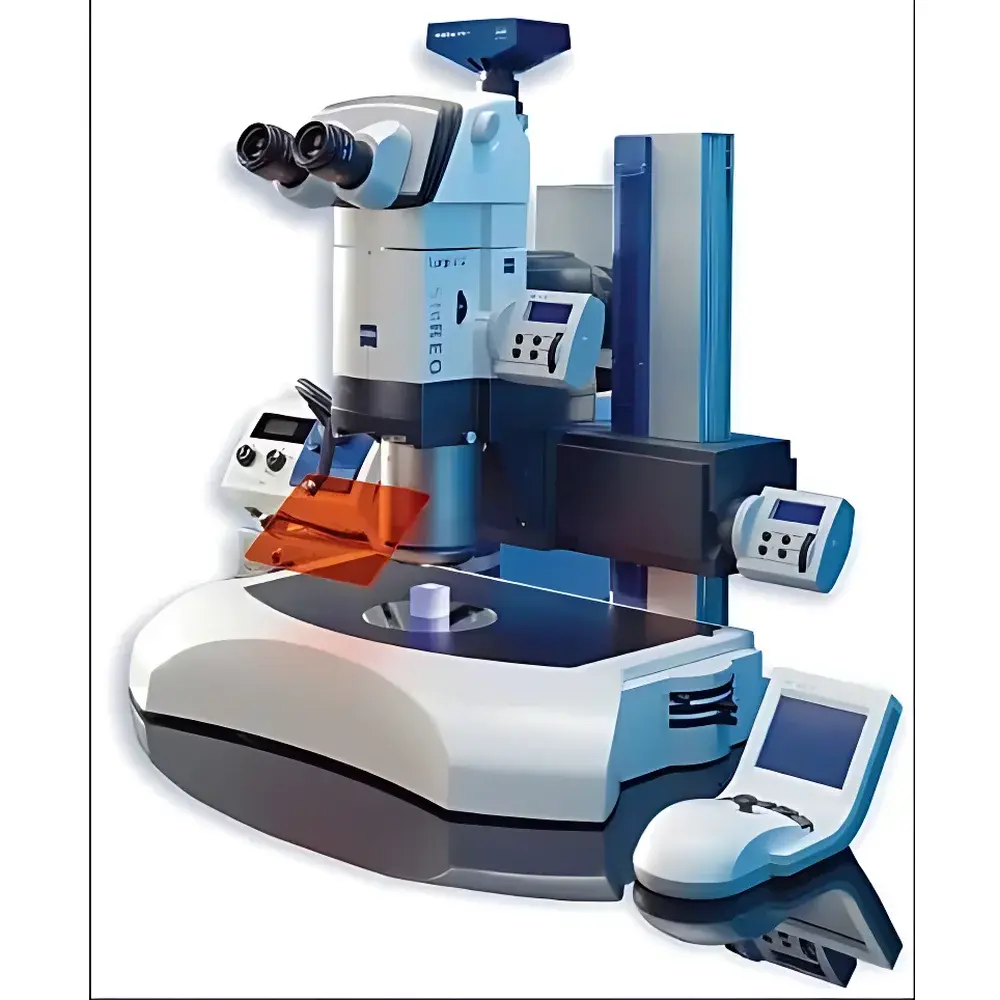
ZEISS SteREO Lumar.V12 Advanced Stereo Fluorescence Microscope
| Brand | ZEISS |
|---|---|
| Origin | Germany |
| Model | SteREO Lumar.V12 |
| Maximum Resolution | 1000 LP/mm |
| Maximum Magnification | 345× |
| Working Distance | Extended (optimized for in vivo specimen handling) |
| Fluorescence Objective NA | High numerical aperture (designed for bright, low-magnification fluorescence imaging) |
| Control Interface | Integrated LCD touchscreen |
Overview
The ZEISS SteREO Lumar.V12 is an advanced stereo fluorescence microscope engineered for seamless transition between macroscopic survey and microscopic detail in life science research. It employs reflected-light epifluorescence illumination combined with high-precision Galilean zoom optics to deliver true stereoscopic depth perception across a continuous magnification range — from whole-organism overview down to subcellular structural assessment. Unlike conventional widefield fluorescence systems constrained by shallow depth of field or limited working distance, the Lumar.V12 integrates a rigid, vibration-damped optical bench and an inverted illumination path optimized for upright specimen positioning — making it particularly suited for longitudinal in vivo imaging of small model organisms (e.g., zebrafish larvae, mouse embryos, Drosophila pupae) and tissue explants. Its optical architecture conforms to ZEISS’ TissueClear™-compatible design principles, enabling compatibility with both native autofluorescence and exogenous fluorophore labeling (e.g., GFP, mCherry, Alexa Fluor dyes) without compromise in signal-to-noise ratio.
Key Features
- Continuous zoom system with 12.5:1 magnification range (0.63×–7.8× base magnification), extendable to 345× total magnification using auxiliary objectives and eyepiece combinations
- Optimized fluorescence path featuring high-transmission dichroic mirrors, narrow-band excitation/emission filters, and LED-based illumination modules with selectable wavelengths (365 nm, 470 nm, 530 nm, 590 nm)
- Extended working distance up to 105 mm at lowest magnification — sufficient to accommodate live animal holders, perfusion chambers, and microinjection rigs
- Integrated 7-inch capacitive LCD touchscreen for one-touch control of focus drive, illumination intensity, filter turret position, and camera trigger
- Modular stand with reinforced cast-aluminum base and adjustable height column; supports optional motorized Z-drive and XY stage for automated tile scanning
- High-NA apochromatic fluorescence objectives (0.5×, 1.0×, 2.0×) delivering diffraction-limited resolution up to 1000 line pairs per millimeter at optimal Nyquist sampling
Sample Compatibility & Compliance
The SteREO Lumar.V12 accommodates diverse biological specimens — including intact vertebrate and invertebrate embryos, organotypic brain slices, 3D cell cultures, and translucent plant tissues — without requiring sectioning or mounting under coverslips. Its large-stage clearance and vertical optical axis support integration with environmental control units (temperature, CO₂, humidity) for long-term live-cell observation. The system complies with ISO 10993-5 (biocompatibility of microscope components in contact with biological samples) and meets essential requirements of IEC 61000-6-3 (EMC emission standards) and IEC 61000-6-2 (immunity). When operated with ZEISS ZEN Blue software and configured for electronic recordkeeping, it supports audit-trail-enabled workflows aligned with GLP and 21 CFR Part 11 requirements for regulated preclinical studies.
Software & Data Management
Control and image acquisition are managed via ZEISS ZEN Blue (v3.5+), a modular platform supporting multi-channel fluorescence time-lapse acquisition, extended depth-of-field (EDF) reconstruction, and spatial calibration traceable to NIST-traceable stage micrometers. Raw data are saved in ZEN’s proprietary .czi format — fully compliant with OME-TIFF export protocols for interoperability with Fiji/ImageJ, Imaris, and Python-based analysis pipelines (e.g., scikit-image, napari). Metadata embedding includes objective ID, exposure parameters, illumination settings, and user-defined experimental annotations. Optional ZEN Connect module enables secure cloud synchronization and role-based access control for collaborative labs operating under ISO/IEC 27001-aligned IT infrastructure.
Applications
- In vivo developmental biology: Real-time tracking of fluorescently labeled cell migration in zebrafish gastrulation or neural crest formation
- Neuroscience: Whole-brain imaging of calcium dynamics in cleared murine brain slices using GCaMP6s
- Plant phenotyping: Non-invasive monitoring of root architecture and symbiotic fungal colonization under GFP-tagged promoters
- Regenerative medicine: Assessment of scaffold-integrated stem cell engraftment and vascular network formation in bioreactor-cultured constructs
- Toxicology screening: Quantitative analysis of apoptosis markers (e.g., Annexin V–FITC) in 3D spheroid models exposed to nanomaterials
FAQ
Is the SteREO Lumar.V12 compatible with third-party cameras?
Yes — it features a standardized C-mount and M42 thread interface, supporting scientific CMOS and sCMOS cameras from vendors including Hamamatsu, Andor, and PCO, provided pixel size and sensor format align with the system’s optical conjugate plane.
Can the microscope be integrated into automated imaging workflows?
Absolutely — ZEISS provides SDK documentation and COM/DCOM APIs for custom scripting in MATLAB, Python, or LabVIEW; motorized components (Z-drive, filter wheel, shutter) support TTL and RS-232 triggering for synchronized hardware control.
Does the system support spectral unmixing for multicolor fluorescence experiments?
While the standard configuration uses fixed-bandpass filters, optional motorized filter turrets with ≥6-position capacity and ZEISS’s SpectraVision module enable sequential acquisition and linear unmixing of spectrally overlapping fluorophores when paired with appropriate reference spectra.
What maintenance intervals are recommended for long-term stability?
ZEISS recommends annual optical alignment verification and LED intensity calibration; mechanical components require biannual lubrication of precision gears and quarterly inspection of touchscreen responsiveness and cable integrity per ZEISS Service Bulletin SB-LUMAR-2023-04.