
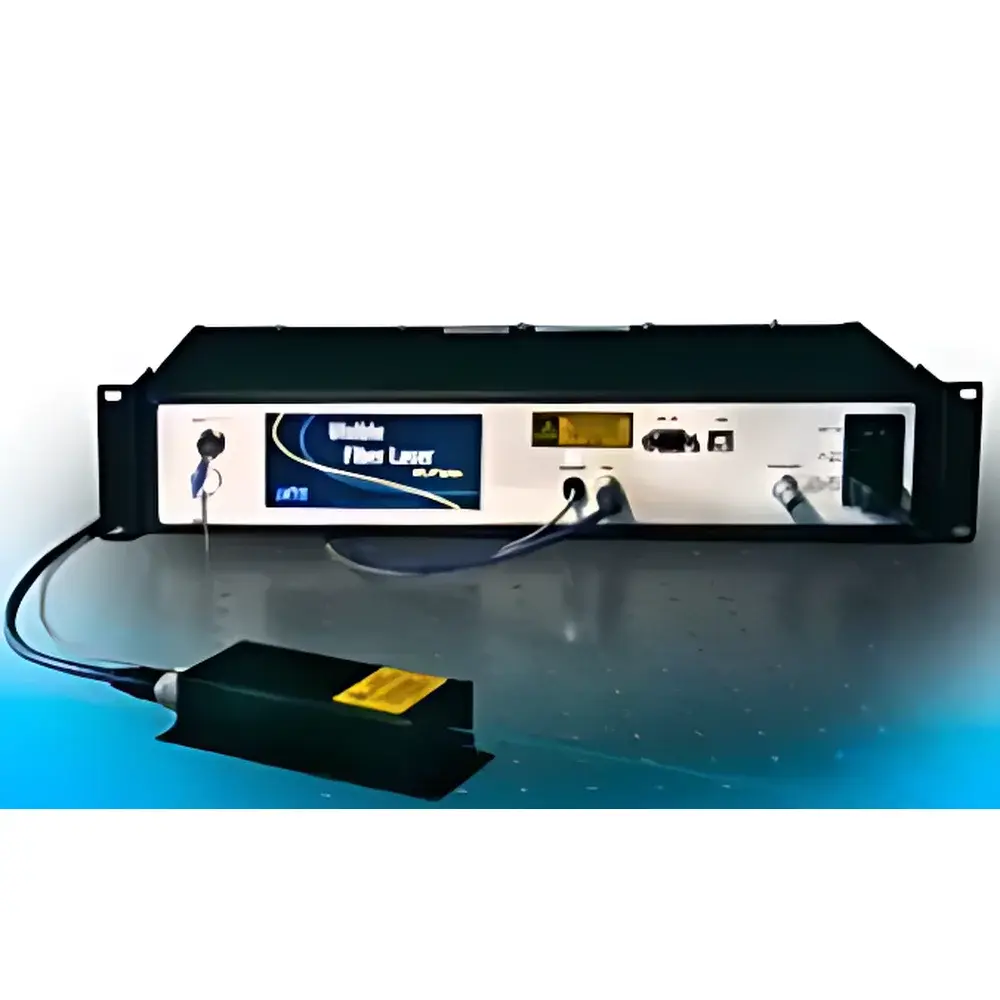
MPB Communications 2RU-VFL-P-200-488 488 nm Fiber-Coupled Continuous-Wave Diode-Pumped Solid-State Laser
| Brand | MPB Communications |
|---|---|
| Origin | Canada |
| Model | 2RU-VFL-P-200-488 |
| Output Power | 200 mW (CW) |
| Wavelength | 488 nm |
| Beam Mode | TEM₀₀ |
| M² | ≤1.1 |
| Polarization | Linear, vertical to baseplate |
| Beam Divergence (full angle) | <5 mrad |
| Power Stability (rms, over 8 hrs) | ±0.5% |
| Wavelength Stability | ±0.02 nm |
| Cooling | Air-cooled |
| Interfaces | RS232, USB |
| Safety | Interlock-compatible |
Overview
The MPB Communications 2RU-VFL-P-200-488 is a compact, air-cooled, fiber-coupled continuous-wave (CW) diode-pumped solid-state (DPSS) laser system engineered for high-stability visible-light excitation at the critical 488 nm spectral line. Unlike conventional free-space argon-ion lasers, this instrument leverages monolithic nonlinear frequency conversion in a waveguide-integrated architecture to deliver diffraction-limited output with exceptional spectral purity and long-term power consistency. Its TEM₀₀ spatial profile and M² ≤1.1 ensure optimal coupling efficiency into single-mode optical fibers (e.g., SMF-28), enabling seamless integration into confocal microscopes, flow cytometers, and spectroscopic platforms requiring precise beam delivery and minimal modal noise. Designed for laboratory and OEM deployment, the 2RU-VFL series adheres to IEC 60825-1:2014 Class 3B laser safety requirements and supports fail-safe interlock circuits compliant with EN 61511 functional safety standards.
Key Features
- Stable CW output at 488 nm with 200 mW nominal power — calibrated and certified per ISO 11554
- Diffraction-limited beam quality (M² ≤1.1) and linear polarization orthogonal to mounting surface for predictable interference and modulation behavior
- Integrated thermal management via passive convection and intelligent fan control — no external chiller or water lines required
- Dual digital interfaces (RS232 and USB 2.0) enabling remote control of output power (20–100% range), emission enable/disable, and real-time status monitoring
- Embedded GUI software for Windows-based configuration, including power ramping profiles, temperature logging, and fault diagnostics
- Robust 2RU (3.5″ H × 19″ W × 20″ D) rack-mount enclosure with EMI-shielded chassis and conformal-coated PCBs for operation in regulated environments
- Compliance with RoHS 3 and REACH directives; CE-marked for EMC (EN 55011) and safety (EN 60950-1)
Sample Compatibility & Compliance
This laser is routinely deployed in applications demanding strict photostability and low temporal intensity noise, including fluorescence lifetime imaging (FLIM), Förster resonance energy transfer (FRET), and quantitative flow cytometry per ISO 13251 and CLSI H44-A3 guidelines. Its narrow linewidth (<0.1 nm FWHM) and wavelength stability (±0.02 nm over 8 hours at constant ambient temperature) meet spectral fidelity requirements for excitation of common fluorophores such as FITC, Alexa Fluor 488, and GFP derivatives. The system supports GLP/GMP-aligned usage through audit-trail-capable firmware logging (timestamped power setpoints, thermal events, interlock triggers), and optional 21 CFR Part 11-compliant software modules are available for pharmaceutical QC laboratories.
Software & Data Management
The included VFL Control Suite provides deterministic command-line and GUI-driven operation under Windows 10/11 (64-bit). All parameter changes are logged with UTC timestamps and user identifiers. Export formats include CSV and HDF5 for traceable data interchange with MATLAB, Python (via PyVISA), or LabVIEW-based acquisition systems. Firmware updates are performed via signed binary packages verified using SHA-256 checksums and X.509 certificate validation. Remote monitoring via Ethernet (optional module) enables SNMP v3 integration into facility-wide equipment health dashboards.
Applications
- Confocal and super-resolution fluorescence microscopy (STED, SIM)
- High-throughput flow cytometry with multi-laser excitation architectures
- Retinal imaging and adaptive optics-assisted ophthalmic diagnostics
- Raman spectroscopy excitation source for aqueous biological samples
- Laser-induced forward transfer (LIFT) in thin-film patterning of biomaterials
- Calibration reference source for spectroradiometers traceable to NIST SRM 2031
- OEM integration into analytical instruments requiring stable 488 nm illumination with low pointing instability (<2 µrad/hr)
FAQ
Is the 488 nm output derived from direct diode emission or frequency-doubled technology?
The 2RU-VFL-P-200-488 employs intracavity frequency doubling of a 976 nm pump diode in a periodically poled KTP (PPKTP) crystal, yielding fundamental 488 nm output without external SHG stages.
What is the maximum allowable back-reflection into the output fiber?
Maximum tolerable optical feedback is –30 dB relative to output power; an integrated optical isolator (25 dB isolation @ 488 nm) is standard.
Can the laser be operated in analog modulation mode?
Yes — a 0–5 V TTL-compatible analog input accepts external modulation signals up to 100 kHz bandwidth with <1% linearity error.
Does MPB provide factory calibration certificates with NIST-traceable power measurements?
Each unit ships with a test report referencing NIST-traceable power meter calibrations (Thorlabs S120VC, calibrated annually by A2LA-accredited lab).
What is the expected lifetime of the pump diode under continuous operation?
MTTF exceeds 20,000 hours at rated output power and ambient temperatures ≤30 °C, per Telcordia GR-468-CORE reliability testing protocols.




