
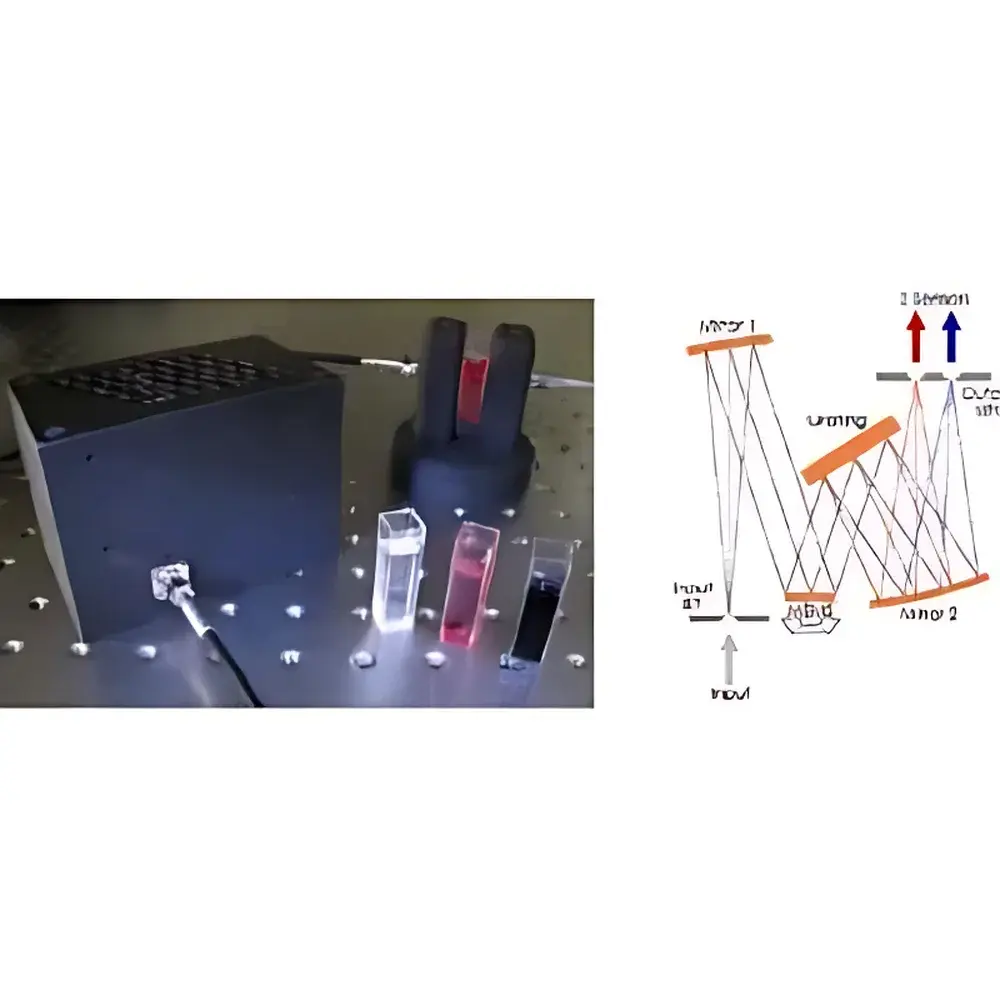
MicroMirror Spectrometer NIR/MIR Series
| Origin | Imported |
|---|---|
| Manufacturer Type | Distributor |
| Model | NIR/MIR |
| Price | Upon Request |
| Wavelength Range (NIR) | 0.6–1.7 µm, 0.9–2.1 µm |
| Wavelength Range (MIR) | 2.5–5 µm, 5–10 µm |
| Spectral Resolution | <9 nm (NIR), <12 nm (NIR), <30 nm (MIR), <50 nm (MIR) |
| Wavelength Accuracy | <0.5 nm (NIR), <2 nm (MIR) |
| SNR | >7000:1 (NIR), >1000:1 (NIR), >500:1 (MIR), >500:1 (MIR) |
| Integration Time | 4 ms |
| Dimensions (NIR) | 107 × 66 × 80 mm |
| Dimensions (MIR) | 107 × 110 × 80 mm |
| Power Supply | 9–18 V DC (NIR), 18–36 V DC (MIR) |
| Interface | USB, RS-485 |
| Detector Cooling | Optional thermoelectric (TE) cooling |
| Input Coupling | Free-space or fiber-optic |
Overview
The MicroMirror Spectrometer NIR/MIR Series is a compact, scanning monochromator-based spectrometer engineered for high-speed, field-deployable spectral analysis across near-infrared (NIR) and mid-infrared (MIR) bands. Unlike array-based spectrometers, this instrument employs a precision micro-electromechanical systems (MEMS) scanning mirror in conjunction with a fixed diffraction grating to sequentially disperse broadband light onto a single-element detector. This optical architecture—rooted in classical Czerny-Turner or Littrow configuration principles—delivers superior stray-light rejection, enhanced wavelength reproducibility, and inherent immunity to pixel-to-pixel non-uniformity. The system operates on the principle of angular dispersion: incident polychromatic light is reflected off the oscillating micro-mirror at calibrated angles, directing discrete wavelength bands onto the detector over time. This time-resolved scanning approach enables full-spectrum acquisition in as little as 4 ms per scan, making it suitable for real-time process monitoring, embedded OEM integration, and portable laboratory applications where space, power, and mechanical robustness are constrained.
Key Features
- High-speed spectral acquisition with fixed 4 ms integration time across all configured bands
- Modular optical design supporting both free-space and fiber-coupled input (SMA 905 standard)
- Optional thermoelectric (TE) cooling for detector stabilization—critical for low-noise MIR measurements and extended dynamic range
- Low-noise transimpedance preamplifier enabling >7000:1 SNR in NIR and >500:1 SNR in MIR under optimal conditions
- Ruggedized aluminum housing with vibration-damped internal optics; qualified for operation in industrial environments (IEC 60068-2-6 compliant mounting)
- Compact footprint: 107 × 66 × 80 mm (NIR variant) and 107 × 110 × 80 mm (MIR variant), facilitating integration into handheld analyzers or robotic platforms
- Dual-voltage compatibility: 9–18 V DC for NIR modules; 18–36 V DC for MIR modules with higher thermal load requirements
Sample Compatibility & Compliance
This spectrometer supports direct transmission, reflectance, and attenuated total reflectance (ATR) configurations via external accessories. Sample interfaces accommodate solids, liquids, powders, and gases when paired with appropriate sampling optics (e.g., integrating spheres, gas cells, or MIR-specific diamond ATR crystals). The instrument complies with electromagnetic compatibility standards IEC 61326-1 (industrial environment) and safety standard IEC 61010-1. While not intrinsically rated, optional enclosure variants meet IP54 for dust and splash resistance. Data integrity protocols align with GLP/GMP documentation workflows: timestamped spectra, detector temperature logs, and mirror position metadata are embedded in each acquired file. Firmware supports audit-trail-enabling modes compatible with FDA 21 CFR Part 11–aligned software environments upon host-side implementation.
Software & Data Management
Driver-level support includes native DLLs for Windows (x64/x86), Linux kernel modules (via libusb), and Python bindings (PyMicroMirror v2.3+). The SDK provides low-level control over mirror scan profiles, gain settings, trigger synchronization (TTL input/output), and real-time spectrum streaming. Preconfigured applications include spectral calibration utility (NIST-traceable line sources supported), chemometric preprocessing toolkit (baseline correction, Savitzky-Golay smoothing, vector normalization), and batch export to ASTM E131-compliant .jdx format. All raw data is stored in HDF5 containers with embedded metadata (wavelength axis, integration time, detector bias, ambient temperature), ensuring traceability and interoperability with MATLAB, Python (h5py), and commercial chemometrics platforms such as Unscrambler X or Pirouette.
Applications
- Real-time quality control of pharmaceutical tablets (NIR: 0.9–2.1 µm for API concentration, excipient hydration)
- Industrial gas leak detection (MIR: 3.3–3.5 µm for CH₄, 4.2–4.4 µm for CO₂)
- In-line monitoring of polymer extrusion processes (MIR fingerprint region: 5–10 µm for carbonyl, amide, and olefin bond tracking)
- Portable food authenticity screening (NIR: 0.6–1.7 µm for moisture, fat, protein estimation)
- Environmental soil organic carbon quantification (NIR + MIR fusion via external beam splitter)
- OEM integration into UAV-mounted hyperspectral payloads (weight < 420 g, power draw < 3.2 W @ 12 V)
FAQ
Is this spectrometer suitable for quantitative analysis in regulated environments?
Yes—when deployed with documented calibration procedures, NIST-traceable reference standards, and validated chemometric models, it meets ASTM E1655 and USP requirements for spectroscopic instrumentation used in QC labs.
Can the MIR module operate uncooled?
The 2.5–5 µm module may acquire usable spectra without TE cooling under ambient conditions, but SNR degrades significantly above 35 °C; the 5–10 µm module requires active cooling for stable dark current and acceptable SNR.
What is the maximum optical throughput for fiber-coupled operation?
With a 400 µm core multimode fiber (NA 0.22), throughput is optimized at ~75% relative to free-space input—verified using calibrated tungsten-halogen source and NIST SRM 2035.
Does the firmware support external hardware triggering?
Yes—TTL-compatible trigger input (rising-edge sensitive) enables synchronization with pump lasers, motor encoders, or PLC-controlled sample stages.
Are calibration certificates included with shipment?
A factory spectral calibration certificate (covering wavelength accuracy and linearity) is provided; optional ISO/IEC 17025-accredited calibration is available upon request.





