
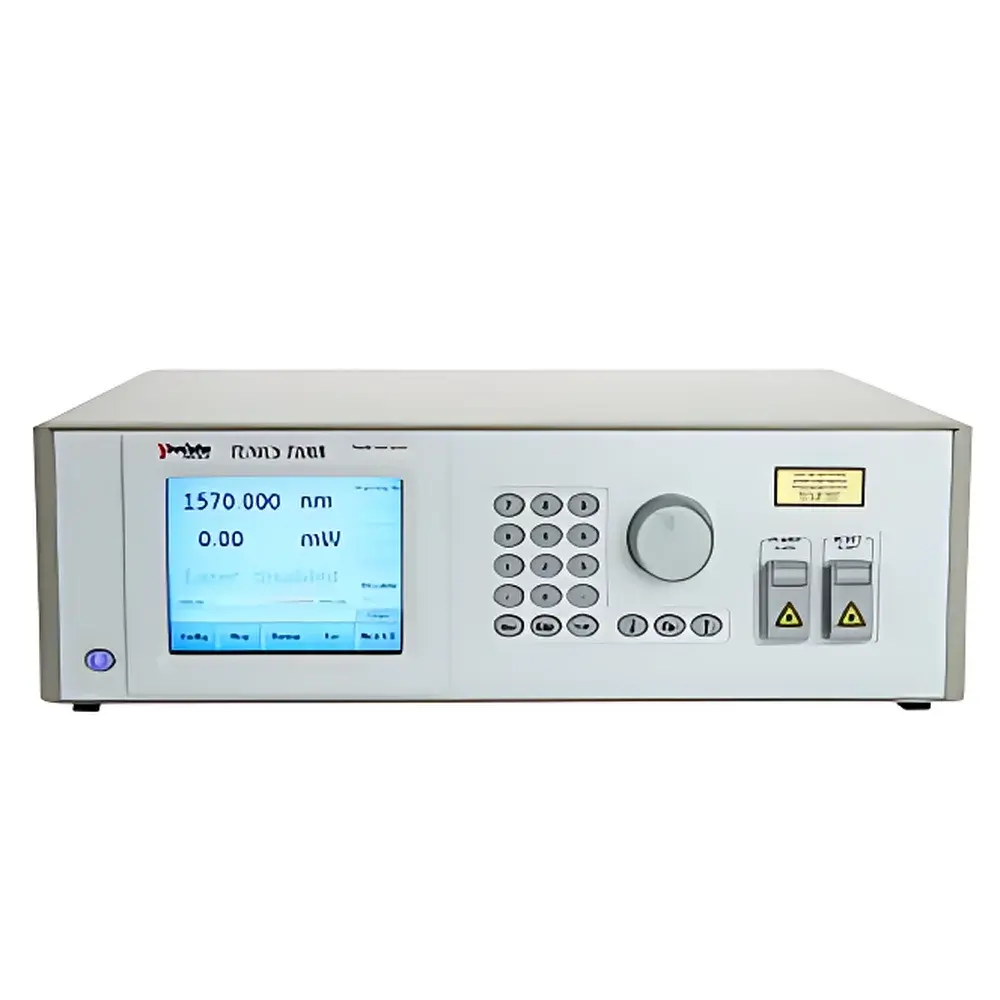
Yenista TUNICS T100R High-Performance Tunable Laser Source
| Brand | Yenista |
|---|---|
| Origin | France |
| Model | TUNICS T100R |
| Wavelength Range | 1490–1650 nm |
| Absolute Wavelength Accuracy | ±5 pm |
| Output Power | >+10 dBm |
| Scan Speed | Up to 100 nm/s |
| ASE Suppression Ratio (SSE) | >100 dB |
| Linewidth (FWHM) | 500 kHz (typ., coherence control off) |
| Wavelength Repeatability | ±1 pm (typ.) |
| Power Stability | ±0.01 dB/h |
| Interface | RS-232C, IEEE-488.2 (GPIB) |
| Operating Temperature | +18 to +30 °C |
| Dimensions | 448 × 133 × 370 mm |
| Weight | 12.5 kg |
Overview
The Yenista TUNICS T100R is a high-precision, fully integrated tunable laser source engineered for demanding optical component and subsystem characterization in R&D, manufacturing test, and metrology laboratories. It operates on the principle of external cavity diode laser (ECDL) architecture enhanced by Yenista’s proprietary Optim-Y technology — a monolithic intra-cavity ASE suppression mechanism that eliminates broadband amplified spontaneous emission at the source. This enables exceptional spectral purity, with a signal-to-spontaneous-emission ratio (SSE) exceeding 100 dB and a typical linewidth of 500 kHz (coherence control disabled), making it suitable for high-dynamic-range measurements including insertion loss, polarization-dependent loss (PDL), group delay, and chromatic dispersion of dense wavelength division multiplexing (DWDM) filters, arrayed waveguide gratings (AWGs), fiber Bragg gratings (FBGs), reconfigurable optical add-drop multiplexers (ROADMs), and wavelength selective switches (WSS). Its absolute wavelength accuracy of ±5 pm—traceable to NIST-traceable wavelength standards—and continuous, mode-hop-free tuning across 1490–1650 nm at 0 dBm output define a new benchmark for calibration-grade tunable sources in telecom and photonic integrated circuit (PIC) testing.
Key Features
- Mode-hop-free tuning across the full C+L band (1490–1650 nm) at 0 dBm, and extended 1520–1620 nm range at +10 dBm output power;
- Ultra-high wavelength fidelity: ±5 pm absolute accuracy, ±1 pm/h short-term stability (±1 pm/24 h typical), and 1 pm wavelength setting resolution—with 0.1 pm fine-tuning capability via GHz-scale frequency offset;
- High optical output power: >+10 dBm across the entire tuning range, enabling direct testing of high-loss devices without external amplification;
- Fast, programmable scanning: Linear sweep speeds from 1 to 100 nm/s, with power flatness maintained within ±0.25 dB (typ.) and repeatability of ±0.05 dB (typ.) over ≥100 consecutive scans;
- Optim-Y ASE suppression technology: Intra-cavity filtering achieves SSE >100 dB, effectively removing background noise that would otherwise degrade dynamic range and measurement confidence in low-signal applications;
- Integrated reference-grade wavemeter: Real-time, closed-loop wavelength monitoring ensures traceability and compensates for thermal drift without requiring external recalibration;
- Robust industrial-grade platform: Designed for 24/7 operation in controlled lab environments; meets IEC 61326-1 for EMC compliance and supports GLP/GMP-aligned audit trails when used with compliant software.
Sample Compatibility & Compliance
The TUNICS T100R is optimized for characterization of passive and active photonic components operating in the O-, E-, S-, C-, and L-bands. It interfaces seamlessly with standard single-mode fiber (SMF-28™) via FC/APC connectors (return loss >60 dB) and supports both manual and automated test configurations. The instrument complies with ISO/IEC 17025 requirements for calibration laboratories when operated under documented procedures, and its wavelength accuracy aligns with ITU-T G.694.1 channel grid specifications for DWDM systems. For regulated environments—including those subject to FDA 21 CFR Part 11 or EU Annex 11—the device supports secure remote control via IEEE-488.2 (GPIB) or RS-232C, enabling integration into validated test systems with electronic signatures, change control, and audit trail capabilities when paired with compliant host software.
Software & Data Management
Yenista provides the TUNICS Control Suite—a Windows-based application supporting full instrument configuration, scan automation, data logging, and export to CSV, MATLAB (.mat), or HDF5 formats. The suite includes built-in routines for IL/PDL sweep synchronization with optical power meters and polarization controllers, as well as scripting support via COM/ActiveX and SCPI command sets. All wavelength and power readings are timestamped and associated with system metadata (e.g., ambient temperature, internal thermistor values), ensuring full traceability. When deployed in networked environments, the T100R supports TCP/IP-over-serial bridging for integration into LabVIEW, Python (PyVISA), or TestStand frameworks—facilitating compliance with ASTM E2500-13 (verification of computerized systems) and ICH Q9 risk-based qualification protocols.
Applications
- Calibration and verification of optical spectrum analyzers (OSAs), interferometric wavelength meters, and optical channel monitors (OCMs);
- Insertion loss, return loss, and PDL mapping of thin-film filters, cascaded MUX/DEMUX modules, and planar lightwave circuit (PLC) splitters;
- Group delay and dispersion measurement of FBGs and chirped mirrors using phase-shifted interferometry;
- Wavelength-dependent gain profiling of EDFAs and Raman amplifiers;
- Characterization of silicon photonics devices—including microring resonators and Mach-Zehnder modulators—under swept-wavelength excitation;
- Long-term stability monitoring in thin-film deposition processes, where sub-picometer wavelength drift detection is critical.
FAQ
What wavelength standards is the TUNICS T100R calibrated against?
The internal wavemeter is factory-calibrated using NIST-traceable iodine-stabilized HeNe lasers and verified against primary wavelength standards per ISO/IEC 17025 procedures.
Can the T100R be used in a Class 100 cleanroom environment?
Yes—its sealed optical bench and convection-cooled design meet ISO 14644-1 Class 5 particulate limits when installed with appropriate air filtration and vibration isolation.
Does the instrument support user-defined sweep profiles (e.g., non-linear or multi-segment scans)?
Yes—via SCPI commands or the TUNICS Control Suite, users can define arbitrary wavelength vs. time trajectories, including dwell times, acceleration ramps, and conditional triggers.
How is long-term wavelength drift mitigated during extended measurements?
The integrated wavemeter performs real-time feedback correction every 10 seconds (configurable), and the thermal management system maintains cavity temperature stability within ±0.02 °C over 24 hours.
Is firmware upgradability supported in the field?
Yes—firmware updates are delivered via signed .hex files through the USB service port, with rollback capability and cryptographic signature validation to ensure integrity and regulatory compliance.




