
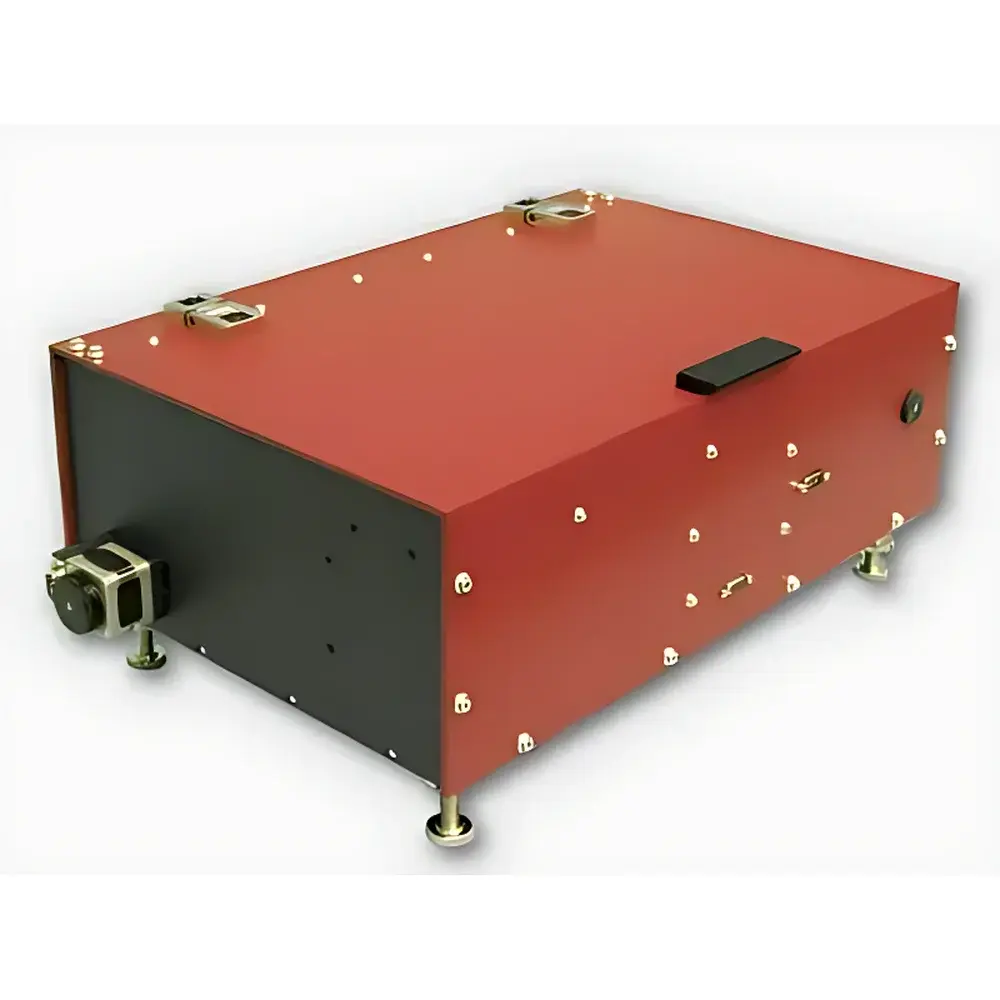
Rayscience COMET Third-Order Cross-Correlator
| Brand | Rayscience |
|---|---|
| Origin | Russia |
| Model | COMET |
| Wavelength Range | 700–1500 nm |
| Dynamic Range | >10¹⁰ |
| Temporal Range | 870 ps |
| Input Pulse Energy (40–50 fs) | 50–100 µJ |
| Minimum Pulse Duration | >20 fs |
| Repetition Rate | <10 kHz |
| Input Polarization | Horizontal Linear |
| Temporal Resolution | 100 fs |
| Interface | USB |
Overview
The Rayscience COMET Third-Order Cross-Correlator is a precision optical diagnostic instrument engineered for quantitative characterization of ultrashort laser pulses in the femtosecond regime. Based on third-order intensity autocorrelation via sum-frequency generation (SFG) in nonlinear crystals, the COMET enables direct measurement of pulse contrast ratio, pedestal structure, pre- and post-pulse wings, and amplified spontaneous emission (ASE) background—critical parameters for high-intensity laser systems such as Ti:sapphire amplifiers, optical parametric chirped-pulse amplifiers (OPCPAs), and high-harmonic generation (HHG) drivers. Unlike second-order correlators, the third-order configuration provides intrinsic immunity to common-mode noise and yields higher-fidelity intensity profile reconstruction by suppressing contributions from non-collinear parasitic reflections and residual interferometric artifacts. The system operates across a broad spectral window (700–1500 nm), making it compatible with oscillator-amplifier chains based on Yb-, Er-, or Ti:sapphire gain media.
Key Features
- Third-order intensity cross-correlation architecture for unambiguous pulse contrast assessment and ASE quantification
- Dynamic range exceeding 10¹⁰—enabling detection of nanosecond-scale pedestals beneath femtosecond main pulses
- Temporal scanning window of 870 ps with 100 fs step resolution, supporting full characterization of pulse envelopes up to ~435 ps FWHM equivalent
- High-sensitivity photodetection chain optimized for low-energy input pulses (50–100 µJ per 40–50 fs pulse)
- USB 2.0 interface with vendor-provided Windows-compatible control software for real-time scan acquisition, background subtraction, and baseline normalization
- Robust mechanical design featuring motorized delay stage with sub-micron positioning repeatability and passive thermal stabilization
- Input requirement: horizontally linearly polarized pulses with duration >20 fs and repetition rate <10 kHz
Sample Compatibility & Compliance
The COMET is designed for use with solid-state ultrafast laser sources—including mode-locked oscillators, regenerative amplifiers, and multipass amplifiers—operating within the specified wavelength and energy ranges. It complies with IEC 61000-6-3 (EMC emission standards) and meets CE marking requirements for laboratory optical instrumentation. While not certified to ISO/IEC 17025 for calibration traceability, its measurement methodology aligns with established practices referenced in ISO 13695 (optical radiation—measurement of ultrashort laser pulses) and supports GLP-compliant data recording when integrated with timestamped, audit-trail-enabled acquisition software. Users are advised to implement beam conditioning optics (e.g., variable attenuators, polarization rotators, and spatial filters) upstream of the correlator to ensure optimal signal-to-noise performance and avoid crystal damage at peak intensities.
Software & Data Management
The COMET is operated via Rayscience’s proprietary “CorrView” software suite, distributed as a standalone Windows application (x64, Windows 10/11). The software provides synchronized motor control, real-time CCD frame averaging, automatic dark-current subtraction, and configurable scan parameters (step size, dwell time, number of averages). Raw correlation traces are exported in ASCII format (.txt) with metadata headers including date/time stamp, delay stage position (ps), normalized intensity, and system configuration flags. For integration into automated test benches, a documented DLL-based API supports remote triggering and parameter setting via LabVIEW, MATLAB, or Python (PyWin32). All acquired datasets retain full traceability; no proprietary binary formats are used. Software updates are distributed through Rayscience’s secure customer portal and include version-controlled release notes aligned with ISO 9001 change management protocols.
Applications
- Quantitative contrast ratio evaluation of CPA and OPCPA systems prior to target interaction in high-field physics experiments
- Diagnosis and suppression of ASE in multi-stage Ti:sapphire amplifier chains
- Time-resolved pump–probe diagnostics requiring precise knowledge of pulse temporal structure
- Validation of pulse compression and dispersion compensation algorithms in adaptive optics setups
- Calibration reference for single-shot third-harmonic generation (THG) autocorrelators and FROG systems
- Characterization of post-compression effects in hollow-core fiber or gas-filled capillary compressors
FAQ
What laser parameters can the COMET directly measure?
It measures third-order intensity autocorrelation traces, from which pulse contrast ratio, pedestal amplitude, temporal width of satellite structures, and ASE-to-main-pulse energy ratio are derived. It does not directly output FWHM duration without deconvolution modeling.
Is the COMET compatible with 1030-nm Yb-based amplifiers?
Yes—the 700–1500 nm operational range fully covers Yb:YAG, Yb:fiber, and Yb:CALGO amplifier outputs, provided input polarization is horizontal linear and pulse energy falls within the 50–100 µJ (40–50 fs) specification.
Can it be used with kHz-repetition-rate oscillators?
No—its design assumes low-repetition-rate (<10 kHz), high-energy pulses. For MHz oscillators, average-power limitations and detector saturation require alternative architectures such as scanning SHG-FROG or spectral phase interferometry for direct electric-field reconstruction (SPIDER).
Does the system require external alignment tools or auxiliary optics?
The COMET includes internal collimation and focusing optics optimized for standard 12.7-mm-diameter input beams. Users must supply appropriate beam expansion, attenuation, and polarization control upstream to meet input specifications.
How is temporal resolution of 100 fs achieved mechanically?
Via a high-precision piezoelectric-driven delay stage with closed-loop position feedback, calibrated against HeNe interferometer references during factory alignment. Step resolution is decoupled from mechanical jitter through software-averaged multi-shot acquisition at each delay point.




