
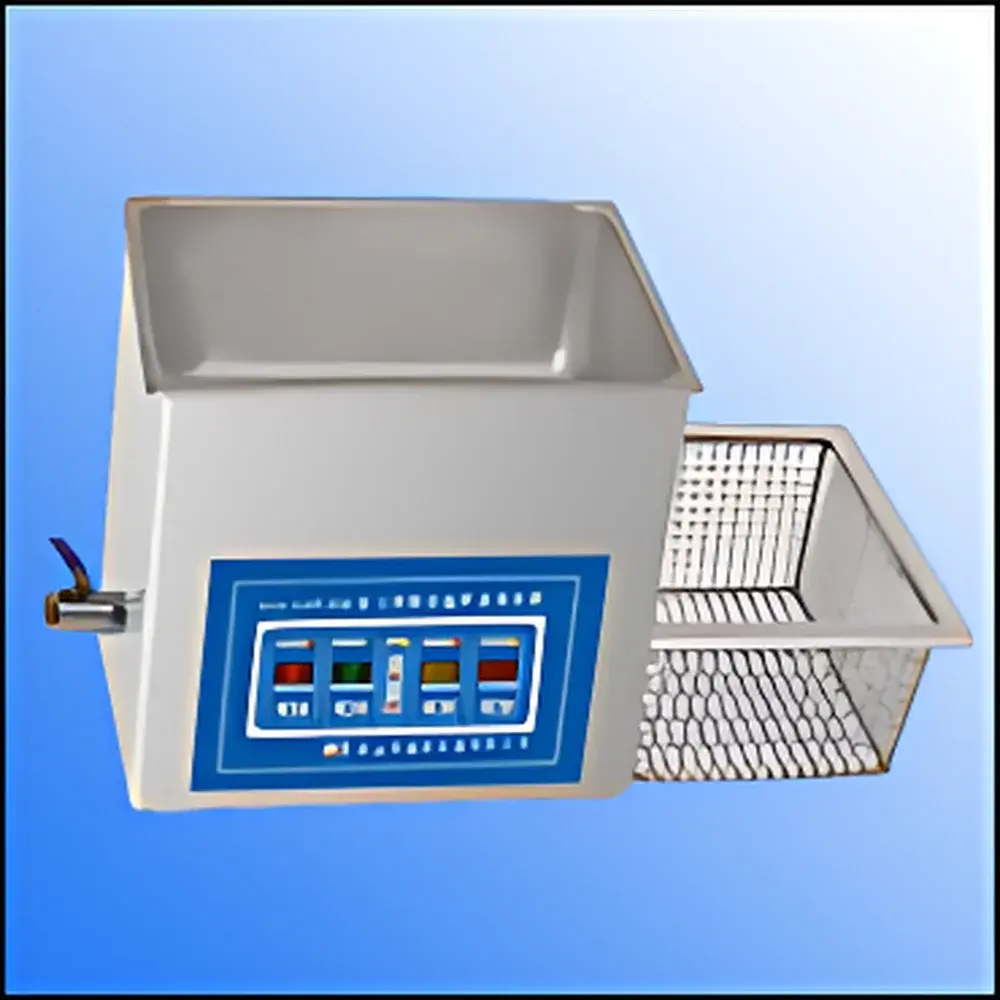
Chu Ding KQ3200DA / KQ3200DB / KQ3200DE / KQ3200DV Benchtop Digital Ultrasonic Cleaner
| Brand | Chu Ding Technology |
|---|---|
| Origin | Shanghai, China |
| Model Series | KQ3200DA / KQ3200DB / KQ3200DE / KQ3200DV |
| Ultrasonic Frequency | 40 kHz |
| Ultrasonic Power Output | 150 W |
| Tank Capacity | 6 L (KQ3200DA/DB) / 8 L (KQ3200DV) |
| Tank Internal Dimensions | 300 × 150 × 150 mm (DA/DB) / 300 × 150 × 180 mm (DV) |
| Power Adjustment Range | 40–100% |
| Heating Power | 0 W (DA) / 600 W (DB/DV) |
| Temperature Control Range | 20–80 °C (DB/DV) |
| Timer Range | 1–480 min |
| Built-in Stainless Steel Mesh Basket | Yes |
| Sound-Dampening Lid | No (DA/DB) / Yes (DV) |
| Drain Valve | Yes (DA/DB/DV) |
| Low-Level & Dry-Run Protection | Yes |
| Microprocessor-Controlled Operation | Yes |
| Cumulative Operating Hours Counter | Up to 999,999 h |
Overview
The Chu Ding KQ3200 series comprises a family of benchtop digital ultrasonic cleaners engineered for precision cleaning, degassing, dispersion, emulsification, and cell disruption in academic, industrial, and R&D laboratory environments. These units operate on the principle of high-frequency acoustic cavitation—generated by piezoelectric transducers bonded to the stainless steel tank bottom—at a fixed frequency of 40 kHz. This frequency delivers optimal energy transfer for removing sub-micron contaminants from complex geometries, including microfluidic devices, optical components, surgical instruments, chromatography columns, and semiconductor wafers. Unlike analog predecessors, the KQ3200 series integrates a microcontroller-based digital control system that ensures repeatable process parameters across multiple cleaning cycles—a prerequisite for method validation under GLP and ISO/IEC 17025-compliant workflows.
Key Features
- Digital microprocessor control with real-time display of operating parameters—including elapsed time, set temperature, actual temperature, power level, and cumulative runtime (up to 999,999 hours).
- Adjustable ultrasonic power output (40–100% of nominal 150 W), enabling optimization for delicate samples or aggressive contaminant removal without manual hardware modification.
- Integrated safety interlocks: automatic shutdown upon low liquid level detection, over-temperature, over-current, and over-voltage conditions—ensuring equipment longevity and user safety per IEC 61010-1 requirements.
- Stainless steel tank (SUS304) and mesh basket fabricated via argon arc welding for corrosion resistance and structural integrity; outer housing constructed from brushed stainless steel (except entry-level models).
- KQ3200DV variant includes a sound-dampening lid and volatile solvent vapor recovery system (V-type configuration), supporting use with flammable or environmentally regulated solvents such as acetone, isopropanol, or chlorinated hydrocarbons.
- Drain valve standard on all variants for rapid, residue-free tank emptying—critical for multi-solvent protocols and cross-contamination prevention.
Sample Compatibility & Compliance
The KQ3200 series accommodates a broad range of sample types: metal, glass, ceramic, and polymer substrates; fragile optics and MEMS devices; porous filters and membrane assemblies; and biological specimens requiring gentle lysis. Its 40 kHz frequency balances penetration depth and cavitation intensity—minimizing surface erosion while achieving effective particulate dislodgement. Units comply with CE marking directives (EMC Directive 2014/30/EU and LVD Directive 2014/35/EU) and meet RoHS 2.0 substance restrictions. While not certified for medical device reprocessing per ISO 15883, the series supports cleaning validation studies aligned with ASTM D2603 (Standard Test Method for Sonic Shear Stability of Lubricating Oils) and USP (Ultrasonic Cleaning of Laboratory Glassware). For GMP-regulated environments, optional audit-trail-capable firmware upgrades may be implemented to support 21 CFR Part 11 compliance when paired with validated networked data logging systems.
Software & Data Management
Operation is fully standalone—no PC interface or proprietary software required. All parameters are configured via intuitive membrane keypad and stored in non-volatile memory for recall across sessions. The embedded controller logs cumulative operational hours and retains last-used settings (time, temperature, power) to reduce setup variability between users. For laboratories requiring traceability, external USB data loggers can capture serial output (RS232 port available on select configurations) to record timestamps, temperature profiles, and power modulation events—facilitating IQ/OQ documentation and periodic performance verification per ISO/IEC 17025 clause 7.7.
Applications
- Precision cleaning of HPLC/GC injectors, flow cells, and capillary tubing prior to calibration.
- Removal of polishing compounds and organic residues from optical lenses and laser components.
- Preparation of nanoparticle suspensions and colloidal dispersions via ultrasonic deagglomeration.
- Cell lysis and nucleic acid extraction in molecular biology workflows—particularly where mechanical homogenization risks DNA shearing.
- Degassing of solvents prior to vacuum filtration or HPLC mobile phase preparation.
- Post-print cleaning of 3D-printed metal parts to eliminate sintering-support residues.
FAQ
What is the difference between KQ3200DA, DB, and DV models?
The DA model provides ultrasonic cleaning only (no heating); the DB adds adjustable heating (20–80 °C, 600 W); the DV includes both heating and a sound-dampening lid with solvent vapor recovery.
Can this unit be used with flammable solvents?
Only the KQ3200DV model—with its V-type vapor recovery system and sealed lid—is suitable for low-flashpoint solvents; always consult local fire safety regulations and conduct risk assessment per NFPA 30 before operation.
Is the timer programmable for delayed start?
No—the timer initiates immediately upon activation; it does not support delayed or scheduled start functionality.
What maintenance is required for long-term reliability?
Routine cleaning of the tank interior with mild detergent, inspection of the drain valve seal, and periodic verification of transducer adhesion integrity using impedance testing (recommended annually for high-throughput labs).
Does the unit support external temperature probes?
No—temperature sensing is internal only, via a calibrated NTC thermistor embedded in the tank wall; external probe integration is not supported in standard configuration.



