
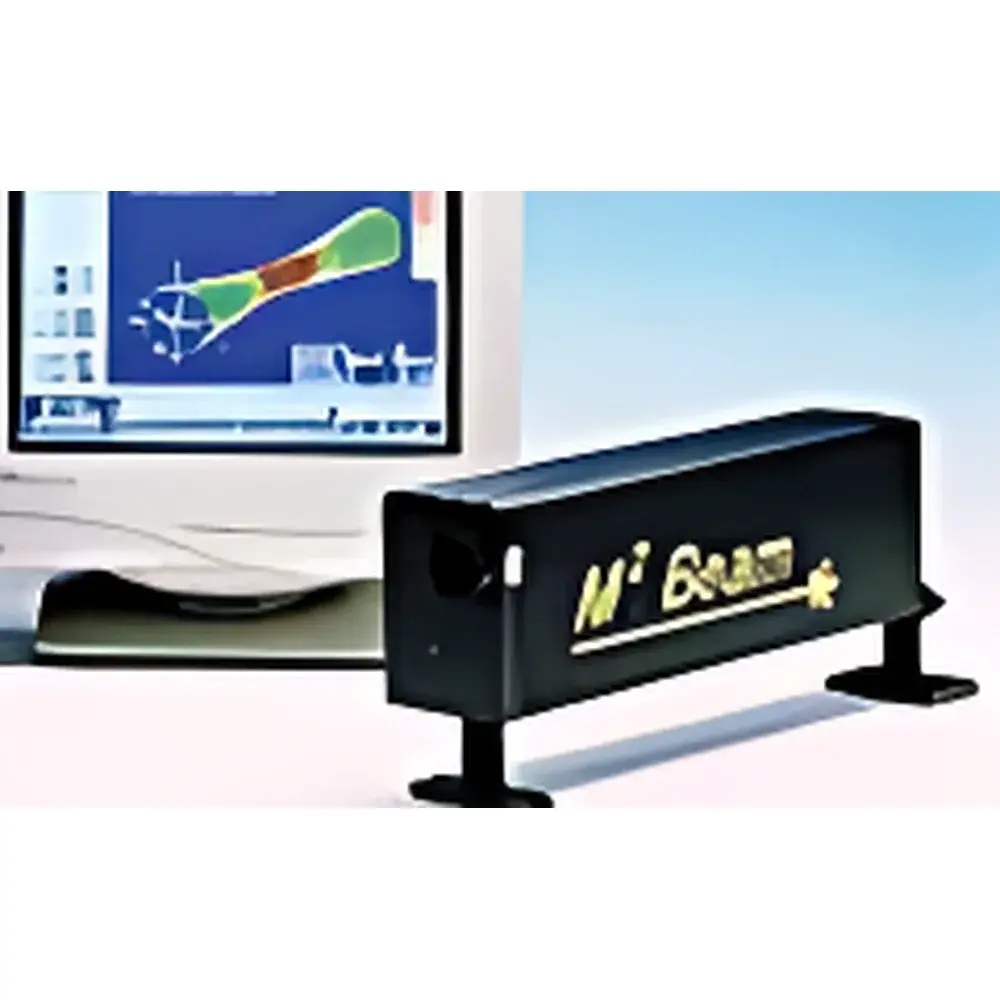
Duma Optronics M2-Beam Laser Beam Quality Analyzer
| Brand | Duma Optronics |
|---|---|
| Country of Origin | Israel |
| Model | M2-Beam |
| Wavelength Range | 190–1800 nm |
| Beam Diameter Measurement Range | Up to 15 mm |
| Power Range | 100 µW–1 W (Si), 100 µW–5 mW (InGaAs/UV) |
| Detector Types | Si, UV-enhanced Si, InGaAs |
| Blade Aperture Configurations | 7-blade scanning slit (10×10 mm² Si/UV |
| Measurement Principle | Scanning Slit Method per ISO 11146-1:2005 |
| Compliance | ISO 11146, ANSI Z136.1, IEC 60825-1 |
Overview
The Duma Optronics M2-Beam Laser Beam Quality Analyzer is a precision-engineered instrument designed for comprehensive characterization of continuous-wave (CW) and quasi-CW laser beams in research, industrial manufacturing, and laser system integration environments. Based on the scanning-slit methodology defined in ISO 11146-1:2005, the M2-Beam quantifies critical beam propagation parameters—including the beam propagation ratio (M²), beam waist diameter and location, divergence angle, Rayleigh length, and intensity distribution—by performing sequential orthogonal scans across the beam profile at multiple axial positions (Z-steps). Unlike camera-based profilers, the scanning-slit architecture delivers high dynamic range (>70 dB), minimal saturation risk, and immunity to pixelation artifacts, making it especially suitable for high-brightness, spatially coherent sources such as single-mode fiber lasers, diode-pumped solid-state (DPSS) lasers, and ultrafast oscillators operating near diffraction-limited conditions.
Key Features
- ISO 11146-compliant M² measurement with traceable uncertainty estimation per NIST-traceable calibration protocols
- Multi-wavelength support across three detector configurations: UV-enhanced Si (190–1100 nm), standard Si (350–1100 nm), and InGaAs (800–1800 nm)
- Modular 7-blade scanning head design enabling rapid interchange between 10×10 mm² (Si/UV) and Ø3 mm / Ø5 mm (IR) apertures to match beam size and power density requirements
- Real-time beam parameter calculation including M², beam waist (d₀), confocal parameter (b), divergence (θ), and kurtosis-based beam quality index
- Integrated power monitoring channel with <1 nW resolution and 1 kHz single-channel bandwidth for synchronized intensity normalization
- RS232 and USB 2.0 interfaces supporting remote operation, automated Z-stage control, and time-stamped data logging
- Embedded display module with intuitive GUI for on-device setup, live scan visualization, and pass/fail threshold evaluation
Sample Compatibility & Compliance
The M2-Beam accommodates free-space and fiber-coupled beams with diameters up to 15 mm and power levels ranging from 100 µW to 1 W (Si), or 100 µW to 5 mW (InGaAs/UV-enhanced Si), depending on detector variant. Its non-imaging scanning geometry eliminates concerns related to pixel saturation, blooming, or sensor damage common in CCD/CMOS-based systems. The analyzer meets optical safety standards per IEC 60825-1:2014 and ANSI Z136.1-2022 for Class 3B and Class 4 laser alignment and qualification tasks. All firmware and software modules are developed under GLP-aligned documentation practices, with full audit trail capability for FDA 21 CFR Part 11–compliant environments when deployed with validated PC host systems.
Software & Data Management
The M2-Beam operates with Duma’s proprietary BeamGage Pro software suite (Windows 10/11 compatible), which provides full control over acquisition parameters, Z-stage sequencing, and report generation. The software implements ISO 11146–defined second-moment analysis with optional Gaussian fit validation and beam ellipticity correction. Raw scan data is stored in HDF5 format with embedded metadata (wavelength, aperture ID, timestamp, operator ID, calibration certificate ID). Export options include CSV, XML, and PDF reports conforming to internal QA templates or external regulatory submission requirements. Batch processing mode enables unattended multi-beam qualification across production lots, while API support (DLL and COM interfaces) allows integration into LabVIEW, MATLAB, or Python-based test automation frameworks.
Applications
- Qualification of single-mode and multimode fiber lasers prior to OEM integration
- M² verification of ultrafast amplifier chains in scientific laser facilities
- Beam diagnostics during laser cavity alignment and resonator optimization
- QC testing of laser diodes and VCSEL arrays in semiconductor packaging lines
- Validation of beam delivery optics (collimators, beam expanders, focus lenses) for medical and materials processing systems
- Support for ISO 13694 and EN 60825-2 compliance testing in laser safety laboratories
FAQ
What beam parameters does the M2-Beam measure?
It measures M², beam waist diameter and position, Rayleigh length, far-field divergence, beam propagation factor, and normalized intensity profiles along X and Y axes.
Can the M2-Beam analyze pulsed lasers?
It is optimized for CW and quasi-CW sources. For pulsed lasers, average power must remain within specified limits and pulse repetition rate should exceed 1 kHz to ensure stable thermal equilibrium in the scanning mechanism.
Is calibration traceable to national standards?
Yes—each detector module ships with a factory calibration certificate traceable to PTB (Physikalisch-Technische Bundesanstalt) via Duma’s ISO/IEC 17025-accredited calibration laboratory.
How is beam alignment performed before measurement?
The system includes a built-in alignment mode using low-power visible pilot beam guidance and real-time centroid tracking to center the input beam on the scanning aperture.
Does the software support automated reporting for ISO/IEC 17025 accredited labs?
Yes—customizable report templates include fields for accreditation body ID, equipment ID, environmental conditions, and digital signature blocks compliant with ISO/IEC 17025 Clause 7.8.2.




