
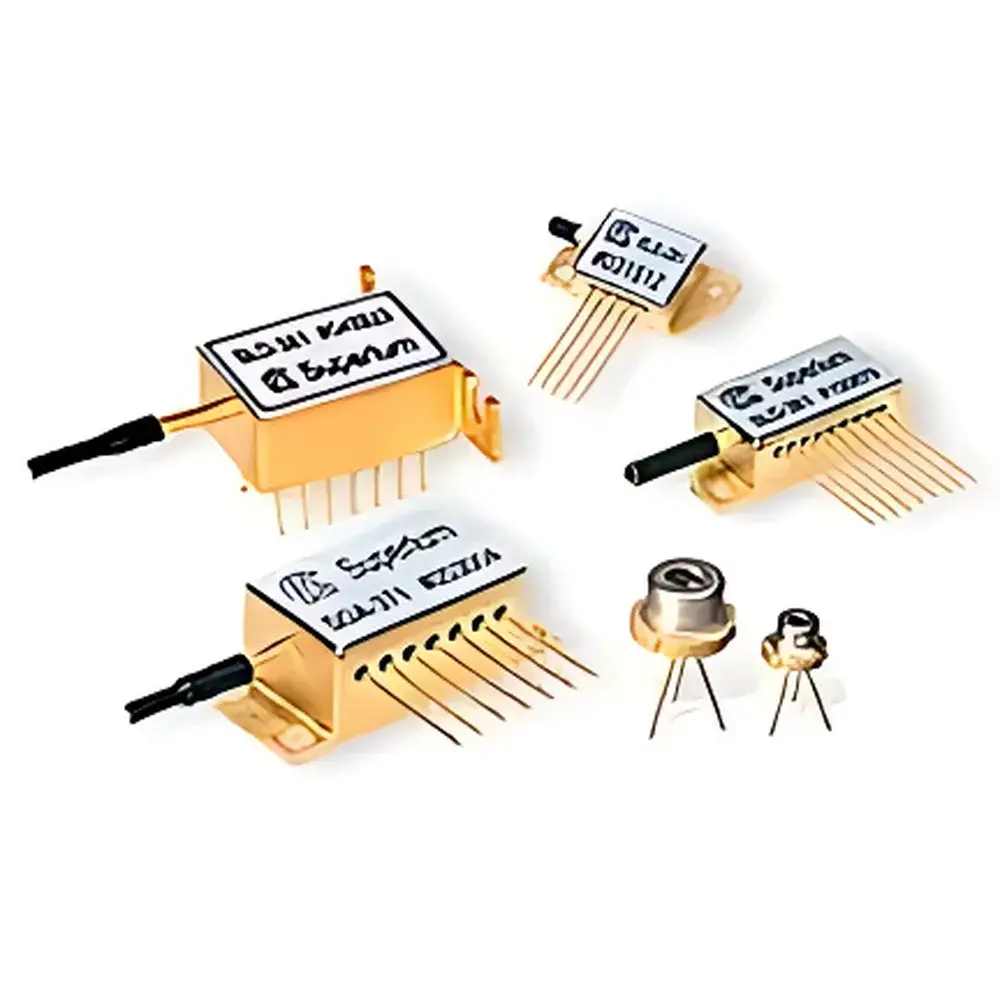
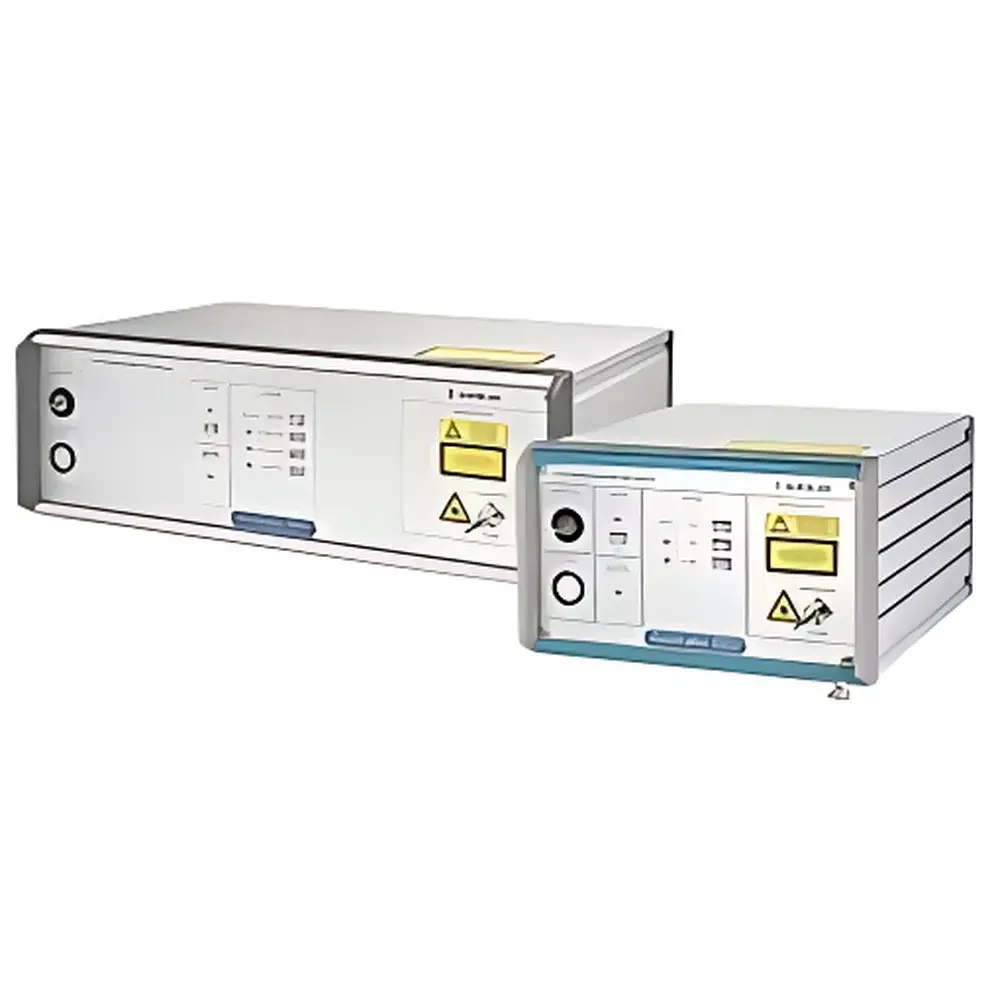
Superlum+ Superluminescent Diode (SLD) Module
| Origin | Russia |
|---|---|
| Manufacturer Type | Distributor |
| Origin Category | Imported |
| Form Factor | Benchtop Module |
| Price | €10,000 |
| Component Class | Optical Component |
Overview
The Superlum+ Superluminescent Diode (SLD) Module is a high-stability, broadband optical source engineered for applications requiring low temporal coherence, high spatial coherence, and narrow spectral ripple. Unlike laser diodes, SLDs operate below lasing threshold—emitting amplified spontaneous emission (ASE) via stimulated emission in a waveguide structure without optical feedback. This results in broad optical bandwidth (typically 20–100 nm full width at half maximum), low coherence length (<50 µm), and near-Gaussian spectral shape—ideal for interferometric sensing, optical coherence tomography (OCT), fiber optic gyroscopes (FOGs), and precision optical component characterization. The Superlum+ module integrates thermoelectric cooling (TEC), precision current control, and optical isolation to ensure long-term power stability (<±0.5% over 8 hours) and polarization-maintaining (PM) or standard single-mode fiber output.
Key Features
- Broadband ASE emission with center wavelengths available at 680 nm, 790 nm, 840 nm, 850 nm, 1050 nm, and 1300 nm—optimized for OCT system design and FOG bias stability.
- Integrated TEC and closed-loop temperature control (±0.1 °C stability) to minimize wavelength drift and spectral shape variation across ambient temperatures (15–35 °C).
- Optical output power up to 20 mW (fiber-coupled, PM or SMF-28), with power stability compliant with IEC 61290-1-2 for optical amplifier testing.
- Benchtop form factor with industry-standard 19-inch rack-mountable housing (optional), RS-232 and USB 2.0 interfaces for remote control, and analog modulation input (0–5 V) for intensity tuning.
- Compliant with EN 60825-1:2014 for Class 1M laser product safety when used with appropriate fiber termination and collimation optics.
Sample Compatibility & Compliance
The Superlum+ SLD module is compatible with standard single-mode (SMF-28, HI1060) and polarization-maintaining (PANDA, Bow-tie) fibers. It supports direct coupling into interferometric test benches, fiber-optic sensor arrays, and swept-source OCT reference arms. All units undergo factory calibration traceable to NIST-equivalent national metrology institutes in the EU. Device compliance includes RoHS 2011/65/EU, CE marking under the Low Voltage Directive (2014/35/EU) and Electromagnetic Compatibility Directive (2014/30/EU), and adherence to ISO 9001:2015 quality management protocols during final assembly and burn-in testing.
Software & Data Management
The module ships with Superlum Control Suite v3.2—a Windows-based application supporting real-time monitoring of drive current, TEC voltage, case temperature, and optical power (via integrated photodiode). Export formats include CSV and MATLAB (.mat) for post-acquisition spectral analysis. For integration into automated test systems, SCPI-compatible command sets are provided (e.g., :POWER:SET 15.0, :TEMP:SET 25.0). Audit trails, user access levels, and configuration versioning comply with GLP/GMP documentation requirements per FDA 21 CFR Part 11 when deployed in regulated R&D environments.
Applications
- Optical Coherence Tomography (OCT): Used as a broadband source in time-domain and spectral-domain OCT systems for ophthalmic imaging, dermatology, and intravascular diagnostics—enabling axial resolution down to 5–15 µm depending on bandwidth.
- Fiber Optic Gyroscopes (FOGs): Provides low-coherence light essential for minimizing Kerr effect-induced bias errors and backscatter noise in interferometric rotation sensing.
- Optical Component Testing: Characterizes insertion loss, polarization-dependent loss (PDL), and group delay dispersion (GDD) of isolators, circulators, WDM filters, and FBGs using white-light interferometry.
- Optical Simulation Platforms: Serves as a stable, tunable ASE source in hardware-in-the-loop (HIL) testbeds for photonic integrated circuit (PIC) validation and LiDAR receiver calibration.
FAQ
Is the Superlum+ SLD module suitable for use in medical-grade OCT systems?
Yes—units configured with 840 nm or 1300 nm center wavelengths meet IEC 60601-2-66 requirements for ophthalmic OCT when integrated with appropriate optical safety interlocks and beam delivery optics.
Can the output spectrum be calibrated against a reference spectrometer?
Yes—each unit includes a factory spectral calibration certificate (wavelength accuracy ±0.5 nm, resolution ≤0.2 nm), and spectral data can be exported for cross-validation with NIST-traceable optical spectrum analyzers (e.g., Yokogawa AQ6370D).
Does the module support analog modulation for swept-source OCT synchronization?
Yes—via the 0–5 V analog input port, enabling external TTL-triggered intensity ramping synchronized to A-scan acquisition clocks with jitter <10 ns.
What is the typical lifetime and warranty coverage?
Rated MTTF ≥25,000 hours at 25 °C case temperature; covered by a 24-month limited warranty including parts and labor, extendable to 36 months under annual service agreement.




