
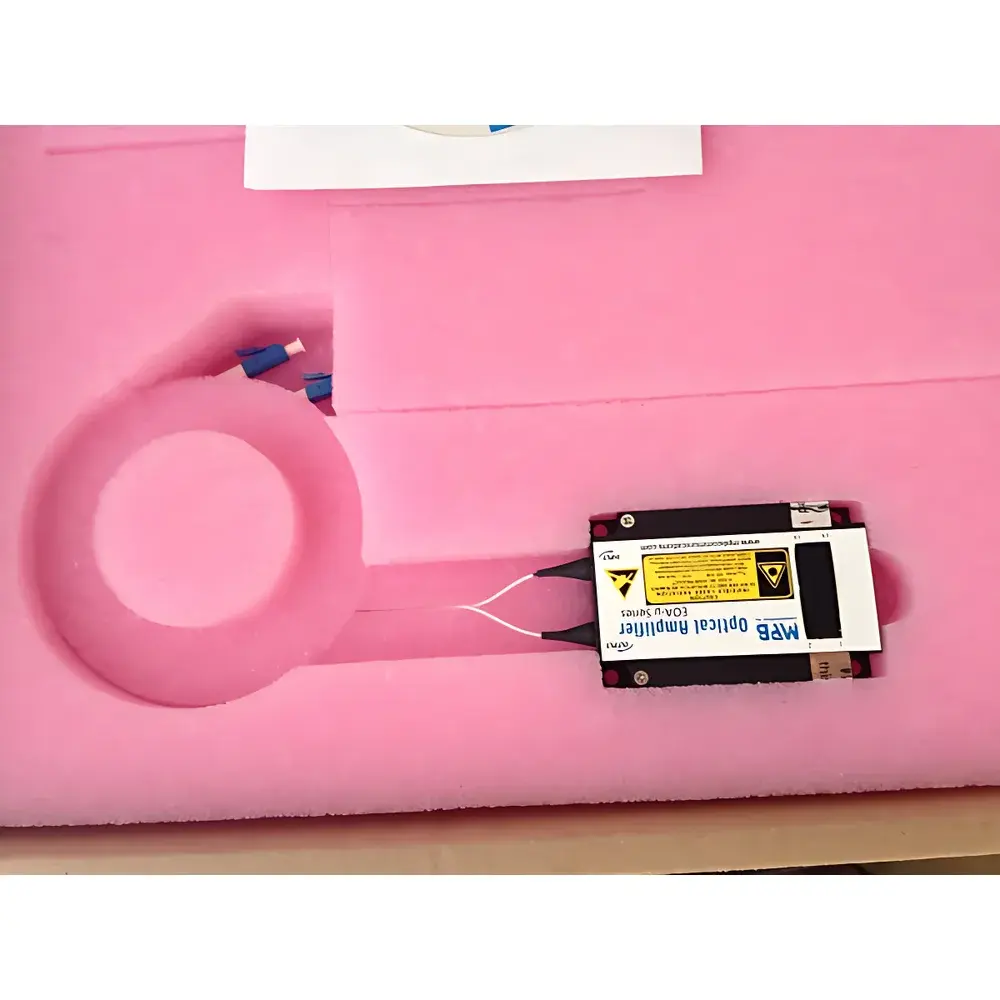
Erbium-Doped Fiber Amplifier EOA-u Series
| Origin | Canada |
|---|---|
| Manufacturer Type | Distributor |
| Origin Category | Imported |
| Model | EOA-u |
| Price | USD 5,200 (approx.) |
| Core Components | Semiconductor Laser Pump Sources & Integrated EDFA Module |
Overview
The EOA-u Series Erbium-Doped Fiber Amplifier (EDFA) is a compact, uncooled, and intelligent optical amplifier engineered for high-reliability deployment in metro, access, and embedded fiber-optic subsystems. Based on standard C-band (1530–1565 nm) or optional L-band (1570–1610 nm) erbium-doped fiber gain media, the EOA-u operates via stimulated emission under 980 nm or 1480 nm semiconductor laser pumping—delivering stable, polarization-insensitive amplification without thermoelectric coolers (TECs). Its architecture adheres to Telcordia GR-1312-CORE reliability requirements, ensuring robust performance across industrial temperature ranges (−5 °C to +70 °C case temperature) with minimal thermal drift. Designed for low-footprint integration, the module supports both pre-amplification and in-line loss compensation in single-mode SMF-28 fiber networks and meets ITU-T G.661 definitions for optical amplifier classification.
Key Features
- Saturated output power up to +20 dBm (100 mW), enabling direct interface with receivers or cascaded passive components without external attenuation
- Small-signal gain configurable up to 44 dB, supporting flexible system budget allocation in multi-node DWDM or CWDM architectures
- Noise figure as low as 3.5 dB (typ.), optimized via dual-stage pump configuration and low-loss fusion spliced pigtails (FC/APC or SC/APC options)
- Ultra-compact footprint of 45 × 70 × 12 mm — compatible with space-constrained OEM chassis, test instrumentation racks, and field-deployable units
- Typical power consumption <1.8 W at +20 dBm output, eliminating dedicated heat sinking and reducing overall system energy overhead
- Embedded digital controller with non-volatile memory for persistent configuration storage, automatic gain control (AGC), and alarm reporting (e.g., pump failure, input loss, over-temperature)
- Dual operating modes: Automatic Power Control (APC) for constant output power and Automatic Current Control (ACC) for stable pump diode bias—user-selectable via serial command or front-panel GUI
- Integrated analog monitors for real-time readout of input power (−30 to 0 dBm), output power (−10 to +23 dBm), and pump current (0–500 mA), calibrated to ±0.5 dB accuracy
Sample Compatibility & Compliance
The EOA-u is qualified for use with standard G.652.D single-mode fiber and compatible with ITU-T G.694.1 channel plans. Input and output ports feature industry-standard FC/APC or SC/APC connectors with return loss >60 dB. All units undergo 100% burn-in testing and conform to Telcordia GR-1312-CORE for shock, vibration, humidity, and long-term operational stability. RoHS 3 and REACH compliance are certified per EU Directive 2015/863. While not FDA-regulated (as a Class 1M optical product per IEC 60825-1:2014), full laser safety documentation—including accessible emission limits and interlock interface specifications—is provided in the technical manual.
Software & Data Management
Configuration and monitoring are performed via ASCII-based RS-232 or TTL-level UART (3.3 V logic) using a documented command set (AT-style syntax). A Windows-compatible graphical user interface (GUI) provides real-time plotting of gain vs. input power, noise figure estimation, and historical logging (CSV export). Firmware updates are performed in-field via bootloader mode; all parameter changes are timestamped and logged with audit-trail capability. For integration into larger test systems, SCPI-like command extensions support synchronization with optical power meters, tunable lasers, and OSA platforms. Data logs comply with GLP-aligned metadata tagging (operator ID, timestamp, firmware version, calibration epoch).
Applications
- Pre-amplification stage in low-light coherent or direct-detection receivers, improving OSNR before photodiode saturation
- Loss compensation at optical add-drop multiplexer (OADM) nodes in passive optical networks (PON) and enterprise campus backbones
- Gain staging within optical time-domain reflectometers (OTDR), tunable laser sources, and swept-wavelength interferometers
- Embedded amplification in fiber Bragg grating (FBG) sensor interrogation units and distributed acoustic sensing (DAS) front-ends
- Lab-based characterization of passive components (WDM filters, isolators, circulators) requiring stable, broadband gain flatness
FAQ
Is the EOA-u suitable for DWDM systems with channel spacing ≤100 GHz?
Yes — its gain flatness (±1.2 dB over C-band, measured with 0.1 nm resolution) supports ITU-T G.694.1-compliant 40- and 48-channel configurations when used with optional gain-flattening filters.
Does it support analog CATV transmission?
The EOA-u is not optimized for RF-over-fiber linearity (CSO/CTB specifications); however, it may be used in baseband digital links meeting SMPTE ST 2082 or IEEE 802.3av standards.
Can the module operate in burst-mode or pulsed input conditions?
No — it is designed for continuous-wave (CW) or quasi-CW optical signals only; transient response time exceeds 10 ms, making it unsuitable for GPON or XGS-PON upstream burst detection.
What calibration traceability is provided?
Each unit ships with NIST-traceable calibration certificates for input/output power monitors, referenced to Hamamatsu PDM series photodetectors and calibrated against NRC (Canada) primary standards.
Is remote firmware update supported over Ethernet or USB?
Firmware updates require direct UART connection; however, USB-to-serial adapters and Ethernet-to-serial gateways (e.g., Moxa NPort) are validated for integration in centralized network management environments.



