
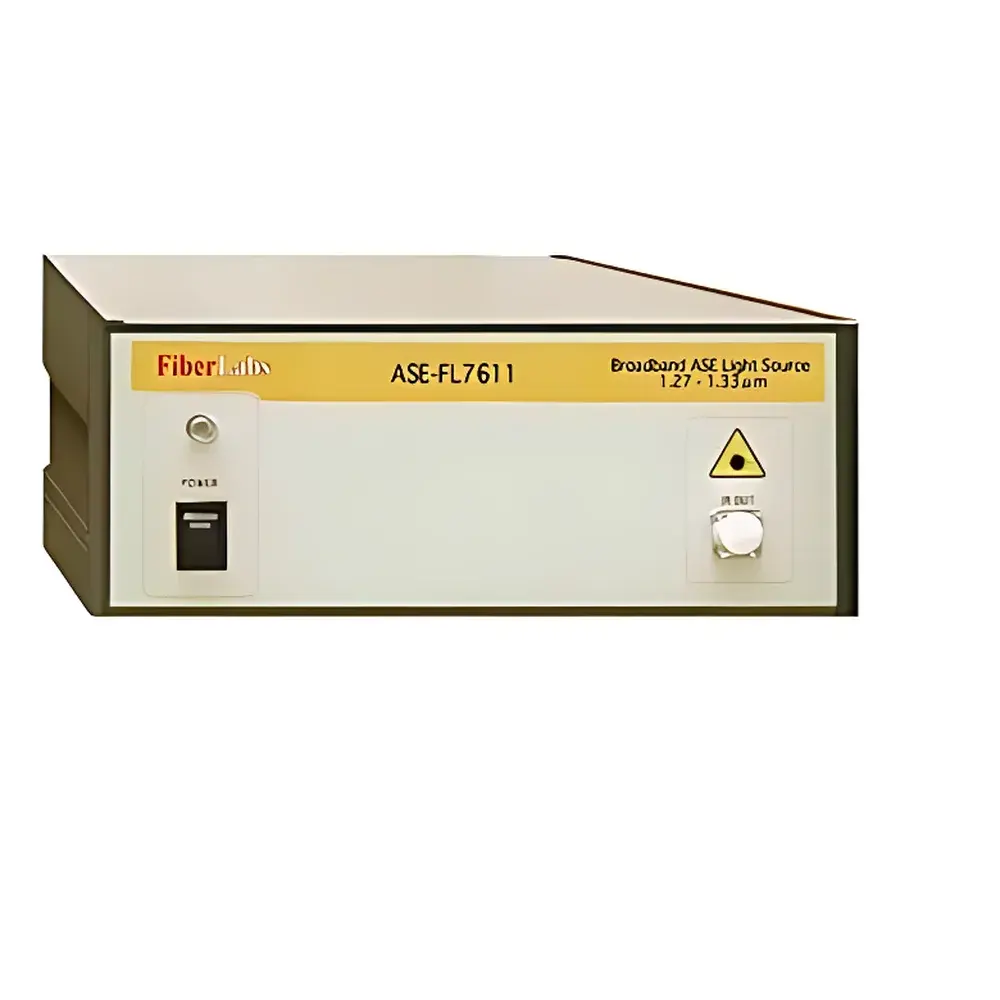
Fiberlabs ASE-1550-25 Broadband Light Source
| Origin | Japan |
|---|---|
| Manufacturer Type | Distributor |
| Origin Category | Imported |
| Model | AD1109F |
| Light Source Type | Amplified Spontaneous Emission (ASE) Source |
| Illumination Mode | External Illumination |
| Output Band | C-band (1530–1570 nm) |
| Output Power | >14 dBm (>25 mW) |
| Spectral Power Density | >−10 dBm/nm @ 1530–1560 nm |
| Power Stability | < ±0.005 dB (typical < ±0.001 dB, measured after 1-hr warm-up, over 15 min) |
| Output Fiber | SMF-28 |
| Connector | FC/PC |
| Dimensions | 66(H) × 160(W) × 230(D) mm (excl. protrusions) |
| Operating Temperature | 0–40 °C |
| Storage Temperature | −10–60 °C |
| Weight | 3 kg |
| Input Power | AC 100–240 V, 50/60 Hz |
Overview
The Fiberlabs ASE-1550-25 is a high-stability, C-band amplified spontaneous emission (ASE) broadband light source engineered for precision optical characterization in research laboratories and industrial test environments. Operating on the fundamental principle of stimulated emission in doped fiber amplifiers—without optical feedback—it generates spectrally smooth, incoherent output across the 1530–1570 nm wavelength range. Unlike laser-based or filtered lamp sources, ASE technology delivers inherently low temporal coherence and minimal mode noise, making it ideal for applications requiring stable spectral power density and immunity to interference fringes. This device is specifically optimized for use in optical component testing, interferometric sensor calibration, and as a seed source in swept-wavelength systems where spectral flatness and long-term power repeatability are critical performance criteria.
Key Features
- High-output ASE spectrum with >25 mW (14 dBm) total power in the C-band, enabling sufficient signal-to-noise ratio for low-loss device insertion loss measurements;
- Exceptional spectral flatness: >−10 dBm/nm power density maintained across 1530–1560 nm, reducing the need for real-time spectral correction in calibrated photodetector setups;
- Ultra-low power drift: < ±0.005 dB stability over 15 minutes (after 60-minute thermal stabilization), meeting stringent requirements for GLP-compliant optical test procedures;
- Integrated single-mode (SMF-28) pigtail with FC/PC connector ensures low back-reflection coupling into interferometers, WDM components, and fiber Bragg grating (FBG) interrogation systems;
- Compact benchtop form factor (66 × 160 × 230 mm) with universal AC input (100–240 V, 50/60 Hz), supporting deployment in multi-instrument racks without external power conditioning;
- Thermally managed architecture with internal temperature monitoring ensures consistent spectral centroid and bandwidth under ambient fluctuations between 0–40 °C.
Sample Compatibility & Compliance
The ASE-1550-25 is compatible with standard silica-based single-mode optical components including isolators, circulators, couplers, tunable filters, and passive multiplexers. Its low-coherence output eliminates speckle and etalon artifacts during spectral response mapping of thin-film filters or arrayed waveguide gratings (AWGs). The unit complies with IEC 61347-1 (lamp control gear safety), IEC 60825-1 (laser product classification—Class 1M per EN 60825-1:2014 due to enclosed ASE fiber output), and meets electromagnetic compatibility requirements per CISPR 11 Group 1, Class B. While not certified to FDA 21 CFR Part 11, its analog output stability and onboard thermal logging support audit-ready documentation for ISO/IEC 17025-accredited calibration labs performing optical attenuation or spectral transmittance validation per ASTM E275 and IEC 61290-1-1.
Software & Data Management
This ASE source operates as a standalone analog instrument with no embedded microcontroller or USB interface. All operational parameters—including output power level, thermal status, and runtime—are monitored via front-panel LED indicators and factory-calibrated analog monitoring outputs (0–5 V proportional to optical power). For integration into automated test systems, users may connect the monitor port to a DAQ system (e.g., National Instruments PXIe-6363) and synchronize measurements using TTL trigger inputs. Raw stability data (±0.001 dB typical) supports traceable uncertainty budgets compliant with GUM (JCGM 100:2008) when paired with NIST-traceable optical power meters (e.g., Keysight N7744A). No proprietary software or drivers are required; configuration remains fully hardware-defined for deterministic behavior in mission-critical optical test benches.
Applications
- Insertion loss and polarization-dependent loss (PDL) characterization of passive DWDM components;
- Benchmarking spectral responsivity of InGaAs photodiodes and optical spectrum analyzers (OSAs);
- Calibration reference for optical time-domain reflectometers (OTDRs) operating in the C-band;
- Stimulated Brillouin scattering (SBS) threshold measurement in specialty fibers;
- Reference illumination in fiber-optic gyroscopes (FOGs) and Michelson/Mach-Zehnder interferometric sensors;
- Seed source for erbium-doped fiber amplifiers (EDFAs) used in metrology-grade wavelength-swept lasers.
FAQ
Is this device classified as a laser product?
No. It is an ASE broadband source emitting incoherent light and is certified as Class 1M under EN 60825-1:2014 when used with the supplied FC/PC-connected SMF pigtail.
Can the output spectrum be tuned or filtered externally?
Yes. The ASE spectrum is inherently broad and continuous; users routinely integrate tunable bandpass filters (e.g., Finisar WaveShaper) or diffraction grating monochromators downstream for wavelength-selective measurements.
What is the recommended warm-up time before achieving specified stability?
Minimum 60 minutes at constant ambient temperature is required to reach thermal equilibrium; stability specifications apply only after this period.
Does the unit include optical isolation?
No internal isolator is integrated; however, the output is designed for direct coupling into low-back-reflection components. An external 30 dB polarization-independent isolator is recommended for sensitive interferometric applications.
Is SMF-28 the only supported fiber type?
The device is factory-terminated with SMF-28. Custom pigtails (e.g., PM1550, HI1060) can be ordered as OEM options but require recalibration and extended lead time.






