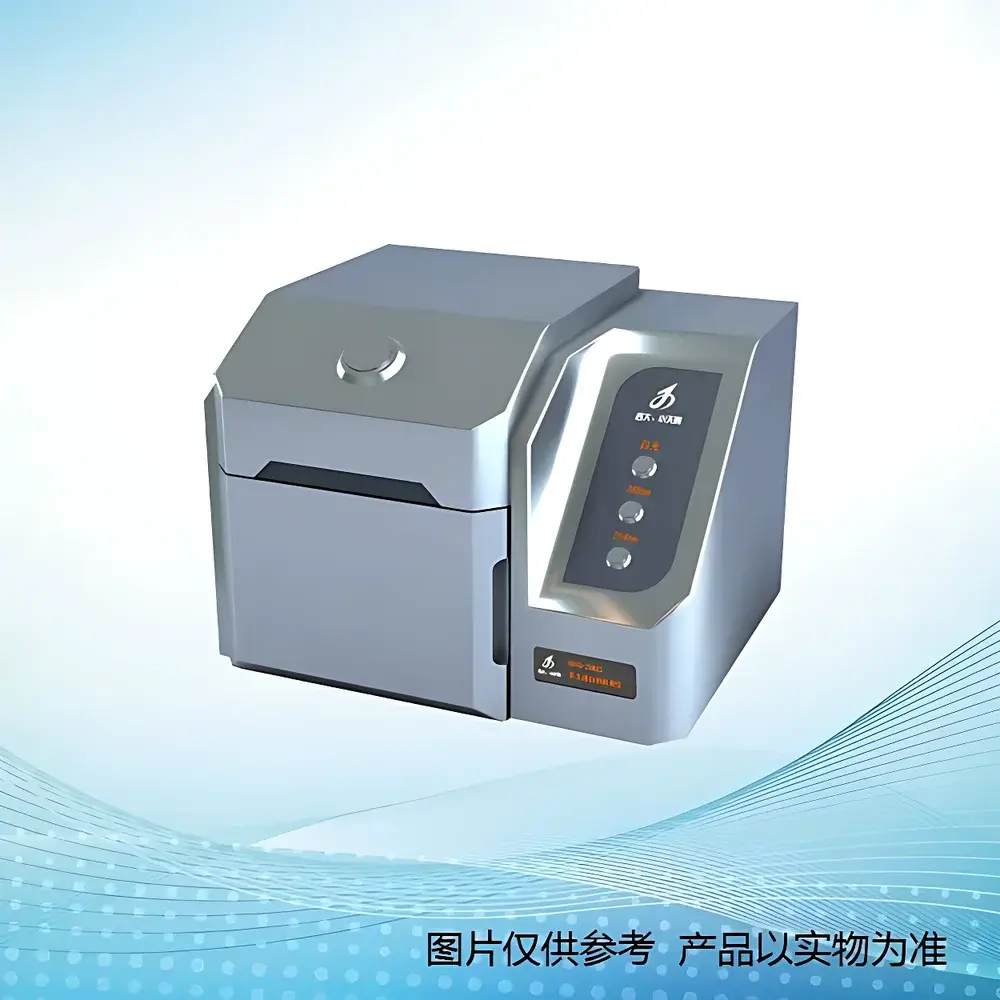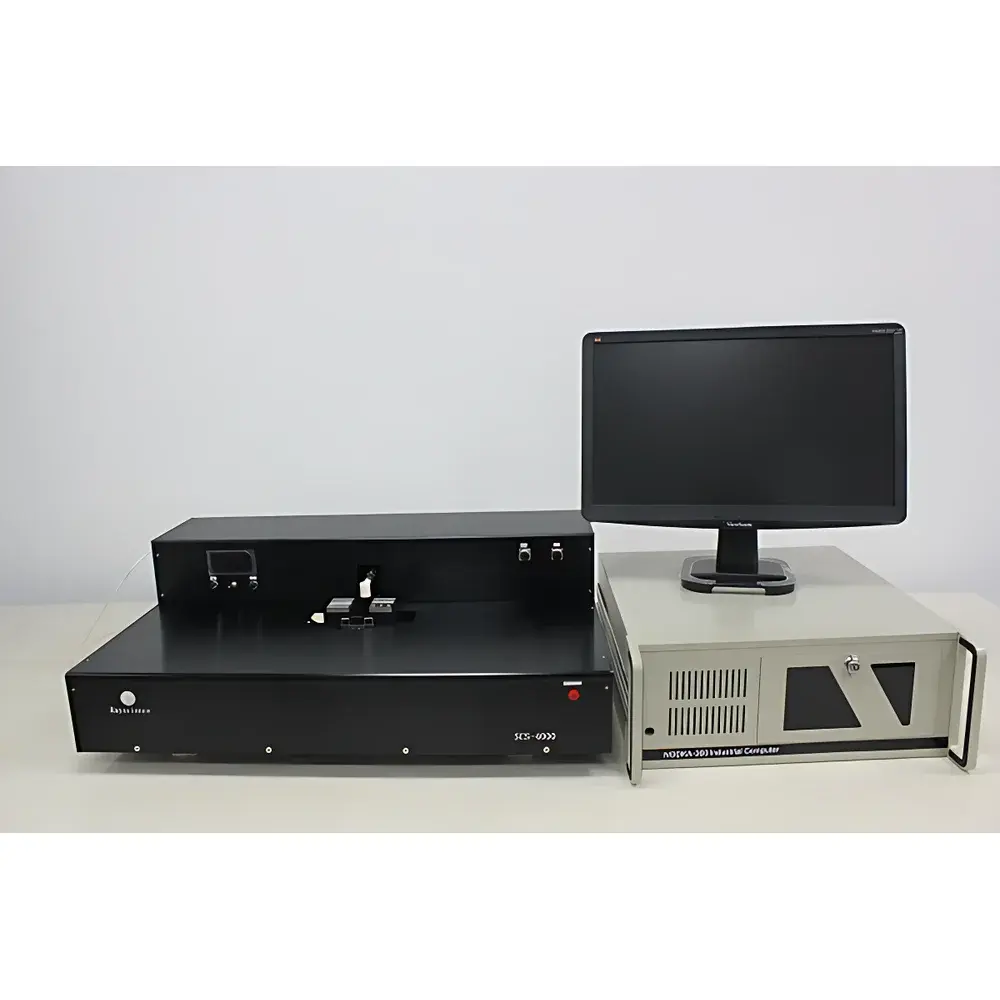
Shanghai Shinmo SCS-4000-P Polarization-Maintaining Fiber Coupler Fusion Tapering System
| Origin | Hong Kong |
|---|---|
| Manufacturer Type | Authorized Distributor |
| Regional Origin | Mainland China |
| Model | SCS-4000-P |
| Price | USD 4,890,000 (FOB Hong Kong) |
| Tapering Precision | ±0.2 µm |
| Max. Bidirectional Stretch Distance | 80 mm |
| Fiber Clamping Diameter Range | φ0.1–0.5 mm |
| Flame Axial Oscillation Range | 0–20 mm |
| H₂ Flow Rate | 0–500 SCCM (adjustable) |
| O₂ Flow Rate | 0–200 SCCM (adjustable) |
| Heating Zone Temperature Control | 0–200 °C (for encapsulation) |
| Wavelength Detection Range | InGaAs (800–1700 nm), Si (400–1000 nm), Ge (1000–1800 nm) |
| Light Sources | 1310/1550 nm FP laser (1 mW), 633 nm HeNe (2 mW), 850/1310 nm multimode LD (optional) |
Overview
The Shanghai Shinmo SCS-4000-P Polarization-Maintaining Fiber Coupler Fusion Tapering System is a precision-engineered platform designed for the reproducible fabrication of polarization-maintaining (PM) fiber couplers, fused biconical taper (FBT) devices, and specialty fiber waveguide structures. It operates on the principle of controlled thermal fusion and axial stretching under inert or reactive gas environments—specifically hydrogen-oxygen flame heating—to induce evanescent field coupling between stripped PM fibers. The system enables deterministic control over taper profile, coupling ratio, and polarization extinction ratio by synchronizing flame position, temperature gradient, fiber translation speed, and gas flow dynamics. Its architecture supports both standard single-mode and high-birefringence PM fibers (e.g., PANDA, Bow-Tie), with integrated optical monitoring to validate mode evolution during real-time tapering.
Key Features
- Proprietary coaxial hydrogen-inner/oxygen-outer burner design ensures stable, uniform thermal profiles—eliminating temperature drift associated with conventional dual-oxygen configurations.
- High-resolution bidirectional stretching mechanism with imported linear guides and precision-ground ball screws (pitch: 2 mm), delivering ±0.2 µm positional repeatability and maximum 40 mm unilateral extension per side.
- Programmable flame scanning amplitude, velocity, and dwell time synchronized with stretch rate and thermal feedback—enabling adaptive taper profile synthesis (e.g., adiabatic, exponential, or parabolic).
- Modular optical detection subsystem with interchangeable InGaAs, Si, and Ge photodetectors covering 400–1800 nm; compatible with multiple calibrated light sources including 1310/1550 nm FP lasers, 633 nm HeNe, and multimode LDs.
- CCD-based real-time alignment visualization system (optional) for core-to-core positioning verification during PM fiber rotation and axis alignment—critical for maintaining high extinction ratio in birefringent coupling.
- Integrated thermal encapsulation station with PID-controlled heating (0–200 °C), supporting both thermal-cure epoxy and UV-curable resin options for hermetic packaging of tapered devices.
Sample Compatibility & Compliance
The SCS-4000-P accommodates PM fibers with cladding diameters from 125 µm to 500 µm (coated or stripped), including Panda-type, Bow-Tie, and elliptical-clad designs. It supports both parallel-fusion and loop-fusion geometries. All operational parameters—including flame stoichiometry, stretch velocity, and thermal ramp rates—are programmable to meet device-specific requirements defined in IEC 61300-2-4 (fiber optic interconnecting devices), Telcordia GR-1209-CORE (reliability of passive components), and ISO/IEC 17025-compliant calibration traceability protocols. The system’s software logs all process variables with timestamped metadata, satisfying GLP/GMP audit trail requirements for R&D and pre-production qualification.
Software & Data Management
The embedded control interface provides full parameter scripting via intuitive GUI, enabling repeatable recipe storage for device families (e.g., 50:50 PM couplers at 1550 nm). Process data—including H₂/O₂ flow rates, flame position coordinates, stretch displacement, real-time optical power transmission, and thermal sensor readings—is streamed to local storage with CSV export capability. Audit-ready logging complies with FDA 21 CFR Part 11 requirements when paired with user-defined electronic signatures and role-based access control (available via optional enterprise license). Raw detector signals are digitized at ≥16-bit resolution with 1 kHz sampling, ensuring fidelity for post-process modal analysis.
Applications
- Fabrication of polarization-maintaining couplers for interferometric fiber optic gyroscopes (FOGs) and coherent detection systems.
- Development of wavelength-selective FBT filters and polarization beam splitters for quantum photonics and sensing platforms.
- R&D of low-loss, high-extinction-ratio couplers for aerospace-grade avionics and submarine communication repeaters.
- Prototyping of specialty tapers for mode-field adapters, fiber Bragg grating (FBG) interrogation, and nonlinear frequency conversion.
- Process validation and failure analysis of fused PM devices under accelerated aging conditions per MIL-STD-883.
FAQ
What fiber types are supported for PM coupler fabrication?
Standard Panda and Bow-Tie PM fibers with 80–125 µm core/cladding configurations, as well as custom elliptical-clad designs up to 500 µm outer diameter.
Is flame temperature directly measured or inferred?
Temperature is inferred via calibrated pyrometric mapping of flame emissivity and validated through thermographic correlation with reference blackbody sources—not via direct probe insertion.
Can the system produce couplers with asymmetric splitting ratios?
Yes—splitting ratios from 1:99 to 99:1 are achievable with ±5% tolerance (e.g., 50:50 ±2.5%) through precise control of taper length, waist diameter, and inter-fiber gap.
Does the system support automated pass/fail criteria during tapering?
Real-time optical power monitoring triggers configurable alarms but does not auto-terminate; final pass/fail judgment requires post-process characterization per IEC 61300-3-4.
Are OEM integration options available for factory automation?
Yes—RS-232, Ethernet TCP/IP, and Modbus RTU interfaces enable PLC-level integration; API documentation and LabVIEW drivers are provided under NDA.