
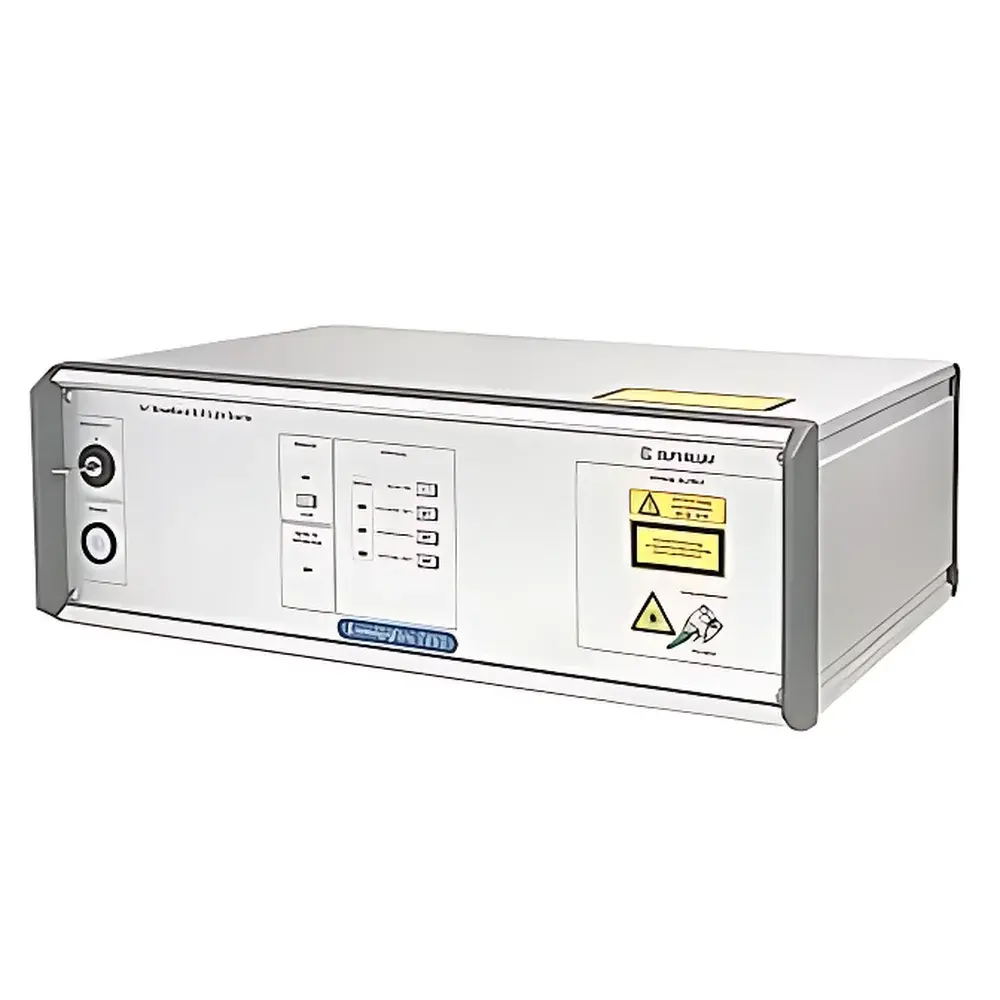
Superlum T-series and Q-series Benchtop SLD Broadband Light Sources
| Brand | Superlum |
|---|---|
| Origin | Russia |
| Model Series | T-series (3-SLD module coupling), Q-series (4-SLD module coupling) |
| Wavelength Ranges | 760–960 nm (T-series), 790–1090 nm / 1270–1470 nm / 1300–1550 nm (Q-series) |
| Output Power | 5–300 mW (model-dependent) |
| Spectral Bandwidth (FWHM) | 40–200 nm (model-dependent) |
| Integrated Optical Isolator | Yes (select models: T-850-HP-I, T-860-HP-I) |
| Illumination Mode | External (free-space or fiber-coupled output) |
| Compliance | CE-marked, RoHS-compliant |
Overview
Superlum T-series and Q-series benchtop superluminescent diode (SLD) broadband light sources are engineered for high-stability, low-coherence illumination in precision optical metrology, interferometry, and biomedical imaging applications. Unlike conventional thermal or arc-based lamps, these sources leverage multi-element SLD chip arrays operating under precisely regulated current and temperature control to generate smooth, Gaussian-like spectral profiles with minimal ripple and exceptional temporal coherence suppression. The T-series integrates three spectrally aligned SLD modules into a single compact chassis, while the Q-series employs four independently optimized modules—enabling broader composite bandwidths across near-infrared (NIR) and short-wave infrared (SWIR) windows critical for optical coherence tomography (OCT), fiber-optic gyroscopes (FOG), and dispersion measurement systems. All units feature active thermal stabilization and low-noise current drivers to ensure long-term power stability (<±0.5% over 8 hours) and wavelength repeatability (±0.1 nm).
Key Features
- Multi-module architecture: T-series (3-SLD), Q-series (4-SLD) — enabling extended spectral coverage without sacrificing spectral smoothness or spatial mode quality
- Factory-calibrated spectral output: Each model is characterized with NIST-traceable spectroradiometric calibration; spectral data provided as ASCII files for integration into system modeling tools
- Integrated optical isolators (on designated models): >30 dB return loss prevents back-reflection-induced instability in sensitive interferometric setups
- Programmable analog/digital interface: 0–5 V analog modulation input and RS-232/USB 2.0 digital control support remote power ramping, on/off sequencing, and fault logging
- Low polarization-dependent loss (PDL 20 dB) — essential for polarization-sensitive OCT and ellipsometry
- EMC-compliant enclosure with IEC 61000-4-3 immunity and conducted emission compliance per CISPR 11 Class B
Sample Compatibility & Compliance
The T- and Q-series sources are designed for direct coupling into single-mode (SMF-28, HI1060) and polarization-maintaining (PM980, PANDA) fibers via FC/APC or FC/PC connectors. Free-space collimated output options (with adjustable focus and beam diameter ≤ 2.5 mm) are available upon request. All units comply with EU Directive 2014/30/EU (EMC), 2011/65/EU (RoHS), and carry CE marking for laboratory use within the European Economic Area. They meet the mechanical and environmental requirements of IEC 61010-1 for safety in electrical equipment for measurement, control, and laboratory use. While not certified for clinical deployment under IEC 60601-1, their optical output characteristics align with ISO 13697:2021 (non-laser broadband sources) and support GLP-compliant documentation workflows when paired with calibrated photodetectors and spectral analyzers.
Software & Data Management
Superlum provides the free SLD Control Suite v3.2 — a Windows-based application supporting real-time power monitoring, spectral snapshot acquisition (via optional USB spectrometer integration), and automated calibration file loading. The software exports time-stamped power logs in CSV format compliant with ASTM E2917-21 (standard practice for recording instrument performance data). For integration into automated test environments, DLL libraries and Python API wrappers are supplied, enabling full control from LabVIEW, MATLAB, or custom C++ applications. Audit trail functionality records all parameter changes with user ID, timestamp, and IP address (when network-enabled), satisfying basic FDA 21 CFR Part 11 requirements for electronic records in non-GMP research settings.
Applications
- Time-domain and Fourier-domain Optical Coherence Tomography (TD-OCT, FD-OCT) systems requiring high axial resolution and low autocorrelation sidelobes
- Fiber-optic sensor interrogation — including white-light interferometric strain/temperature sensors and distributed acoustic sensing (DAS) reference sources
- Calibration of spectrometers, optical spectrum analyzers (OSAs), and wavelength meters across 760–1550 nm
- Dispersion characterization of optical components (e.g., chirped mirrors, Gires-Tournois interferometers) using white-light interferometry
- Development of swept-source OCT engines where broadband seed sources improve sensitivity roll-off performance
- Photonic integrated circuit (PIC) testing, particularly for silicon photonics platforms operating in O-, E-, S-, C-, and L-bands
FAQ
What is the typical coherence length for T-870-HP and Q-1430-HP models?
Coherence length is inversely proportional to spectral bandwidth. For T-870-HP (Δλ ≈ 180 nm at 870 nm), typical coherence length is ~5 µm in air; for Q-1430-HP (Δλ ≈ 250 nm at 1430 nm), it is ~6 µm. Exact values depend on refractive index of the propagation medium and require interferometric verification per ISO 15529.
Can these sources be synchronized with external trigger signals?
Yes — all models support TTL-compatible external triggering (rising-edge) for gated operation with jitter < 50 ns, enabling synchronization with camera exposure, scanner motion, or pulsed pump lasers.
Is fiber pigtail replacement possible in the field?
Fiber pigtails are factory-terminated and hermetically sealed; replacement requires return-to-factory service to maintain spectral and power specifications. Field-replaceable collimator options are available for free-space configurations.
Do Q-series models support simultaneous dual-band output?
No — each Q-series unit operates in a single preconfigured band (e.g., 790–1090 nm OR 1270–1470 nm). Dual-band operation requires two independent units or custom OEM integration with wavelength multiplexing optics.




