
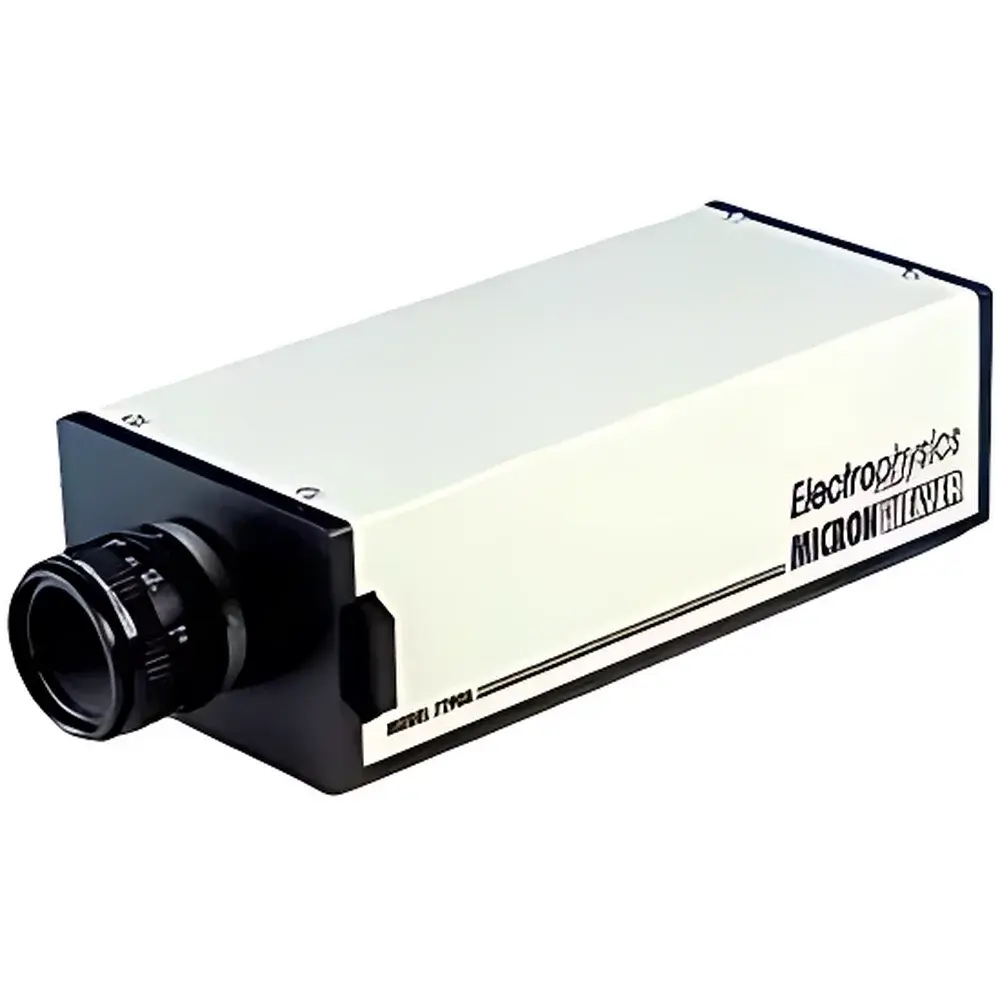
Electrophysics MicronViewer 7290A-06 Near-Infrared Intensified Vidicon Camera
| Brand | Electrophysics |
|---|---|
| Origin | USA |
| Model | 7290A-06 |
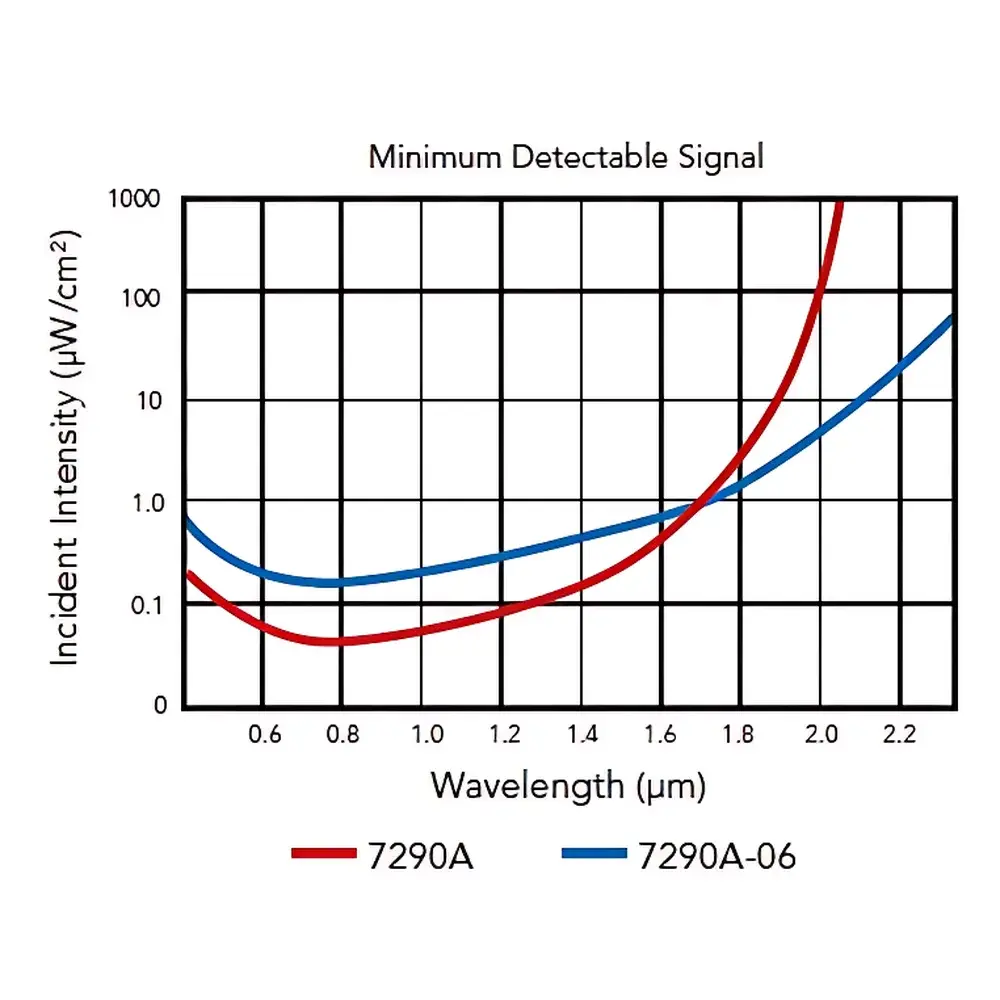
| Spectral Range | 0.4–2.2 µm |
| Sensitivity | <0.1 µW/cm² @ 0.5–1.3 µm, <1 µW/cm² @ 1.3–1.7 µm |
| Damage Threshold | 1 mW/cm² (CW), 10 mJ (pulsed) |
| Resolution | Up to 650 TV lines |
| Dynamic Range | 50:1 |
| SNR | 55 dB (p-p/rms) |
| Target Area | 9.5 × 12.7 mm |
| Video Output | CCIR (50 Hz) or RS-170 (60 Hz) |
| Gain Control | 3-step manual or auto |
| Mount | C-mount |
| Filter Holder | 1-inch threaded |
| Tripod Socket | 1/4"-20 |
Overview
The Electrophysics MicronViewer 7290A-06 is a high-sensitivity, non-cooled near-infrared (NIR) intensified vidicon camera engineered for low-light imaging applications requiring spectral response beyond the visible range. Unlike silicon-based CCD or CMOS sensors, the 7290A-06 employs a lead oxide–sulfide (PbO–PbS) photoconductive vidicon tube with an active imaging area of 9.5 × 12.7 mm — optimized for photon-limited conditions where quantum efficiency and thermal stability are critical. Its extended spectral sensitivity from 0.4 µm to 2.2 µm (enabled by the -06 spectral extension option) supports detection of both visible laser emissions and SWIR radiation from semiconductor luminescence, thermal signatures above 250 °C, and fiber-coupled NIR sources. Designed for integration into optical benches, OEM inspection platforms, and laboratory test setups, the camera operates without cryogenic cooling — reducing power consumption, mechanical complexity, and system footprint while maintaining robust signal-to-noise performance under ambient conditions.
Key Features
- Lead-oxide/sulfide (PbO–PbS) vidicon tube with high quantum efficiency across 0.4–2.2 µm; no thermoelectric or liquid-nitrogen cooling required
- C-mount lens interface compatible with standard industrial and scientific optics; integrated 1-inch filter thread for rapid spectral band selection
- Three-position manual gain control or automatic gain adjustment for adaptive exposure in variable illumination environments
- Dual-standard video output: selectable RS-170 (60 Hz) or CCIR (50 Hz) analog composite signal — compliant with legacy frame grabbers and real-time monitoring systems
- Synchronization input port for external trigger alignment with pulsed lasers, gated illumination, or time-resolved measurements
- Compact, ruggedized aluminum housing with 1/4″-20 tripod socket and standardized mounting flange for benchtop or embedded integration
- Damage threshold rated at 1 mW/cm² continuous wave and 10 mJ per pulse — suitable for alignment of Class 3B and 4 laser systems when used with appropriate attenuation
Sample Compatibility & Compliance
The MicronViewer 7290A-06 is routinely deployed in environments governed by ISO/IEC 17025-accredited calibration laboratories and GLP-compliant R&D facilities. Its analog video architecture ensures compatibility with FDA 21 CFR Part 11–aligned data acquisition systems when paired with validated frame grabbers and timestamped storage workflows. While the camera itself does not generate digital audit trails, its deterministic analog output enables traceable image capture when integrated with NIST-traceable photometric calibration sources (e.g., tungsten-halogen standards per ASTM E308). The device meets CE marking requirements for electromagnetic compatibility (EN 61326-1) and safety (EN 61010-1), and its PbO–PbS detector complies with RoHS exemption 7c-I for lead in electronic ceramic components. For semiconductor wafer inspection, it supports alignment with SEMI E10 guidelines for measurement equipment verification through periodic responsivity checks using calibrated NIR LED arrays.
Software & Data Management
As an analog-output imaging device, the 7290A-06 interfaces directly with industry-standard frame grabbers (e.g., National Instruments PCIe-1433, BitFlow Axion-CL) supporting GenICam-compliant drivers or custom LabVIEW/Vision Builder AI acquisition modules. Electrophysics provides hardware-level documentation including pinout schematics, sync timing diagrams, and gain-response curves — enabling full characterization within MATLAB Image Processing Toolbox or Python-based OpenCV pipelines. When integrated into automated test systems, the camera’s analog signal can be digitized at 8-bit or 10-bit depth with configurable ROI readout, facilitating quantitative intensity profiling for beam centroid analysis (per ISO 11146), fiber coupling efficiency mapping, or thermal gradient tracking. Optional software development kits (SDKs) from third-party frame grabber vendors support metadata embedding (exposure time, gain setting, filter ID) in AVI or TIFF containers — ensuring compliance with internal QA documentation protocols.
Applications
- Laser beam profiling and M² measurement of diode-pumped solid-state (DPSS) and fiber lasers operating at 1064 nm, 1550 nm, or 1950 nm
- Single-mode and multimode optical fiber end-face inspection, cleave quality assessment, and coupling alignment verification
- Non-contact thermal monitoring of microelectronic packages during burn-in testing or failure analysis (≥250 °C blackbody emission)
- Moisture detection in polymer films and composites via SWIR absorption spectroscopy (1450 nm, 1940 nm water bands)
- Photoluminescence imaging of III-V semiconductor wafers (InGaAs, GaSb) and quantum dot structures
- Active illumination surveillance in defense and aerospace contexts using covert 1550 nm laser illumination
FAQ
Is the 7290A-06 suitable for quantitative radiometric measurements?
Yes — when calibrated against NIST-traceable sources and used with linear-gain settings, the vidicon’s analog output supports relative irradiance mapping. Absolute calibration requires empirical correction for spatial non-uniformity and spectral responsivity roll-off.
Can I use standard C-mount lenses designed for visible light?
Most visible-optimized lenses exhibit significant chromatic aberration and transmission loss beyond 1.7 µm. Electrophysics recommends SWIR-optimized lenses (e.g., Edmund Optics #67-725 or Thorlabs AC254-050-SWIR) for optimal resolution and throughput in the 2.2 µm band.
What is the recommended warm-up time before stable operation?
Allow 15 minutes for thermal equilibrium of the vidicon tube and associated high-voltage supply to ensure consistent dark current and gain stability.
Does the camera support GenICam or USB3 Vision protocols?
No — the 7290A-06 outputs analog composite video only. Digital interface requires external frame grabbing hardware with appropriate driver support.
How is the 1-inch filter holder dimensioned, and what thread standard does it follow?
The filter mount accepts 25.4 mm (1 inch) diameter filters with SM1 (1.035″-40) internal threading — compatible with Thorlabs, Newport, and Edmund Optics filter product lines.





