
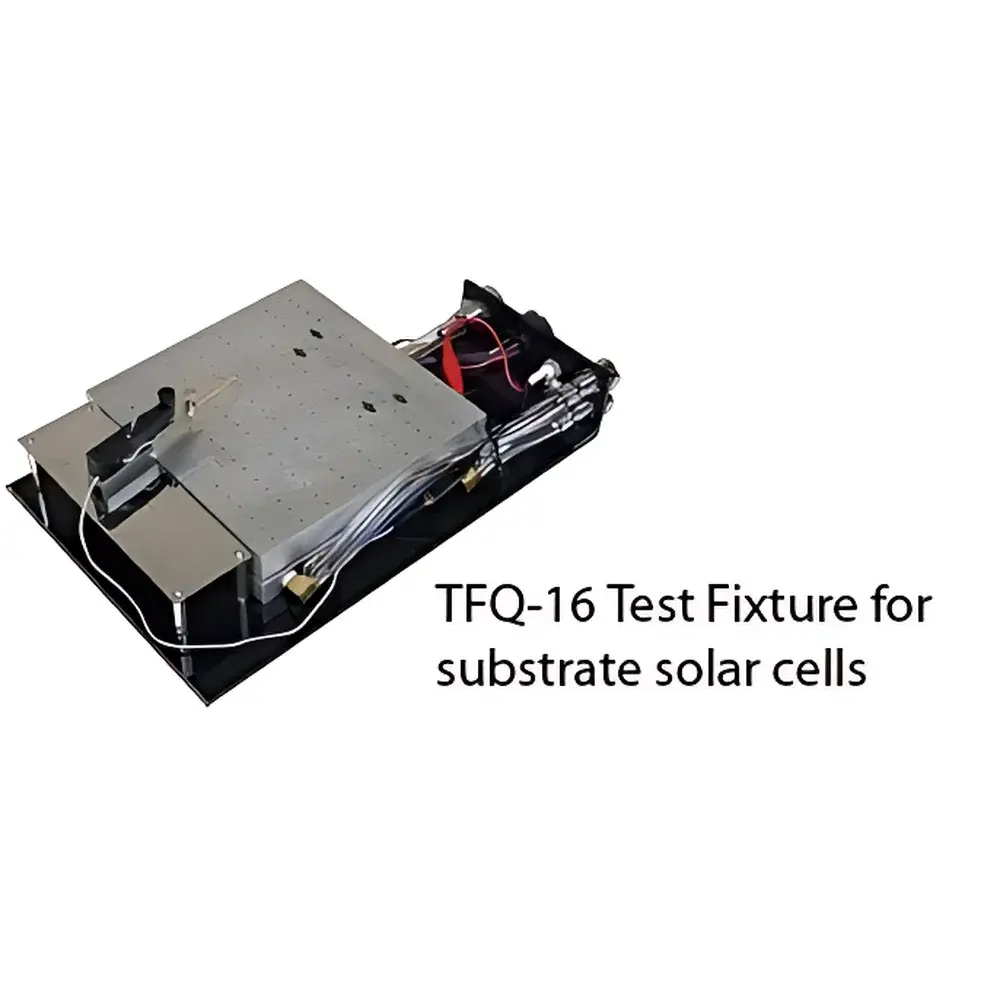
PV Measurements PVM Series IV & QE Test Probe Station
| Brand | PV Measurements |
|---|---|
| Origin | USA |
| Manufacturer Type | Authorized Distributor |
| Product Category | Imported Instrument |
| Model | PVM Test Fixtures |
| Pricing | Available Upon Request |
Overview
The PV Measurements PVM Series IV & QE Test Probe Station is a precision-engineered platform designed specifically for photovoltaic (PV) device characterization under controlled laboratory conditions. It supports both current–voltage (I–V) curve tracing and quantum efficiency (QE), also known as external quantum efficiency (EQE) or spectral response (SR), measurements on solar cells and mini-modules. The system operates on the principle of low-noise, four-terminal (Kelvin) probing to eliminate lead resistance errors during I–V acquisition, while its optomechanical architecture enables uniform, collimated illumination alignment with minimal shadowing—critical for high-fidelity spectral responsivity mapping. Built for compatibility with standard solar simulators (Class AAA, ABA, or AAB per IEC 60904-9) and monochromator-based EQE systems, the PVM probe station serves as a foundational interface between the device under test (DUT) and metrology-grade instrumentation including source-measure units (SMUs), lock-in amplifiers, and calibrated reference detectors.
Key Features
- Modular, vacuum-compatible sample stage with fine Z-axis adjustment (±5 mm travel, 1 µm resolution) for precise probe-to-sample contact control
- Low-shadow probe arm configuration with tungsten-carbide or beryllium-copper tips; tip pitch configurable from 0.5 mm to 25 mm to accommodate single-junction, tandem, and multi-busbar cell geometries
- Integrated thermal management options—including thermoelectric cooling (−10 °C to +80 °C) and optional liquid-nitrogen cold finger mounts—for temperature-dependent I–V and QE analysis per IEC 61215 and IEC 61646
- Optical access ports (Ø25 mm clear aperture) aligned orthogonal to probe plane for simultaneous top-illumination and bottom-contact probing
- ESD-safe construction compliant with ANSI/ESD S20.20; all conductive surfaces grounded via 1 MΩ current-limiting resistors
- Mounting interfaces compatible with standard optical tables (M6 or 1/4″-20 tapped holes) and integration-ready for automated XY stages (optional)
Sample Compatibility & Compliance
The PVM probe station accommodates substrates ranging from 5 × 5 mm² lab-scale perovskite cells to 156 × 156 mm² commercial silicon wafers (with extended-stage variants). It supports rigid (Si, GaAs, CIGS), flexible (organic PV, thin-film on PET), and textured surfaces without requiring adhesive mounting—relying instead on vacuum chuck or mechanical clamping with adjustable pressure. All electrical connections conform to IEEE 1139 definitions for DC and low-frequency AC signal integrity. The system meets mechanical safety requirements outlined in IEC 61010-1 for laboratory electrical equipment and is routinely deployed in ISO/IEC 17025-accredited PV testing labs performing calibration traceable to NIST SRM standards.
Software & Data Management
While the PVM probe station itself is hardware-only, it is fully interoperable with industry-standard data acquisition environments including Keysight PathWave, Keithley TestScript Studio, and Python-based frameworks (e.g., PyVISA + NumPy + SciPy). When paired with SMUs supporting SCPI command sets, the station enables automated sweep sequencing (voltage ramp, light bias steps, temperature ramps) with timestamped metadata logging. Audit trails—including operator ID, environmental sensor readings (ambient T/RH), and instrument firmware versions—can be exported in CSV or HDF5 format to support GLP-compliant reporting and FDA 21 CFR Part 11–aligned electronic records where configured with validated software layers.
Applications
- Calibration of reference cells and secondary standards per IEC 60904-2 and ASTM E1021
- Series/shunt resistance extraction from dark and illuminated I–V curves using double-diode modeling
- Spectral mismatch correction factor (MMF) determination for outdoor performance modeling
- Stability assessment of emerging PV technologies (perovskites, OPVs) under ISOS-L-1 or ISOS-D-1 protocols
- Process development feedback for emitter doping profiles, anti-reflection coating optimization, and contact metallization evaluation
- Failure analysis via localized current mapping using scanning probe techniques (when integrated with motorized XYZ stages)
FAQ
Is the PVM probe station compatible with pulsed light sources for transient I–V measurements?
Yes—its low-inductance probe cabling and ground-plane design support sub-millisecond pulse widths when used with fast-switching SMUs or dedicated transient analyzers.
Can the station be upgraded for in-situ illumination during QE measurement?
Absolutely—the standard optical port configuration allows direct coupling to fiber-fed monochromators or LED-based tunable sources, enabling full-spectrum EQE scans from 300 nm to 1200 nm.
Does PV Measurements provide calibration certificates with shipment?
Traceable electrical calibration (probe contact resistance, open-circuit voltage linearity) is available as an optional service; physical dimensional verification reports are included with each unit.
What vacuum level is supported by the sample chuck?
The integrated diaphragm pump interface achieves ≤50 mTorr base pressure, sufficient for stable contact on most non-porous PV substrates without outgassing concerns.
Are custom probe configurations available for non-standard cell architectures?
Yes—PV Measurements offers engineering consultation and bespoke fixture design (e.g., interdigitated back-contact probes, semi-transparent top contacts) under NDA, with lead times typically 6–8 weeks.



