
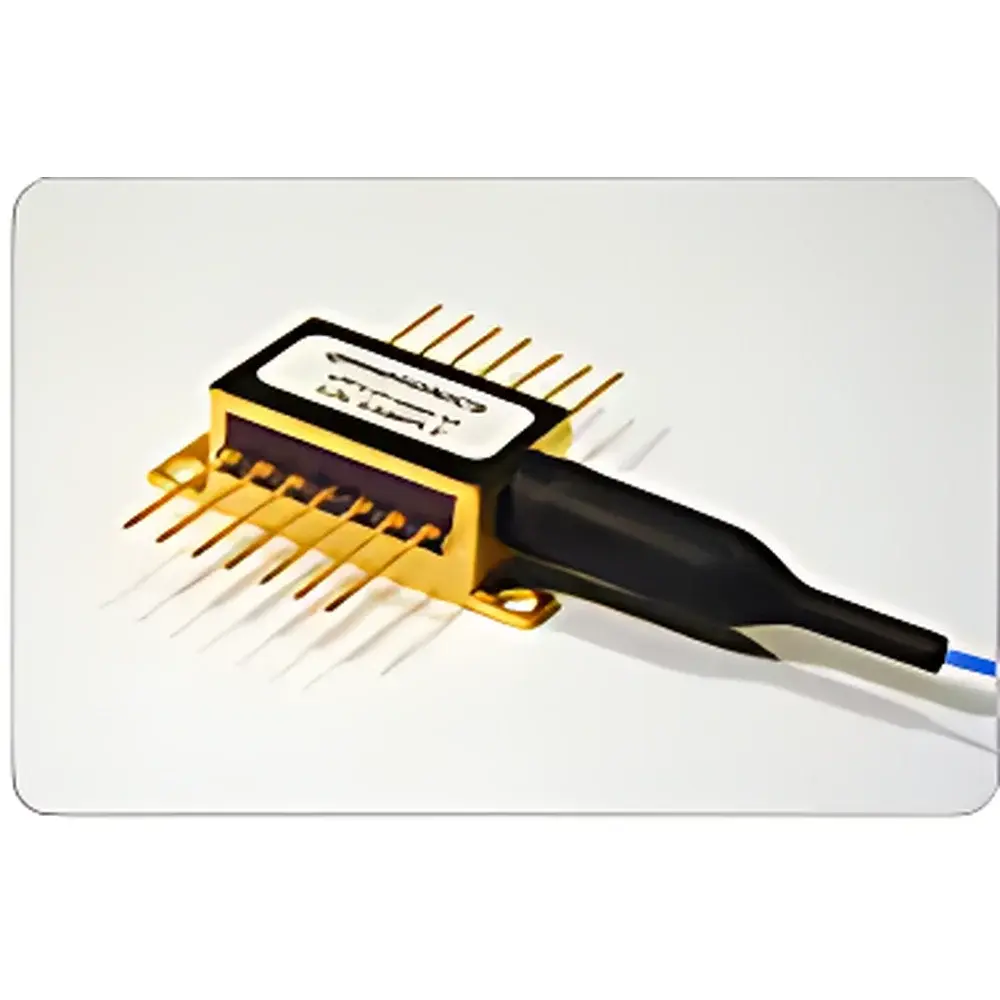
Qphotonics QDFBLD-1550-50 DFB Single-Mode Fiber-Coupled Laser Diode
| Origin | USA |
|---|---|
| Manufacturer Type | Authorized Distributor |
| Origin Category | Imported |
| Model | QDFBLD-1550-50 |
| Output Power | 45 mW (CW) @ 1550 nm |
| Operation Mode | CW or Pulsed |
| Threshold Current | Low |
| Slope Efficiency | High |
| Operating Temperature Range | −10 °C to +70 °C |
| Wavelength vs. Temperature Coefficient | 0.1 nm/°C |
| Wavelength vs. Current Coefficient | 2–5 pm/mA |
| Integrated Components | Optical Isolator, Monitor Photodiode, TEC, Thermistor |
| Fiber Pigtail | Polarization-Maintaining (Corning PM1550), MFD = 10.5 ± 1 µm |
| Connector Options | FC/PC or FC/APC (random polarization orientation, optional) |
Overview
The Qphotonics QDFBLD-1550-50 is a wavelength-stabilized, distributed feedback (DFB) single-mode laser diode engineered for high spectral purity and long-term stability in demanding optical measurement and fiber-optic test applications. Operating at the industry-standard telecommunications wavelength of 1550 nm, this device leverages monolithic DFB grating integration to deliver narrow-linewidth emission (< 2 MHz typical) with minimal mode-hopping across its operational envelope. Its fiber-coupled architecture—featuring Corning PM1550 polarization-maintaining fiber—ensures deterministic polarization state delivery essential for interferometric sensing, coherent detection, and polarization-sensitive spectroscopy. Designed for both continuous-wave (CW) and pulsed operation (with appropriate driver control), the laser exhibits low threshold current ( 0.15 W/A), enabling efficient power conversion and reduced thermal load during extended duty cycles.
Key Features
- Stable single-longitudinal-mode (SLM) output via integrated DFB structure, eliminating external cavity complexity
- Hermetically sealed TO-can package with built-in thermoelectric cooler (TEC) and NTC thermistor for active temperature stabilization
- Integrated optical isolator (≥ 30 dB isolation) to suppress back-reflection-induced intensity noise and frequency instability
- On-board monitor photodiode with calibrated responsivity for real-time power feedback and closed-loop intensity control
- Polarization-maintaining fiber pigtail (Corning PM1550) with measured mode field diameter of 10.5 ± 1 µm, ensuring compatibility with standard PM fiber components and splicing protocols
- Thermal wavelength tuning coefficient of 0.1 nm/°C and current-tuning coefficient of 2–5 pm/mA—enabling fine spectral alignment in metrology-grade setups
- Compliant with Telcordia GR-468-CORE reliability standards for laser diodes used in telecom infrastructure environments
Sample Compatibility & Compliance
The QDFBLD-1550-50 is optimized for integration into laboratory-grade optical benches, automated test equipment (ATE), and OEM instrumentation platforms requiring traceable 1550 nm sources. Its PM fiber output supports direct coupling into interferometers (e.g., Mach–Zehnder, Michelson), fiber Bragg grating (FBG) interrogation systems, and optical coherence tomography (OCT) light engines. The device conforms to IEC 60825-1:2014 Class 3B laser safety requirements when operated within specified limits. All electrical interfaces adhere to JEDEC J-STD-020 moisture sensitivity level (MSL) 3 handling guidelines. While not certified for medical or aviation use out-of-box, its design basis aligns with ISO 13485 quality system prerequisites for component suppliers serving regulated instrument manufacturers.
Software & Data Management
Though the QDFBLD-1550-50 operates as a hardware-level source without embedded firmware, it is fully compatible with third-party laser controllers supporting analog modulation (0–5 V input for current control) and digital monitoring (e.g., via RS-232 or USB-based DAQ modules). When integrated into systems governed by FDA 21 CFR Part 11 or EU Annex 11 requirements, users may implement audit-trail-capable software (e.g., LabVIEW with NI-DAQmx logging, MATLAB Instrument Control Toolbox, or Python-based PyVISA frameworks) to record operating parameters—including drive current, TEC voltage, photodiode output, and ambient temperature—with timestamped metadata. Calibration data (wavelength vs. current/temperature maps) is supplied in CSV format per unit for traceable system characterization.
Applications
- Fiber-optic sensor interrogation (e.g., FBG, interferometric strain/temperature sensors)
- Coherent optical time-domain reflectometry (C-OTDR) and phase-sensitive OTDR (φ-OTDR)
- Low-coherence interferometry for surface profiling and thin-film metrology
- Reference source in wavelength calibration of optical spectrum analyzers (OSAs) and wavemeters
- Seed laser for erbium-doped fiber amplifiers (EDFAs) and nonlinear frequency conversion stages
- Research in quantum optics requiring stable, narrow-linewidth near-IR sources
FAQ
Is the QDFBLD-1550-50 suitable for direct modulation at GHz frequencies?
No—this DFB diode is designed for low-to-medium speed analog modulation (≤ 100 MHz small-signal bandwidth); for high-speed digital modulation, consult Qphotonics’ QFLD series with RF-optimized packaging.
Can the built-in TEC maintain constant wavelength under ambient temperature fluctuations?
Yes—the integrated TEC and thermistor enable closed-loop temperature control with ±0.02 °C stability, reducing wavelength drift to < 0.002 nm over a 1-hour period under controlled lab conditions.
What is the maximum permissible optical feedback level at the fiber facet?
Less than −40 dB relative to output power; exceeding this may induce relaxation oscillations or chaotic intensity noise—hence the integrated isolator is non-removable and critical for performance integrity.
Does the PM fiber pigtail preserve extinction ratio after splicing?
Yes—when fusion-spliced using a PM-aligned splicer (e.g., Fujikura CT-50 or Vytran GPX-3400), extinction ratios > 20 dB are routinely achieved; alignment verification via polarimetric analysis is recommended post-splice.
Is factory recalibration available for wavelength accuracy?
Yes—Qphotonics offers NIST-traceable wavelength calibration (±0.005 nm uncertainty) as a value-added service; calibration certificates include full spectral scan data and environmental test conditions.





