
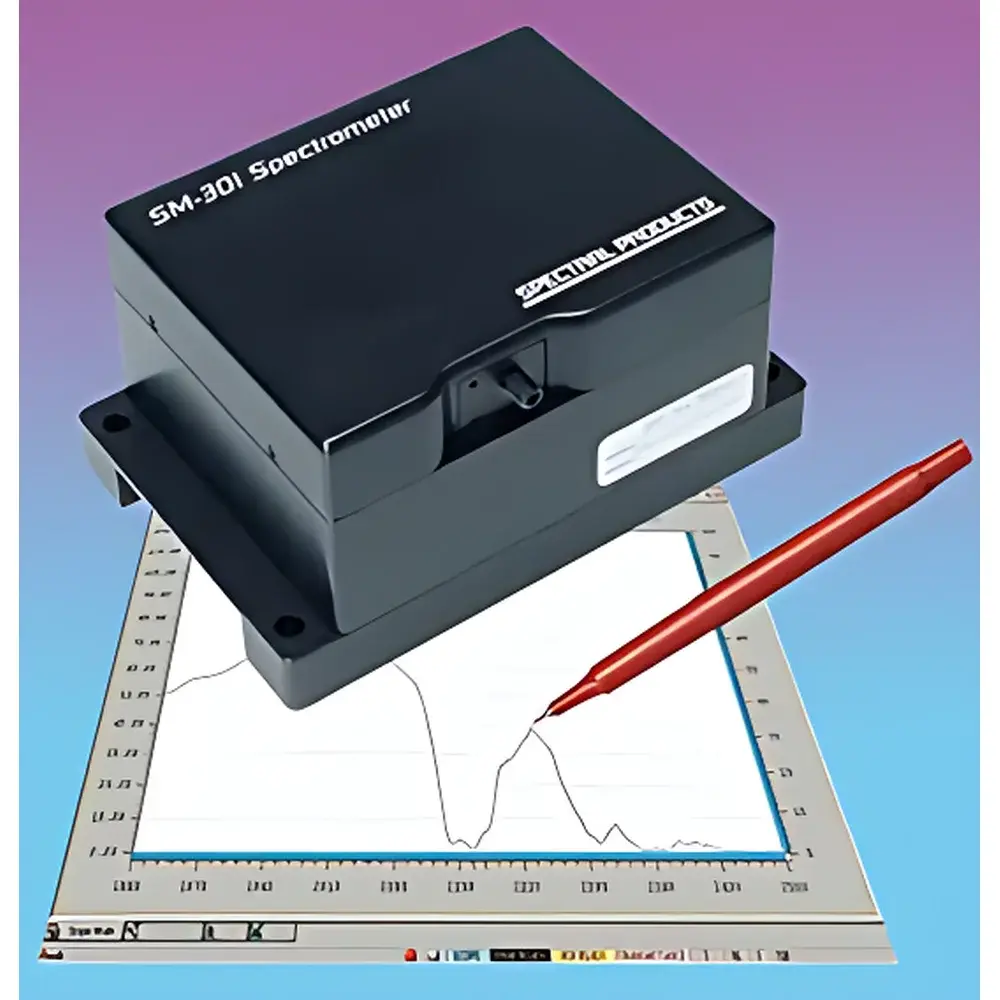
SP SM301 PbS/PbSe Array Mid-Infrared Spectrometer
| Brand | SP/Spectral Products |
|---|---|
| Origin | USA |
| Manufacturer Type | Authorized Distributor |
| Import Status | Imported |
| Model | SM301 |
| Spectral Range | 1.0–5.0 µm |
| Detector Type | Thermoelectrically Cooled PbS/PbSe Linear Array |
| Resolution | 30 nm |
| Sensitivity | High |
| Signal-to-Noise Ratio | High |
| Dynamic Range | High |
| Stray Light | < 0.1% |
| Pixel Count | 256 elements |
| Readout Rate | Up to 2 MHz |
| Cooling | Peltier-cooled to –4 °C |
| Software | SM32Pro (Windows-based) |
Overview
The SP SM301 PbS/PbSe Array Mid-Infrared Spectrometer is a thermoelectrically cooled, multi-channel dispersive spectrometer engineered for high-fidelity spectral acquisition in the mid-infrared region from 1.0 to 5.0 µm. Unlike scanning monochromator-based systems, the SM301 employs a fixed-grating optical design coupled with a 256-element linear PbS (1.0–3.0 µm) or PbSe (1.5–5.0 µm) photodetector array, enabling simultaneous wavelength detection across its full spectral range. This architecture eliminates mechanical scanning motion, thereby improving measurement reproducibility, reducing acquisition time, and minimizing thermal drift during extended operation. The detector array is actively stabilized at –4 °C via integrated Peltier cooling, suppressing dark current and enabling stable baseline performance over hours of continuous use. Its optical input accepts either free-space beam coupling via a precision slit or fiber-optic delivery (SMA 905 compatible), supporting integration into OEM platforms, process monitoring setups, or benchtop analytical configurations.
Key Features
- Thermoelectrically cooled 256-pixel PbS or PbSe linear array detector, maintained at –4 °C for low dark current and long-term signal stability
- Fixed-grating optical layout with no moving parts—ensures mechanical robustness and operational reliability
- Spectral coverage configurable across two detector variants: PbS (1.0–3.0 µm) or PbSe (1.5–5.0 µm)
- Nominal optical resolution of 30 nm (FWHM), optimized for molecular vibrational band analysis in organic and inorganic compounds
- High-speed readout capability up to 2 MHz, supporting rapid averaging and real-time spectral monitoring
- Stray light rejection better than 0.1%, critical for quantitative absorbance measurements in complex matrices
- Integrated dark signal compensation: automatic periodic dark reference acquisition and subtraction via on-board electronics
- Low-noise analog front-end and 16-bit ADC digitization to preserve dynamic range and signal fidelity
Sample Compatibility & Compliance
The SM301 is compatible with transmission, reflection, and attenuated total reflectance (ATR) sampling geometries when paired with appropriate accessories. It supports both direct free-space illumination (via adjustable slit) and fiber-coupled input using standard 400–600 µm core silica or fluoride fibers. As an analytical instrument intended for laboratory and industrial R&D environments, the system complies with CE marking requirements for electromagnetic compatibility (EMC Directive 2014/30/EU) and low-voltage safety (LVD Directive 2014/35/EU). While not certified as medical or IVD equipment, its hardware and firmware architecture support implementation within GLP-compliant workflows. Data integrity is reinforced through timestamped spectral logging and metadata tagging in SM32Pro output files (.spc, .csv), facilitating traceability in regulated environments.
Software & Data Management
The SM301 is fully supported by SM32Pro—a Windows-based application offering real-time spectral display, calibration management (wavelength and radiometric), baseline correction, peak identification, and quantitative analysis tools including multivariate regression (PLS) templates. All acquired spectra are stored with embedded instrument parameters (integration time, cooling status, slit width, grating position), ensuring audit-ready data provenance. Export formats include ASCII CSV, JCAMP-DX, and industry-standard .SPC, enabling interoperability with third-party chemometric platforms (e.g., MATLAB, Unscrambler, Pirouette). SM32Pro supports FDA 21 CFR Part 11–aligned optional features—including user access levels, electronic signatures, and audit trail logging—when deployed on validated IT infrastructure.
Applications
- Quantitative and qualitative analysis of hydrocarbons, polymers, pharmaceutical excipients, and biomolecules via characteristic C–H, O–H, N–H, and C=O vibrational absorptions
- In-line and at-line process monitoring in chemical synthesis, petrochemical refining, and polymer extrusion
- Gas-phase spectroscopy for CO, CO₂, CH₄, NH₃, and NOₓ detection using multipass cells or open-path configurations
- Material characterization of thin films, coatings, and semiconductor layers via transmission or reflection mode
- Research in astrochemistry and planetary science requiring stable, field-deployable mid-IR response
- Calibration transfer between instruments using spectral matching algorithms and reference standards traceable to NIST SRMs
FAQ
What detector materials are used in the SM301, and how do they differ in spectral response?
The SM301 offers two detector configurations: PbS (lead sulfide) for 1.0–3.0 µm operation and PbSe (lead selenide) for extended response from 1.5–5.0 µm. PbSe provides higher sensitivity beyond 3.0 µm but requires more stringent thermal stabilization.
Is the SM301 suitable for GMP-regulated environments?
Yes—when implemented with SM32Pro’s optional 21 CFR Part 11 compliance package and documented validation protocols, the system meets foundational data integrity requirements for QC laboratories under pharmaceutical or biotech quality systems.
Can the SM301 be synchronized with external triggers or timing signals?
Yes—the device includes TTL-compatible trigger input/output ports, enabling precise synchronization with lasers, choppers, or process control PLCs for time-resolved or event-triggered acquisitions.
What optical interfaces are supported for sample illumination?
The spectrometer accepts collimated free-space beams via a 25 µm or 50 µm adjustable entrance slit, or fiber-optic input using SMA 905 connectors with core diameters from 400 µm to 600 µm.
How is wavelength calibration performed, and how often is recalibration required?
Factory calibration uses NIST-traceable emission lines (e.g., Ar, Ne lamps); users may perform verification or re-calibration using built-in polynomial fitting tools in SM32Pro. Recalibration is recommended after significant thermal cycling or mechanical shock, or annually under routine use.




