
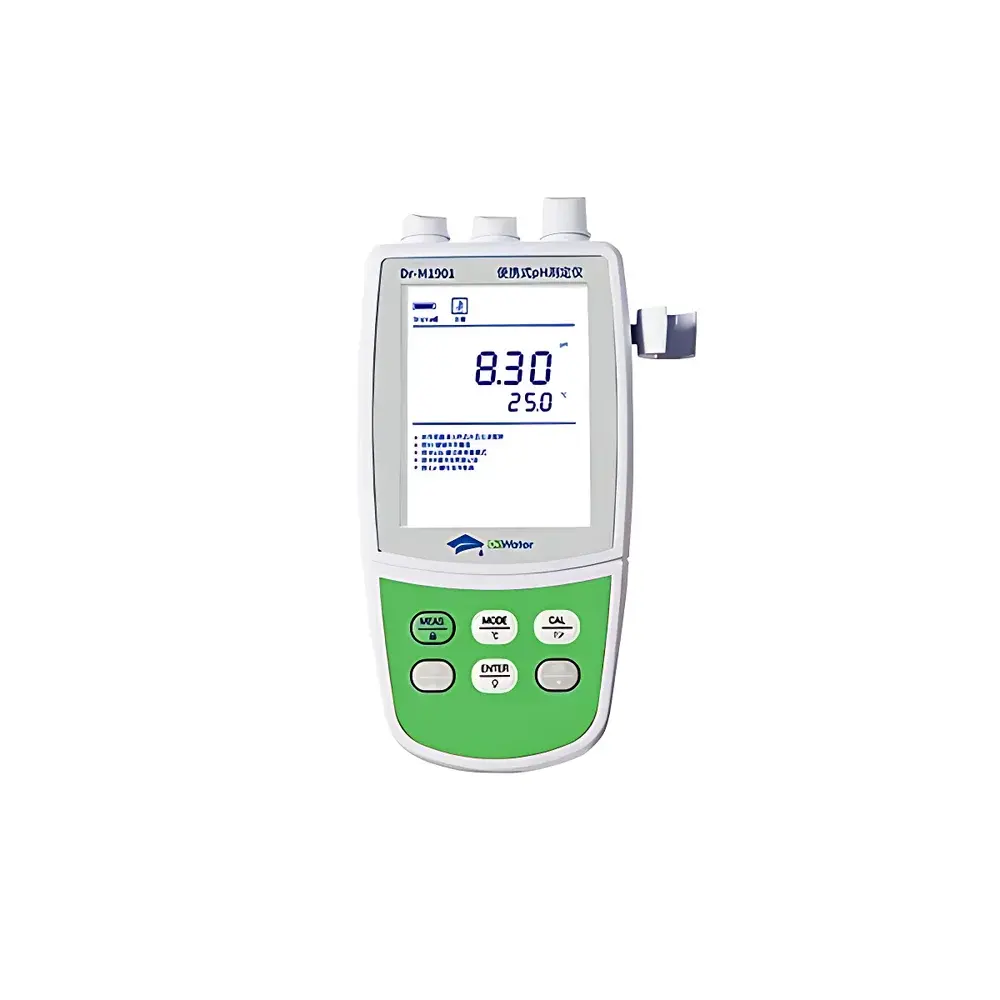
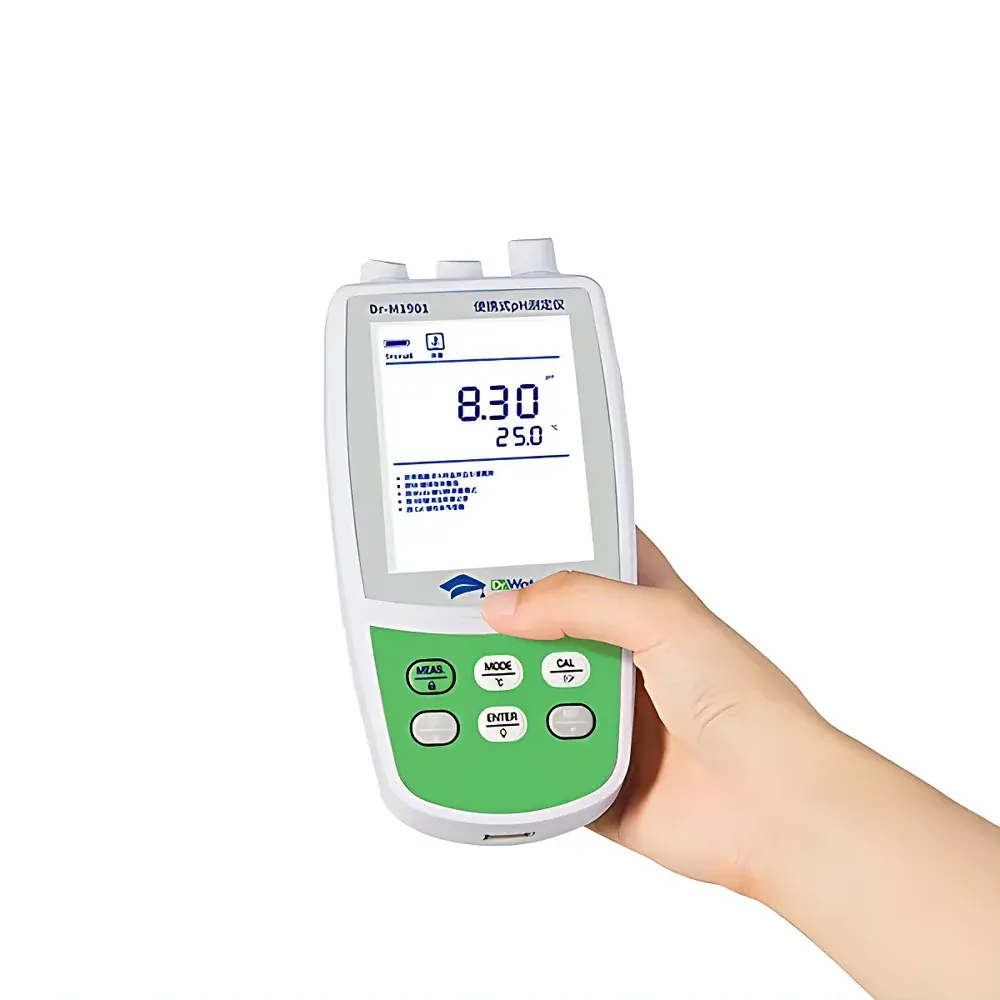
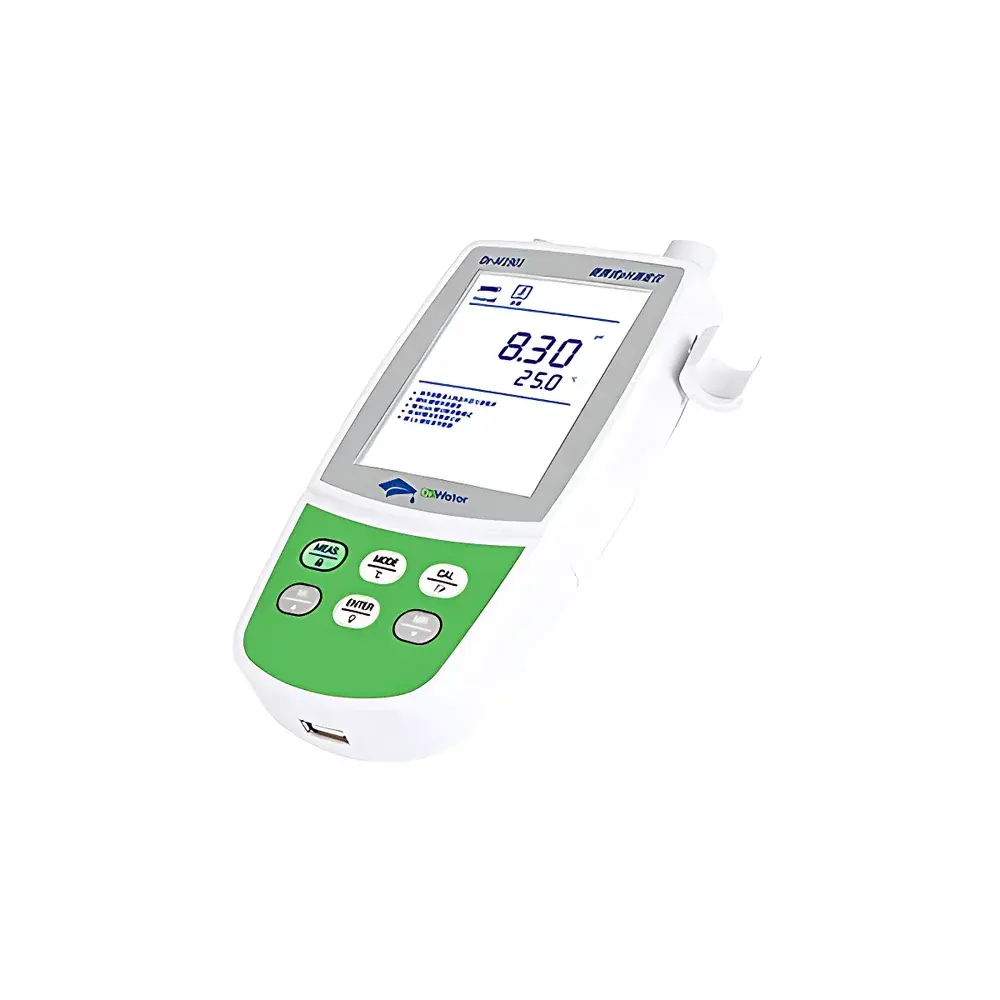
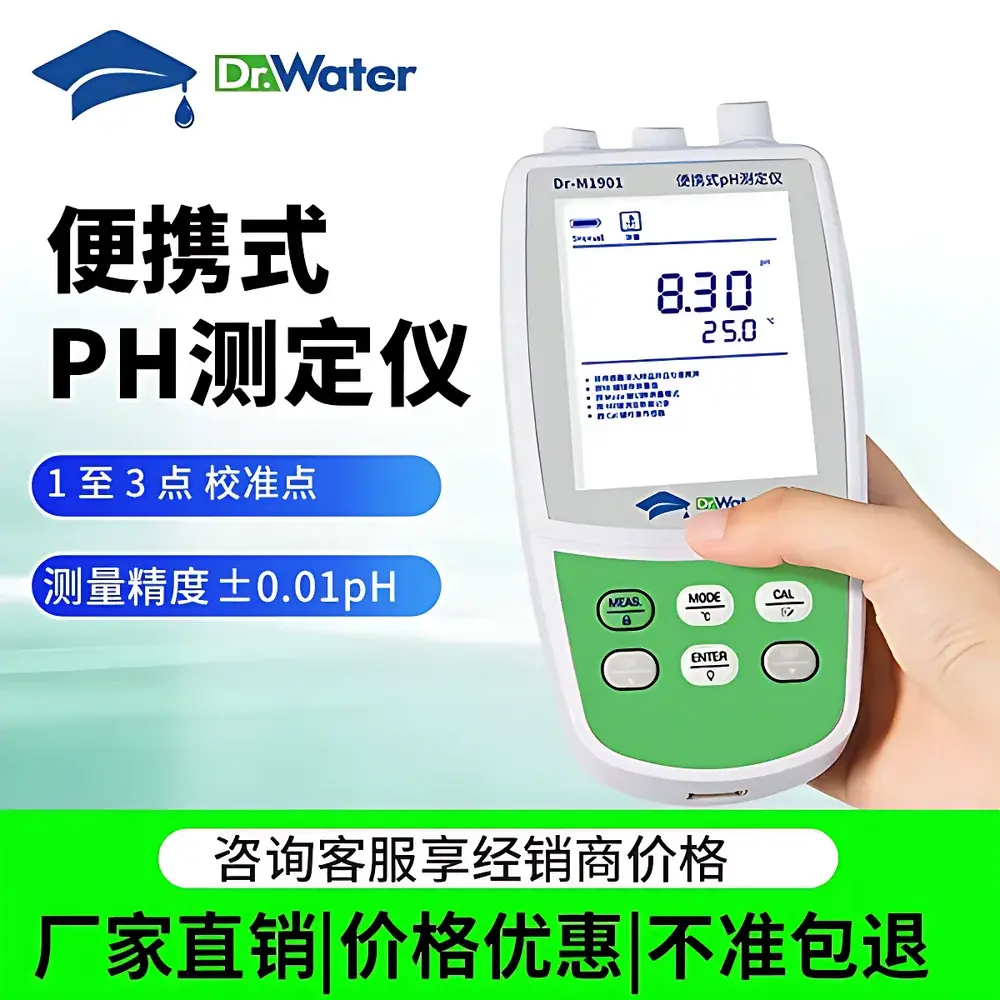
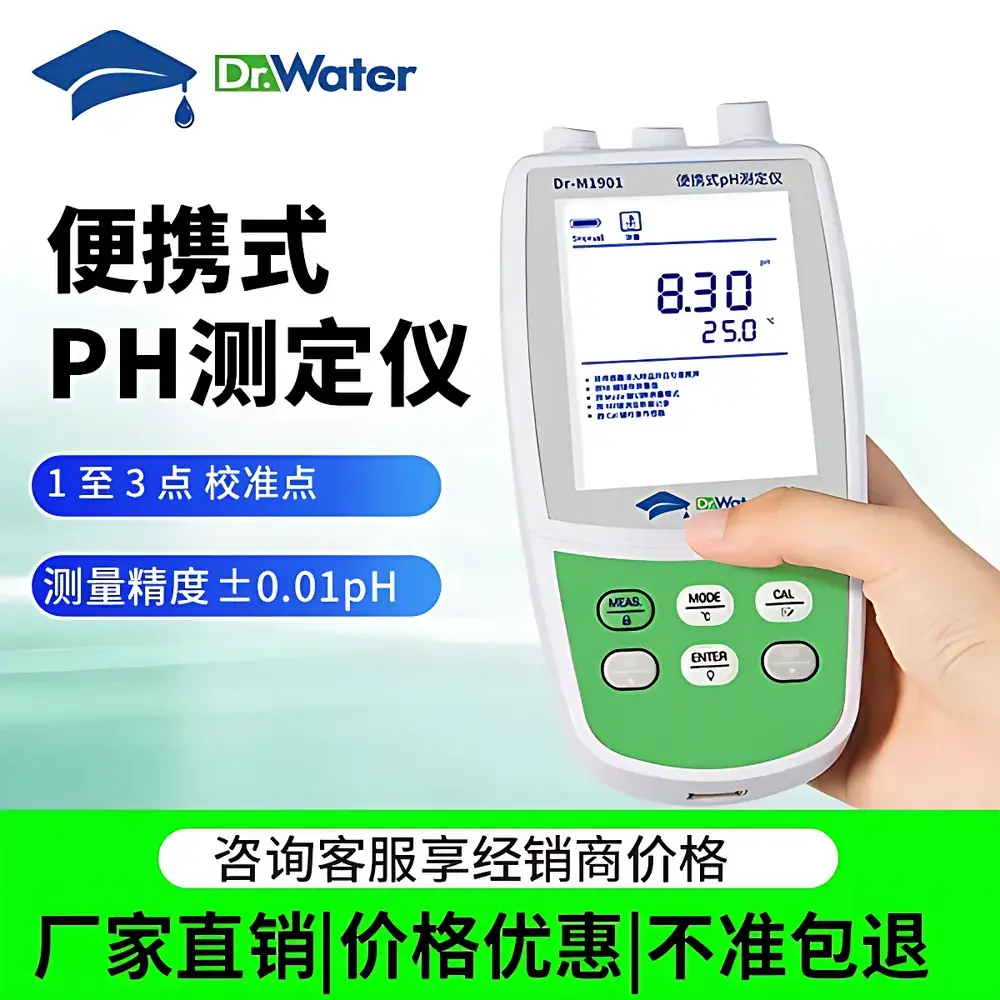
Doctor Water Dr-M1901 Portable pH Meter
| Brand | Doctor Water |
|---|---|
| Origin | Hunan, China |
| Model | Dr-M1901 |
| Instrument Type | Portable |
| Parameter Type | Multi-parameter |
| pH Range | -2.00 to 20.00 pH |
| Display Resolution | 0.01 pH |
| Accuracy | ±0.01 pH |
| Calibration Points | 1–3 point |
| Temperature Range | 0–105 °C |
| Temp. Resolution | 0.1 °C |
| Temp. Accuracy | ±0.5 °C |
| Temperature Compensation | Automatic (0–100 °C) |
| Data Storage | 100 sets |
| Interface | USB, BNC, 3.5 mm audio jack |
| Power | 3 × AA batteries or DC 5 V adapter |
Overview
The Doctor Water Dr-M1901 Portable pH Meter is a field-deployable electrochemical instrument engineered for high-reproducibility pH and temperature measurements in diverse aqueous environments—from municipal water distribution networks and wastewater treatment outfalls to environmental monitoring sites and industrial process streams. Built upon potentiometric measurement principles, the Dr-M1901 detects the voltage difference between a pH-sensitive glass electrode and a stable reference electrode, converting it into a calibrated pH value via Nernst equation-based algorithms. Its extended measurement range (−2.00 to 20.00 pH) supports applications involving strongly acidic or alkaline solutions—such as chemical cleaning agents, caustic scrubber effluents, or acid mine drainage—where conventional meters may saturate or drift. Integrated automatic temperature compensation (ATC) applies real-time correction using a built-in thermistor or optional external temperature probe, ensuring traceable accuracy across the full operational range (0–100 °C). The device complies with fundamental metrological requirements outlined in ISO 7888 (water quality — determination of pH) and supports laboratory- and field-based GLP workflows through audit-ready calibration logging and data integrity features.
Key Features
- Three-point calibration with automatic buffer recognition for both USA (pH 4.01/7.00/10.01) and NIST (pH 4.01/6.86/9.18) standard series, minimizing manual entry errors
- Intelligent electrode diagnostics that evaluate slope (%), offset (mV), and response time to flag aging or contaminated electrodes prior to measurement failure
- Auto-endpoint detection with manual override: stabilizes readings upon signal convergence (±0.01 pH over 3 sec) or allows user-triggered hold for transient samples
- Fully configurable system settings—including selectable pH buffer group, calibration point count, temperature unit (°C/°F), auto-power-off delay (30 min default), and factory reset capability
- Dual-mode temperature measurement: internal sensor (±0.5 °C accuracy) or external probe input with 1-point offset adjustment (±10 °C range)
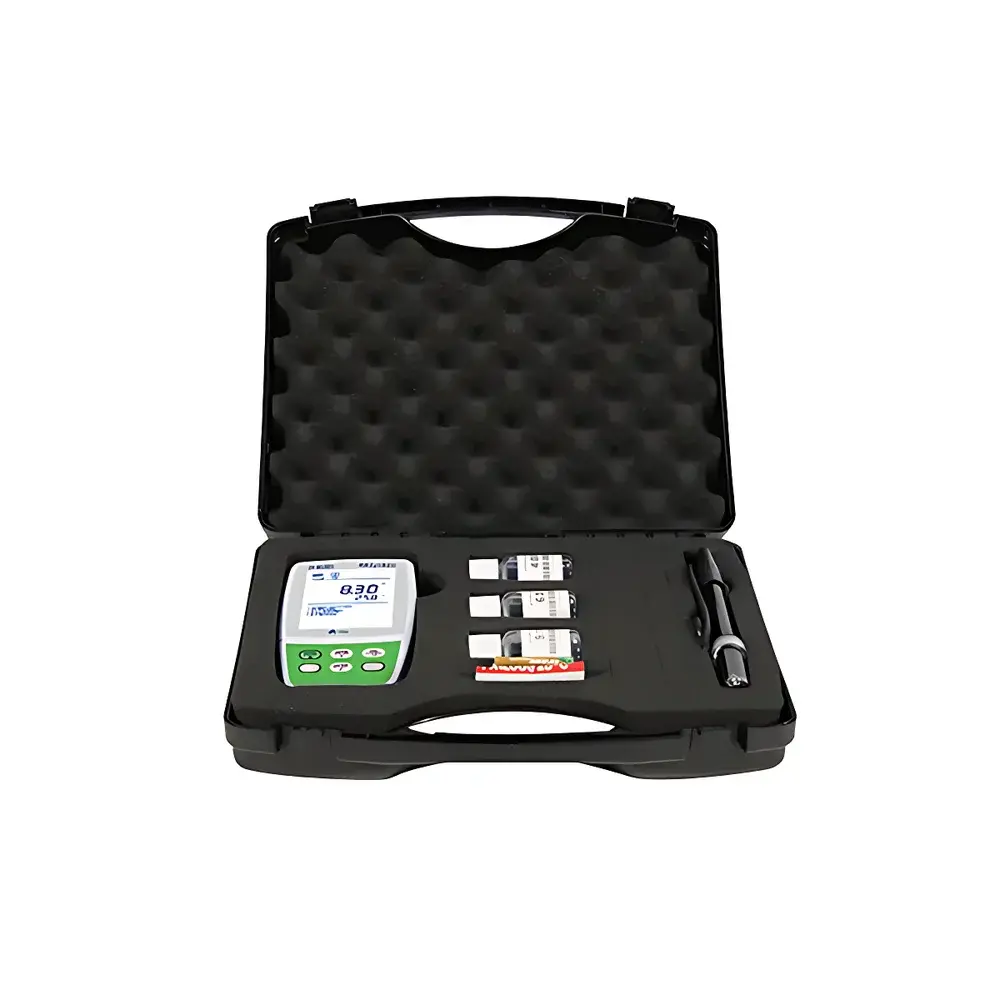
- Robust mechanical design housed in an IP67-rated carrying case, including shock-absorbing foam inserts and weather-resistant seals for outdoor deployment
Sample Compatibility & Compliance
The Dr-M1901 is validated for use with low- to medium-conductivity aqueous samples (≥50 µS/cm), including drinking water, surface water, groundwater, boiler feedwater, swimming pool water, and mild industrial process liquors. It is not recommended for non-aqueous solvents, highly viscous slurries, or samples containing sulfides, proteins, or heavy metal ions without prior electrode conditioning or specialized junction maintenance. All calibration and measurement procedures align with ASTM D1293 (Standard Test Methods for pH of Water) and support regulatory documentation requirements under EPA Method 150.1. The instrument’s firmware enforces mandatory timestamped calibration logs for each session, enabling traceability in ISO/IEC 17025-accredited laboratories and fulfilling basic data integrity expectations per FDA 21 CFR Part 11 when used with validated USB data export protocols.
Software & Data Management
Data acquisition and archival are managed via the embedded 100-entry memory buffer, each record storing pH value, temperature, date/time stamp, calibration status, and electrode ID (if encoded). Export occurs through the standard USB Type-A interface (no proprietary drivers required), delivering CSV-formatted files compatible with LIMS platforms, Excel, and statistical analysis tools. No cloud connectivity or mobile app dependency is introduced—ensuring data sovereignty and eliminating cybersecurity exposure vectors common in IoT-enabled meters. Audit trails include operator-initiated actions (e.g., calibration start/end, reset events), and all stored entries are write-protected until manually cleared—preventing accidental overwrites during field use.
Applications
- Field verification of potable water compliance against WHO and national regulatory limits (e.g., pH 6.5–8.5)
- Real-time monitoring of neutralization tanks in electroplating or metal finishing facilities
- Seasonal profiling of lake and river pH dynamics in ecological assessment studies
- QA/QC checks during pharmaceutical water-for-injection (WFI) distribution loop sanitization cycles
- Educational demonstrations of acid-base equilibria and buffer capacity in undergraduate chemistry labs
- Preventive maintenance screening of cooling tower water chemistry to mitigate corrosion or scaling risks
FAQ
Does the Dr-M1901 support GLP-compliant calibration documentation?
Yes—each calibration event is automatically timestamped and logged with buffer IDs, measured mV values, calculated slope/offset, and operator confirmation. Logs persist until explicitly cleared.
Can the meter be used with non-standard or custom pH buffers?
No—the device only recognizes pre-programmed USA and NIST buffer values; custom buffer entry is not supported to maintain metrological consistency.
Is the included pH electrode refillable or replaceable?
The supplied combination pH/temperature electrode features a gel-filled, double-junction design with non-refillable electrolyte; replacement is recommended after 12 months of intermittent use or upon diagnostic failure.
What is the battery life under typical field conditions?
With three fresh AA alkaline cells and default auto-off enabled, continuous operation exceeds 200 hours; battery status is displayed as a four-bar icon with low-voltage warning at ≤1.1 V per cell.
Does the USB interface support real-time data streaming?
No—it operates in mass-storage mode only for batch file transfer; live serial output is not implemented to preserve measurement stability and electromagnetic compatibility in noisy industrial zones.







