
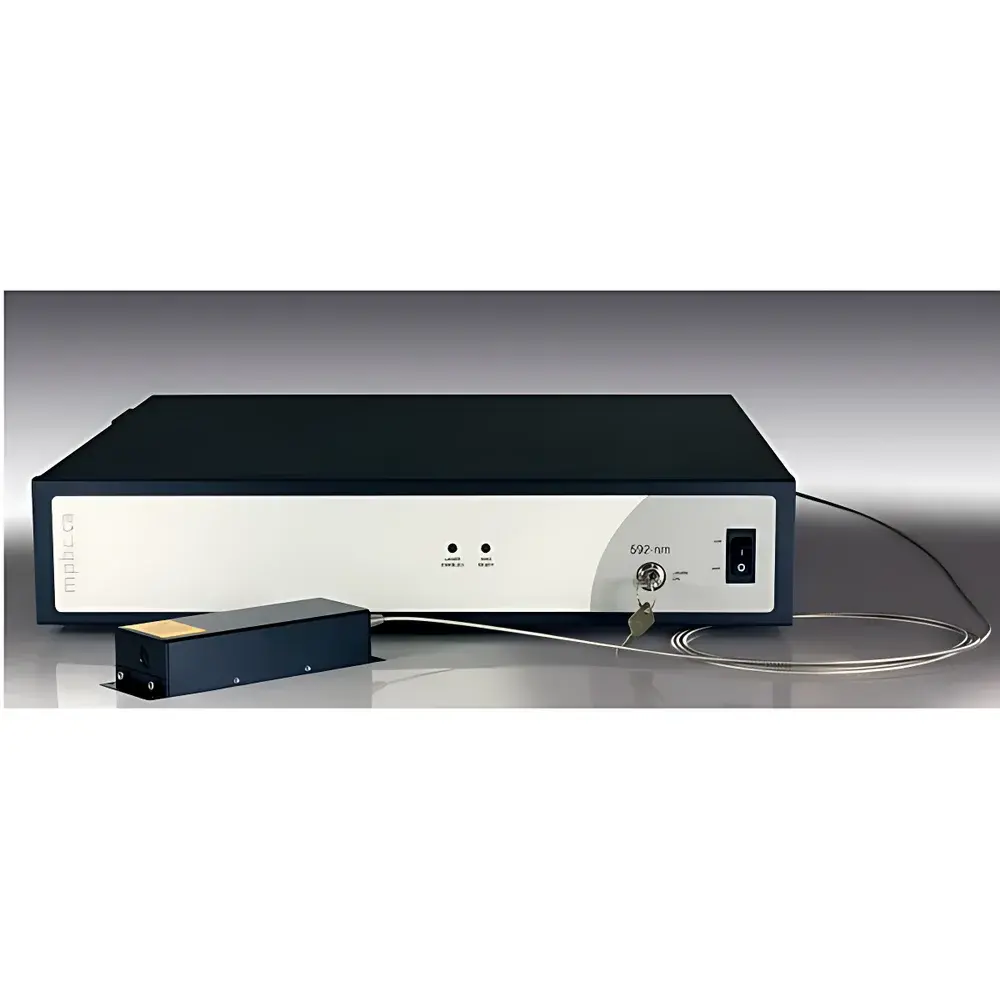
MPB 2RU-VFL-P-power-592 Continuous-Wave 592 nm Fiber-Coupled Laser System
| Brand | MPB |
|---|---|
| Origin | Canada |
| Model | 2RU-VFL-P-power-592 |
| Output Power Options | 1000 / 1500 / 2000 mW |
| Emission Wavelength | 592 nm |
| Beam Diameter | 1.0 mm |
| Beam Quality (M²) | ≤1.1 |
| Transverse Mode | TEM₀₀ |
| Polarization | Linear, vertical to baseplate |
| Polarization Extinction Ratio | >20 dB |
| Power Stability (RMS, over 8 h) | <±0.5% |
| Wavelength Stability | ±0.02 nm (typ.) |
| Beam Divergence (full angle) | <5 mrad |
| Cooling Method | Air-cooled |
| Control Interfaces | RS232 and USB |
| Safety Interlock | Yes (IEC 60825-1 compliant) |
| Form Factor | Benchtop or 2RU Rackmount |
| Input Voltage | Internal AC/DC converter (100–240 VAC, 50/60 Hz) |
| Emergency Stop | Integrated (rackmount version) |
Overview
The MPB 2RU-VFL-P-power-592 is a high-stability, continuous-wave (CW) fiber-coupled yellow laser system engineered for precision photonic applications requiring narrow-linewidth, diffraction-limited output at 592 nm. Unlike DPSS-based yellow sources, this system employs frequency-doubled fiber laser architecture—pumping a polarization-maintaining (PM) Yb-doped fiber amplifier followed by intracavity second-harmonic generation in a periodically poled lithium niobate (PPLN) crystal—to deliver intrinsic wavelength stability and low-amplitude noise. Its TEM₀₀ spatial profile (M² ≤1.1), linear polarization (vertical orientation relative to the mechanical baseplate), and sub-5 mrad full-angle divergence ensure optimal coupling into single-mode fibers, confocal microscope scan heads, and spectroscopic detection paths. Designed for integration into regulated laboratory and industrial environments, the laser complies with IEC 60825-1 Class 3B safety requirements and incorporates hardware-enforced interlocks, redundant thermal monitoring, and fail-safe emergency stop circuitry.
Key Features
- Stable CW output at precisely 592.0 nm with long-term wavelength drift ≤±0.02 nm (typ.), enabling reproducible excitation of fluorophores such as Texas Red®, mCherry, and Cy3.5 without spectral re-alignment.
- Selectable output power levels: 1000 mW, 1500 mW, or 2000 mW — each calibrated and certified with NIST-traceable power metering; power regulation range: 20–100% via analog voltage or digital command.
- Diffraction-limited beam quality (M² ≤1.1) and TEM₀₀ mode purity support high-resolution confocal imaging, optical trapping, and interferometric alignment tasks.
- Dual digital control interfaces: RS232 (TTL-level) and USB 2.0, both supporting SCPI-compliant command sets for automated sequencing in multi-laser platforms.
- Embedded graphical user interface (GUI) enables real-time monitoring of diode current, thermistor readings, interlock status, and output power history — exportable as CSV for GLP-compliant recordkeeping.
- Air-cooling architecture eliminates need for external chillers or water lines; thermal management maintains junction temperature within ±0.1 °C under ambient conditions of 15–30 °C.
- Two mechanical configurations: compact benchtop unit with rear-panel FC/APC fiber output and integrated transformer, or 2RU rackmount version featuring front-panel emergency stop, redundant safety interlock loops, and DIN-rail mounting compatibility.
Sample Compatibility & Compliance
The 2RU-VFL-P-power-592 is routinely deployed in ISO/IEC 17025-accredited laboratories and FDA-regulated biomanufacturing facilities. Its optical output meets ASTM E275-20 spectral band definitions for “yellow” excitation bands and supports USP requirements for laser-based particle characterization instrumentation. The system’s firmware implements audit-trail logging per FDA 21 CFR Part 11 (electronic records and signatures), including timestamped parameter changes, interlock events, and calibration actions. All electrical design conforms to IEC 61000-6-3 (EMC emission limits) and IEC 61000-6-2 (immunity). Laser housing carries CE, UKCA, and RoHS 3 markings. Documentation includes Factory Acceptance Test (FAT) reports, traceable power calibration certificates, and laser safety classification documentation per ANSI Z136.1-2022.
Software & Data Management
MPB provides the LaserControl Suite v3.2—a platform-independent application compatible with Windows, Linux, and macOS—that supports remote configuration, scheduled power ramping, and synchronized triggering with external devices (e.g., cameras, shutters, DAQ systems) via TTL sync outputs. The software logs all operational parameters at 10 Hz resolution, stores data locally in HDF5 format (HDF Group standard), and exports time-synchronized datasets with metadata tags (wavelength, power setpoint, ambient temperature, operator ID). For enterprise integration, RESTful API endpoints enable HTTP POST/GET access to real-time telemetry and allow incorporation into LIMS or MES workflows. Firmware updates are delivered via signed binary packages with SHA-256 checksum verification.
Applications
- Fluorescence Microspectroscopy: Excitation of red-shifted fluorescent dyes and genetically encoded proteins in widefield, confocal, and super-resolution modalities (STED, RESOLFT).
- Flow Cytometry: High-sensitivity multi-parameter analysis using tandem dyes requiring precise 592 nm excitation to minimize spillover into adjacent detection channels.
- Ophthalmic Diagnostics: Retinal imaging and adaptive optics-assisted photocoagulation where chromatic aberration minimization demands fixed-wavelength, low-noise illumination.
- Raman Spectroscopy: Resonant enhancement of Raman signals from biological macromolecules and pharmaceutical crystalline forms exhibiting electronic transitions near 592 nm.
- Laser-Assisted Thin-Film Processing: Selective annealing and crystallization of metal oxide semiconductors (e.g., IGZO) with minimal thermal budget due to high absorption coefficient at 592 nm.
- Optical Trapping & Manipulation: Stable gradient-force trapping of micron-scale dielectric particles and live cells in microfluidic chambers, enabled by low pointing instability (<2 µrad RMS) and amplitude noise <0.3% RMS (10 Hz–10 MHz).
FAQ
Is the 592 nm output derived from direct semiconductor emission or nonlinear frequency conversion?
It is generated via intracavity second-harmonic generation (SHG) in a PPLN crystal pumped by a 1184 nm Yb-fiber oscillator—ensuring superior wavelength accuracy and stability compared to direct diode solutions.
Can the laser be integrated into a multi-laser combiner system?
Yes—the system provides PM fiber output (FC/APC connector) with extinction ratio >20 dB and offers optional free-space collimation kits with adjustable kinematic mounts for spatial overlap alignment.
What is the maximum allowable back-reflection into the output fiber?
<–30 dB (0.1%); operation beyond this threshold may trigger automatic power reduction to protect the SHG crystal and pump diode.
Does the rackmount version support 19-inch EIA cabinet installation with standard depth?
Yes—it occupies 2RU height (88.9 mm) and fits cabinets with minimum 550 mm depth; rear-panel cable management brackets and ventilation grilles comply with NEBS Level 3 airflow specifications.
Is factory recalibration required annually?
No—wavelength and power calibration remain stable for ≥24 months under normal operating conditions; however, MPB recommends annual verification using an accredited spectrometer and thermopile sensor per ISO/IEC 17025 Clause 6.5.






