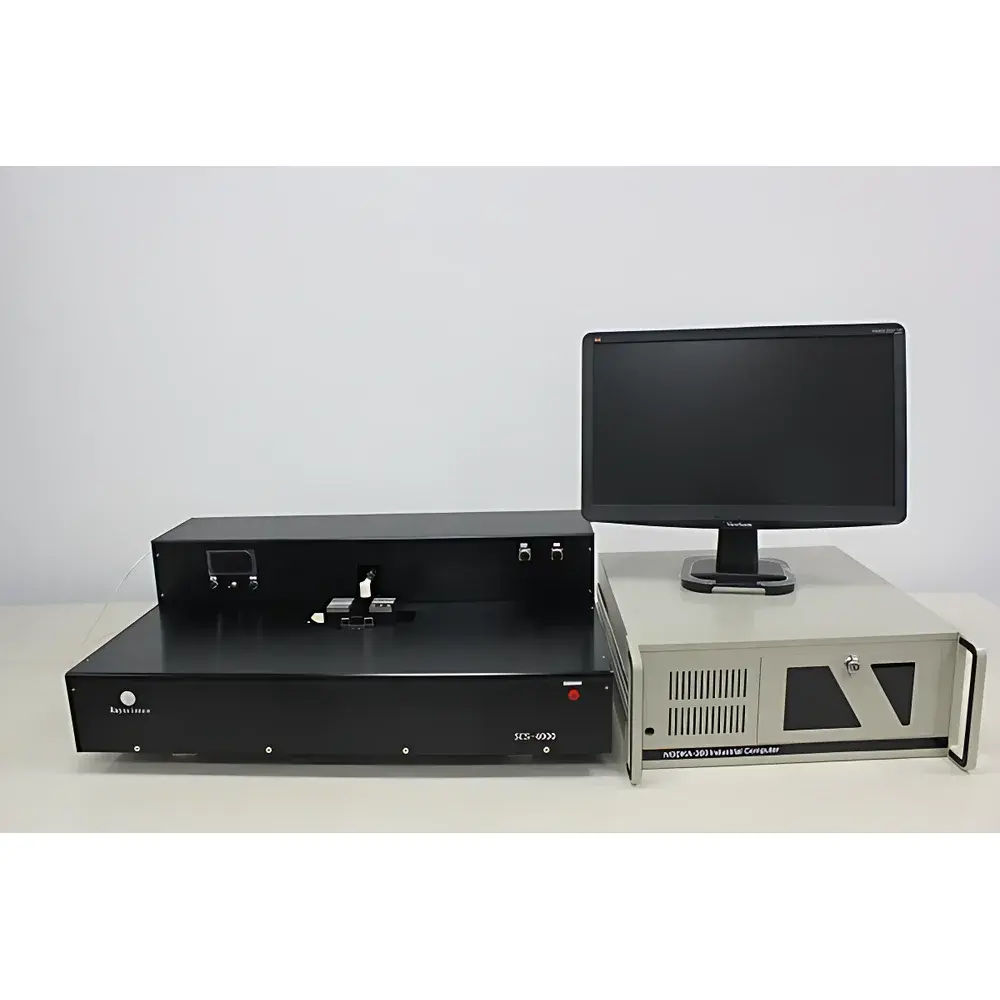
Oelabs SCS-4000-ST Single-Mode Fiber Fusion Tapering System
| Brand | Oelabs |
|---|---|
| Origin | Shanghai, China |
| Manufacturer Type | Authorized Distributor |
| Country of Origin | China |
| Model | SCS-4000-ST |
| Pricing | Upon Request |
| Tapering Precision | ±0.2 µm |
| Stretching Speed Range | 0.2–10,000 µm/s |
| Max Bilateral Stretching Distance | 80 mm |
| Fiber Clamping Diameter | φ0.1–0.5 mm |
| Flame Axial Oscillation Range | 0–20 mm |
| Flame Translation Speed | 0–4 mm/s |
| H₂ Flow Rate | 0–500 SCCM (adjustable) |
| O₂ Flow Rate | 0–200 SCCM (adjustable) |
| Detector Options | InGaAs (800–1700 nm), Si (400–1000 nm), Ge (1000–1800 nm) |
| Light Sources | 1310/1550 nm FP Laser (1 mW), 633 nm HeNe (2 mW), 850/1310 nm Multimode LD |
| Packaging Temperature Range | 0–200 °C |
| Power Supply | 220 V AC, 6 A |
Overview
The Oelabs SCS-4000-ST Single-Mode Fiber Fusion Tapering System is an engineered platform for the reproducible fabrication of fused fiber couplers, adiabatic tapers, and wavelength-selective waveguide structures via controlled thermal drawing. Based on the principle of flame-based fusion tapering—where stripped single-mode fibers are precisely aligned, heated in a hydrogen-oxygen micro-flame, and simultaneously stretched under vacuum-assisted clamping—the system enables sub-micron control over taper profile, coupling ratio, and spectral response. Designed for R&D laboratories and photonics manufacturing facilities, it supports both standard telecom-grade SMF-28 and specialty fibers (e.g., PM, dispersion-shifted, or photosensitive variants), with full traceability of process parameters essential for GLP-compliant device development and ISO/IEC 17025-aligned characterization workflows.
Key Features
- High-precision dual-axis stretching mechanism with ±0.2 µm positional resolution, achieved via imported linear slide rails and P2-grade ball screws (2 mm pitch), ensuring repeatable axial motion stability across 40 mm per side.
- Customizable hydrogen–oxygen hybrid burner head (internally designed by Shanghai瞬渺), delivering uniform thermal profiles and improved temperature stability versus conventional top/bottom oxygen configurations—critical for minimizing axial refractive index perturbations during taper formation.
- Programmable flame scanning module with independent control of oscillation amplitude (0–20 mm) and translation speed (0–4 mm/s), synchronized with real-time stretching velocity and gas flow modulation.
- Multi-wavelength optical monitoring suite: selectable InGaAs (800–1700 nm), Si (400–1000 nm), or Ge (1000–1800 nm) detectors paired with tunable sources including 1310/1550 nm FP lasers (1 mW), 633 nm HeNe (2 mW), and multimode LDs (850/1310 nm).
- Modular fixture architecture supporting φ0.1–0.5 mm bare fiber diameters, with optional CCD-based visual alignment subsystem for real-time observation of core overlap and taper neck evolution.
- Integrated thermal packaging station (0–200 °C) enabling one-step epoxy curing or UV-curable resin processing post-tapering, compliant with MIL-STD-883 and Telcordia GR-1209-CORE environmental stress screening protocols.
Sample Compatibility & Compliance
The SCS-4000-ST accommodates standard ITU-T G.652.D single-mode fibers as well as polarization-maintaining (PANDA, bow-tie), high-numerical-aperture, and radiation-hardened variants. Alignment routines support both rotational core matching (for PM fiber) and passive lateral positioning (for non-birefringent structures). All hardware modules meet CE safety directives (2014/35/EU, 2014/30/EU) and operate within Class 1 laser safety limits per IEC 60825-1:2014 when used with approved optical sources. Process logs—including flame position, gas flow rates, stretch displacement, and detector output—are timestamped and exportable for audit-ready documentation required under FDA 21 CFR Part 11 and ISO 9001 quality management systems.
Software & Data Management
The proprietary tapering control software provides deterministic parameter mapping between target coupling ratio, working wavelength, and physical taper geometry. Users define stretch length, final waist diameter, and heating duration; the system automatically calculates optimal flame scan trajectory, H₂/O₂ flow ramping profiles, and dynamic speed compensation to maintain constant strain rate. All operational data—including raw photodetector traces, motor encoder feedback, and thermocouple readings—are logged in HDF5 format with metadata tagging (user ID, timestamp, fiber ID, recipe version). Export options include CSV, MATLAB .mat, and XML schemas compatible with LIMS integration. Audit trails record every parameter change, user login/logout event, and firmware update—fully satisfying GLP/GMP electronic record retention requirements.
Applications
- Fabrication of 1×2 and 2×2 fused biconical couplers for WDM and PON networks, meeting Telcordia GR-1221-CORE insertion loss (<0.2 dB) and uniformity specifications.
- Production of broadband adiabatic tapers for mode-field adaptation between dissimilar fibers (e.g., SMF to PCF or SMF to tapered fiber sensors).
- Development of interferometric devices including Mach–Zehnder and Michelson configurations on a single fiber platform.
- Research into evanescent field coupling for biosensing, gas detection, and refractive index monitoring using tapered regions functionalized with nanomaterial coatings.
- Prototyping of nonlinear optical components such as supercontinuum generation seeds and four-wave mixing waveguides in highly nonlinear tapered fibers.
FAQ
What fiber types can be processed on the SCS-4000-ST?
Standard SMF-28, HI1060, PM1550, and custom-doped silica fibers with cladding diameters from 125 µm to 500 µm are supported. Specialty polymer or fluoride fibers require customized fixtures and flame calibration.
Is the system compatible with automated optical testing workflows?
Yes—via Ethernet-connected GPIB/LAN interfaces, the system integrates with commercial OTDRs, optical spectrum analyzers, and polarization controllers for closed-loop process optimization.
Does the software support recipe-based repeatability across multiple operators?
Yes—user-authenticated recipe libraries enforce version-controlled parameter sets, with mandatory electronic signatures for critical process steps per 21 CFR Part 11 Annex 11 guidelines.
Can the flame unit be retrofitted for alternative fuel gases?
No—the burner is optimized exclusively for H₂/O₂ mixtures; substitution with propane or butane compromises thermal stability and introduces carbon deposition risks.
What is the typical turnaround time for custom fixture design?
Standard clamping solutions ship with the system; bespoke fixtures for non-circular or coated fibers require 3–4 weeks lead time following mechanical drawing approval.