
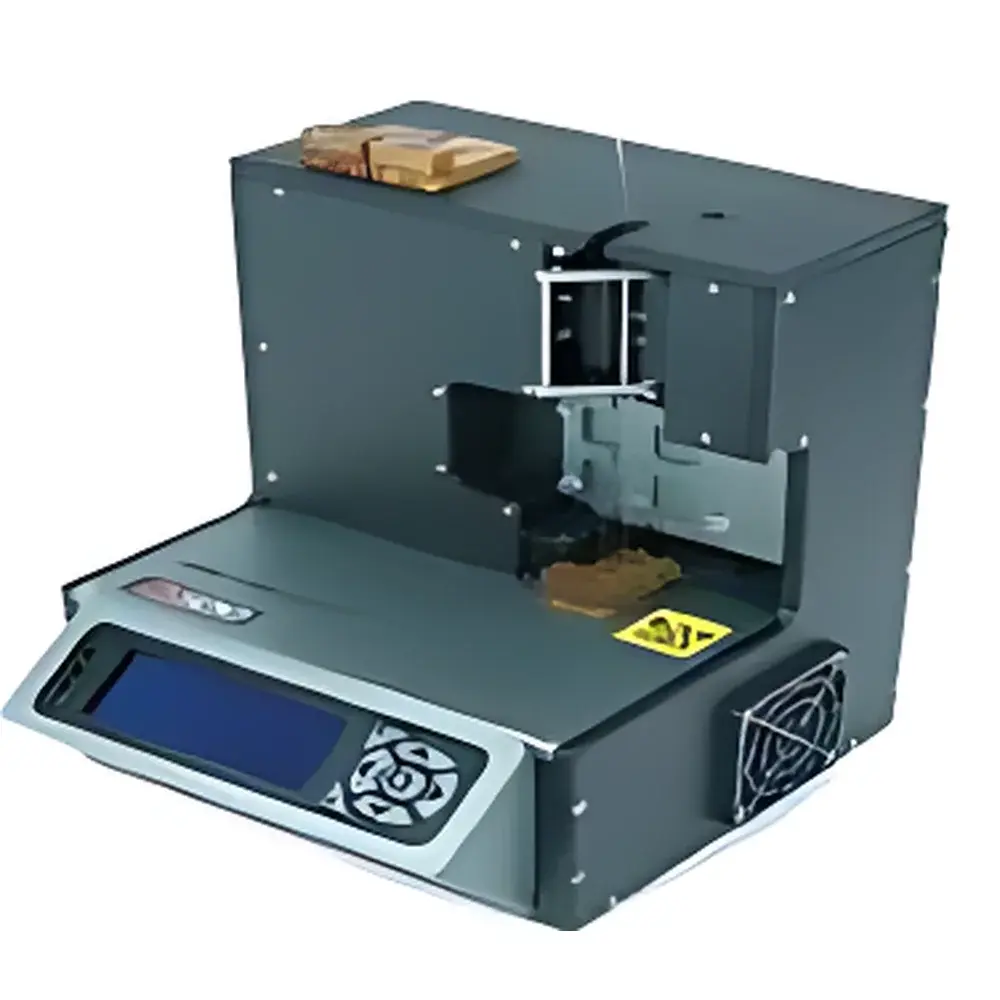
3SAE LCC II LDF Precision Fiber Cleaver
| Origin | USA |
|---|---|
| Manufacturer Type | Authorized Distributor |
| Origin Category | Imported |
| Model | LCC II LDF |
| Pricing | Available Upon Request |
Overview
The 3SAE LCC II LDF Precision Fiber Cleaver is an advanced, laboratory-grade cleaving instrument engineered for high-fidelity end-face preparation of specialty and large-diameter optical fibers. Unlike conventional cleavers relying on horizontal clamping mechanisms—which inherently induce torsional stress and compromise planarity—the LCC II LDF employs a patented longitudinal liquid-metal alloy clamping system. This system utilizes low-melting-point eutectic alloy blocks (boiling point below 100 °C) that flow vertically around the fiber under controlled thermal activation, then solidify upon cooling to form a conformal, torque-free grip. The principle enables distortion-free immobilization of non-circular fiber geometries—including octagonal, rectangular, and elliptical inner claddings—critical for high-power fiber laser systems and photonic crystal fibers where beam quality and splice loss are directly governed by cleave angle accuracy and surface flatness (Ra < 0.5 nm typical). Designed for reproducible cleaving across a broad cladding diameter range (125–1000 µm), the LCC II LDF operates on the fundamental principle of controlled scribe-and-break using a diamond-tipped blade with programmable lateral force and axial stroke timing.
Key Features
- Longitudinal liquid-metal alloy clamping system eliminates rotational torque during fixation—ensuring zero angular deviation and sub-micron end-face flatness
- Programmable angular cleaving from 0° to 15° in 0.1° increments, supporting polarization-maintaining (PM), tilted-facet, and beam-shaping fiber configurations
- Dedicated multi-range clamping fixtures: three interchangeable modules cover 125–300 µm, 300–600 µm, and 600–1000 µm cladding diameters
- 10 user-configurable cleaving protocols stored in non-volatile memory—each defining blade pressure, scoring depth, break velocity, and angle offset
- Extended diamond blade service life (>50,000 cleaves per edge) due to optimized load distribution and automated blade repositioning
- RS-232 serial interface (9-pin D-sub, male) for remote operation, firmware updates, and integration into automated test benches or GLP-compliant lab workflows
Sample Compatibility & Compliance
The LCC II LDF accommodates both standard single-mode/multimode fibers (SMF/MMF) and advanced specialty fibers including octagonal double-clad fibers (DCF), photonic bandgap fibers (PBGF), hollow-core fibers, and polymer optical fibers (POF). Its adaptive clamping geometry ensures mechanical stability without micro-bending or core deformation—particularly essential for fibers with non-circular cross-sections where traditional v-groove fixtures fail. The instrument complies with IEC 61300-3-1 (fiber optic interconnecting devices and passive components – basic test and measurement procedures – part 3-1: examinations and measurements – fiber cleave quality) and supports documentation traceability required under ISO/IEC 17025-accredited calibration laboratories. Optional audit trail logging via RS-232 enables alignment with FDA 21 CFR Part 11 electronic record requirements when integrated into regulated manufacturing environments.
Software & Data Management
While the LCC II LDF operates autonomously via its front-panel membrane keypad and LCD display, its RS-232 interface permits bidirectional communication with host PCs running custom LabVIEW, Python (PySerial), or MATLAB control scripts. Users may export cleave logs—including timestamp, program ID, fiber diameter input, actual cleave angle, and blade usage count—for QA/QC reporting. Firmware version 2.4+ supports SCPI-like command syntax (e.g., :CLEAVE:ANGLE 8.5, :PROG:LOAD 3) and returns status codes compliant with IEEE 488.2. No proprietary software installation is required; configuration files are human-readable ASCII text. All parameter settings persist through power cycles, and factory defaults can be restored via hardware reset sequence.
Applications
- Preparation of high-brightness fiber laser pigtails with angled (8°) or ultra-flat (0°) facets to minimize back-reflection in MOPA architectures
- Cleaving of octagonal inner-clad pump delivery fibers for kW-class Yb-doped amplifiers—where mechanical symmetry preservation is mandatory
- R&D prototyping of multicore, few-mode, and microstructured fibers requiring repeatable facet geometry for near-field/far-field characterization
- Quality assurance in fiber-optic sensor manufacturing, especially for Fabry–Pérot and Bragg grating-based devices sensitive to end-face roughness
- Calibration reference fiber production in national metrology institutes adhering to ISO 10110 surface quality specifications
FAQ
What fiber geometries does the LCC II LDF support beyond circular cross-sections?
It natively accommodates octagonal, square, rectangular, and elliptical claddings up to 1000 µm diagonal dimension—enabled by isotropic alloy flow during clamping.
Is the liquid-metal alloy reusable, and how many cycles does one block support?
Each CON-01-0005 alloy block is rated for ≥200 thermal cycles (melt/solidify) and retains dimensional integrity; ten blocks are included in standard configuration.
Can cleave angle be verified in situ without removing the fiber?
No real-time angle measurement is built-in; however, post-cleave inspection via interferometric microscope (e.g., Zygo NewView) or scanning electron microscopy (SEM) confirms achieved angle within ±0.05° tolerance.
Does the device meet electromagnetic compatibility (EMC) standards for use in shielded laser labs?
Yes—it conforms to EN 61326-1:2013 for laboratory equipment immunity and emissions, with conducted/radiated emission levels measured below Class B limits.
How is blade wear compensated during long-term operation?
The cleaver automatically advances the diamond edge laterally after every 500 cleaves (configurable threshold), maintaining consistent scribe depth and minimizing manual recalibration frequency.



