
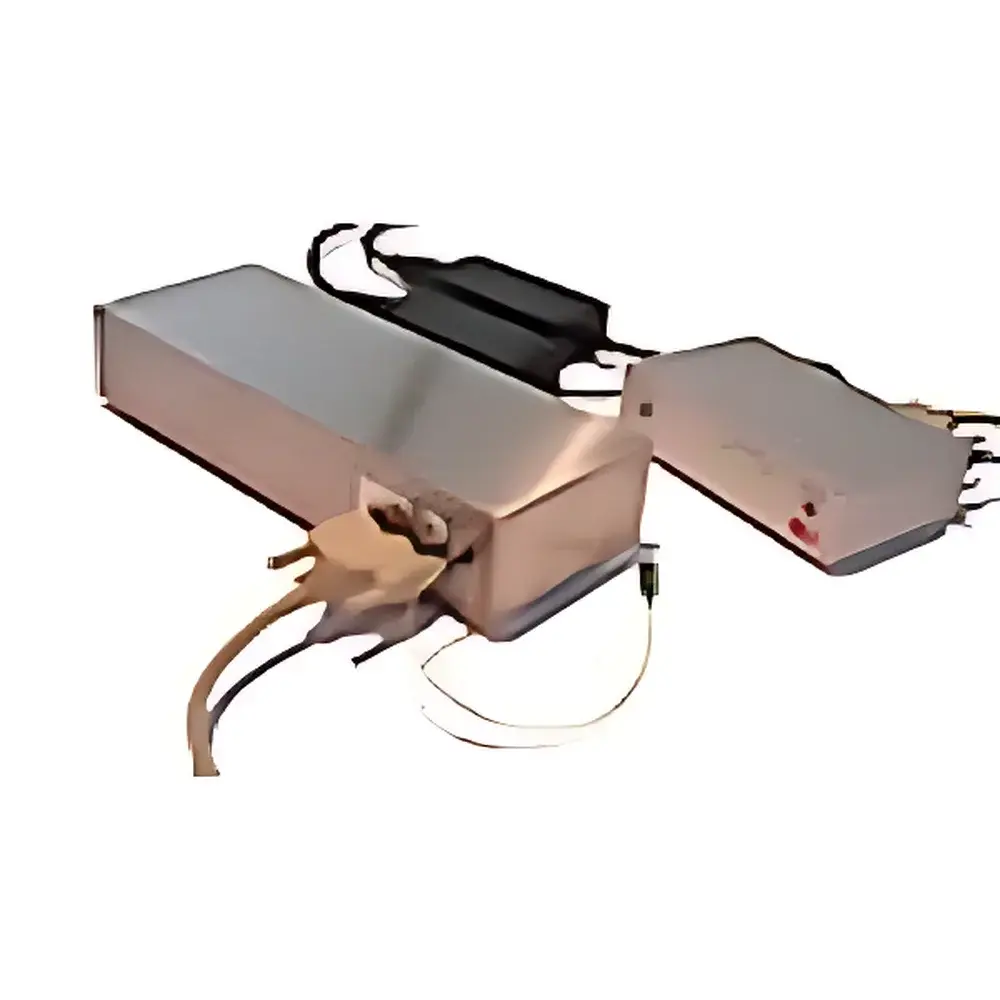
Rayscience SUMO-C00123 Single-Frequency Tunable Laser Source
| Brand | Rayscience |
|---|---|
| Model | C00123 |
| Wavelength Range | 1050–1060 nm / 1536–1546 nm |
| Linewidth | ~10 kHz |
| Output Power | >20 mW (1050 nm band), >15 mW (1540 nm band) |
| FM Modulation Bandwidth | 10 kHz |
| FM Frequency Deviation | ≤10 GHz |
| Side-Mode Suppression Ratio | >60 dB |
| Polarization Extinction Ratio (PER) | >13 dB |
| Amplitude Noise | <0.5 % rms (over 1 h) |
| Warm-up Time | <15 min |
| Operating Temperature | 10°C to 40°C |
| Laser Head Dimensions | 300 × 117 × 48 mm³ |
| Power Consumption | <10 W |
| Input Power | 90–264 VAC, 47–63 Hz |
Overview
The Rayscience SUMO-C00123 is a compact, single-frequency tunable laser source engineered for integration into OEM optical systems requiring high spectral purity, low phase/frequency noise, and long-term amplitude stability. Based on distributed feedback (DFB) or external cavity diode laser (ECDL) architecture—depending on wavelength variant—the SUMO-C00123 delivers narrow-linewidth emission with intrinsic coherence lengths exceeding 30 km, making it suitable for interferometric sensing, coherent optical communications, fiber optic gyroscopes, and precision spectroscopy applications. Its design emphasizes robustness under varying thermal and mechanical conditions, with active temperature stabilization and low-noise current control ensuring stable operation across the specified 10°C–40°C ambient range. The laser emits through polarization-maintaining (PM) fiber with >13 dB PER, enabling direct coupling into polarization-sensitive components without additional alignment or compensation stages.
Key Features
- Two independently optimized wavelength bands: 1050–1060 nm (ideal for Yb-doped fiber amplification and OCT applications) and 1536–1546 nm (C-band telecom compatibility and LIDAR heterodyne detection)
- Ultra-narrow instantaneous linewidth of ~10 kHz (equivalent to 3×10⁻⁷ cm⁻¹), verified via delayed self-heterodyne interferometry
- Low amplitude noise (<0.5 % rms over 1-hour measurement window), critical for high-dynamic-range photonic analog signal processing
- Integrated frequency modulation capability with 10 kHz bandwidth and ≤10 GHz deviation, supporting lock-in detection, Pound–Drever–Hall stabilization, and swept-wavelength interferometry
- High side-mode suppression ratio (>60 dB), confirming fundamental mode dominance and minimizing parasitic mode interference in sensitive metrology setups
- Compact form factor (300 × 117 × 48 mm³) with low power draw (<10 W), enabling deployment in space-constrained rack-mounted or portable instrumentation platforms
Sample Compatibility & Compliance
The SUMO-C00123 is designed for seamless integration into laboratory-grade and industrial optical testbenches, including fiber-based interferometers (Michelson, Mach–Zehnder), atomic vapor cells (e.g., Rb or Cs D2-line spectroscopy), and optical coherence tomography (OCT) engines. Its PM fiber output (FC/APC connector standard) ensures compatibility with industry-standard polarization controllers, isolators, and modulators. While not certified to IEC 61000-6-3 or FDA 21 CFR Part 11 out-of-the-box, the laser’s analog modulation interface and stable analog/digital control signals support traceable calibration workflows compliant with ISO/IEC 17025 requirements when deployed within validated system architectures. It meets RoHS Directive 2011/65/EU for hazardous substance restrictions and conforms to CE marking requirements for electromagnetic compatibility (EN 61326-1) and safety (EN 60825-1:2014 Class 1M laser product classification).
Software & Data Management
The SUMO-C00123 operates via RS-232 or USB virtual COM port using ASCII command protocol, enabling full remote control of wavelength tuning, output power level, FM parameters, and status monitoring. Rayscience provides a Windows-compatible GUI application for rapid setup and characterization, along with documented SCPI-like command sets for integration into LabVIEW, Python (PySerial), MATLAB, or custom C++ control frameworks. All operational parameters—including setpoints, real-time sensor readings (TEC temperature, photodiode monitor output), and error logs—are timestamped and exportable in CSV format. For GxP-regulated environments, users may implement audit-trail functionality at the host system level; the device itself supports deterministic response timing and non-volatile parameter storage across power cycles.
Applications
- Fiber-optic sensing: Distributed acoustic sensing (DAS), strain/temperature mapping in smart structures
- Coherent detection: Metrology-grade optical time-domain reflectometry (OTDR), Brillouin optical time-domain analysis (BOTDA)
- Quantum optics: Pumping of nonlinear crystals for SPDC photon-pair generation, cavity-enhanced absorption spectroscopy
- Biophotonics: Swept-source OCT systems requiring high sweep linearity and phase stability
- Telecom R&D: Characterization of DWDM components, optical filter response mapping, and coherent receiver testing
- Atomic physics: Laser cooling and trapping experiments requiring precise frequency locking to atomic transitions
FAQ
Is the SUMO-C00123 suitable for use in vacuum or elevated temperature environments?
No—it is rated for operation only within 10°C–40°C ambient temperature and standard atmospheric pressure. Extended environmental operation requires external thermal management and hermetic packaging.
Can the laser be operated in continuous-wave (CW) mode without modulation?
Yes—FM modulation is optional and disabled by default. The unit delivers stable CW output with factory-set center wavelength and power level.
What fiber type is used for the PM output, and is customization available?
Standard delivery uses Panda-type PM fiber with 1.5 m length and FC/APC connector. Custom fiber types (e.g., HiBi-1060, PM1550), lengths, or connectors (e.g., FC/PC, SC/APC) are available upon request with lead-time adjustment.
Does the SUMO-C00123 include built-in wavelength calibration?
It incorporates an internal wavelength reference via thermally stabilized etalon monitoring, providing ±5 pm relative accuracy. Absolute wavelength calibration traceable to NIST standards is achievable using an external wavemeter and is recommended for metrology-critical applications.
How is long-term power stability ensured during extended operation?
Amplitude drift is actively suppressed via integrated photodiode feedback loop controlling the laser diode bias current, maintaining <0.5 % rms fluctuation over 1-hour intervals under constant thermal conditions.





