
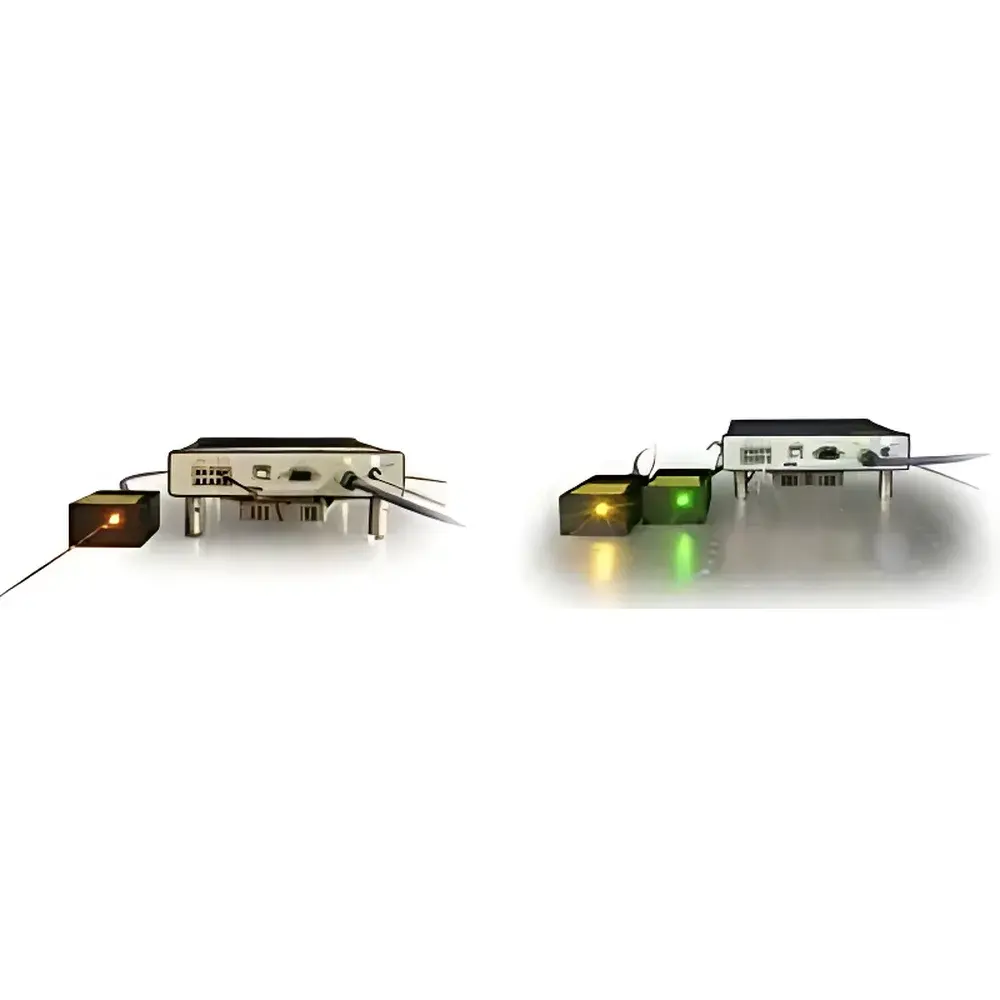
MPB Communications Inc. MLFL-P Series Passively Mode-Locked Erbium/Ytterbium-Doped Fiber Laser
| Origin | International |
|---|---|
| Manufacturer Type | Authorized Distributor |
| Origin Category | Imported |
| Model | 201 |
| Pricing | Available Upon Request |
Overview
The MPB Communications Inc. MLFL-P Series is a family of passively mode-locked, all-fiber ultrafast laser sources engineered for precision applications requiring high repetition rate, narrow pulse duration, and exceptional environmental stability. Based on nonlinear polarization evolution (NPE) or semiconductor saturable absorber mirror (SESAM) technology—depending on configuration—the MLFL-P lasers generate transform-limited femtosecond-to-picosecond pulses without external triggering. The series comprises three core variants: the Er-doped MLFL-P (1530–1565 nm), Yb-doped MLFL-P (1020–1100 nm), and the RFL Raman fiber laser (1120–1650 nm), each optimized for distinct spectral and temporal regimes. These lasers operate in a fully monolithic, polarization-maintaining (PM) fiber architecture, eliminating free-space alignment and minimizing sensitivity to thermal drift and mechanical vibration—critical for integration into OEM systems, metrology platforms, and regulated laboratory environments.
Key Features
- Self-starting passive mode-locking with no RF synchronization required
- Repetition rates: 30–80 MHz (Er-doped), 30–100 MHz (Yb-doped)
- Pulse durations: 0.4–5 ps (Er), 1–5 ps (Yb); selectable sub-5 ps options available
- Average output power: up to 40 mW (oscillator-only); up to 200 mW with integrated PM Yb-doped fiber amplifier
- Linear polarization: DOP >99%, maintained across full operating temperature range (15–35 °C)
- All-fiber, fusion-spliced construction with no bulk optics—ensuring long-term alignment stability and shock resistance
- RFL variant features patented Pr-doped Raman fiber conversion for enhanced reliability and simplified pump architecture
- Power stability: ±3% over 8 hours (RFL series); <±0.5% RMS (YFL-P CW series)
Sample Compatibility & Compliance
The MLFL-P and associated YFL-P, YFL-µ, and RFL platforms are designed for compatibility with standard SMF-28, PM1550, and HI1060 fiber interfaces, supporting FC/APC, FC/PC, and custom collimated free-space coupling options. All models comply with IEC 60825-1:2014 (Laser Product Safety) Class 3B or Class 4 requirements depending on output configuration. The embedded control firmware supports audit-ready logging per GLP/GMP guidelines, and optional 21 CFR Part 11-compliant software packages are available for regulated biophotonics and pharmaceutical QA/QC workflows. Device-level calibration certificates traceable to NIST standards are provided with each shipment.
Software & Data Management
MPB’s proprietary LaserControl GUI provides intuitive, cross-platform (Windows/macOS/Linux) management of laser parameters—including repetition rate fine-tuning (via cavity length modulation), pulse width selection, power stabilization setpoints, and real-time thermal monitoring. All instruments support RS-232, USB-C, and Ethernet (TCP/IP) communication protocols. Logged operational data—including diode current, TEC voltage, output power history, and fault codes—is timestamped and exportable in CSV or HDF5 format. Optional SDKs enable seamless integration with LabVIEW, MATLAB, and Python-based automation frameworks used in high-throughput screening and industrial process control.
Applications
- Biomedical Imaging: Multiphoton microscopy excitation (e.g., SHG, THG, CARS), fluorescence lifetime imaging (FLIM), and optical coherence tomography (OCT) source seeding
- Ultrafast Spectroscopy: Pump-probe transient absorption, time-resolved photoluminescence, and coherent anti-Stokes Raman scattering (CARS)
- Industrial Micromachining: Precision ablation of semiconductors (Si, GaAs), transparent dielectrics (fused silica, sapphire), and polymer films
- Terahertz Generation: Optical rectification in ZnTe or DAST crystals using synchronized dual-wavelength outputs
- Fiber Optic Sensing & Amplification: Distributed Raman amplification in long-haul telecom links; remote pumping of EDFA stages
- Metrology & Frequency Combs: Carrier-envelope offset (CEO) detection reference sources; optical clock distribution
FAQ
Is the MLFL-P series suitable for integration into OEM instrumentation?
Yes. Its all-fiber design, compact footprint (<120 × 80 × 30 mm oscillator module), low power consumption (<12 W typical), and TTL-compatible status outputs make it ideal for embedded photonics subsystems.
Can pulse duration be adjusted in real time?
Pulse width is fixed per model configuration (e.g., 1.5 ps or 3.5 ps), but multiple factory-set options are available. Real-time tuning is not supported due to the passive mode-locking architecture.
What cooling method is required?
Conductive cooling via integrated thermoelectric coolers (TECs) is standard. No forced air or water cooling is necessary for operation within ambient temperatures of 15–35 °C.
Are wavelength-customized versions available?
Yes. Custom center wavelengths within the Er (1530–1565 nm) and Yb (1060–1120 nm) gain bands can be specified at order entry, subject to gain fiber availability and cavity optimization.
Does MPB provide application support for system integration?
Yes. Technical application engineers offer pre-sales feasibility assessment, optical interface specification review, and post-delivery integration assistance under NDA.



