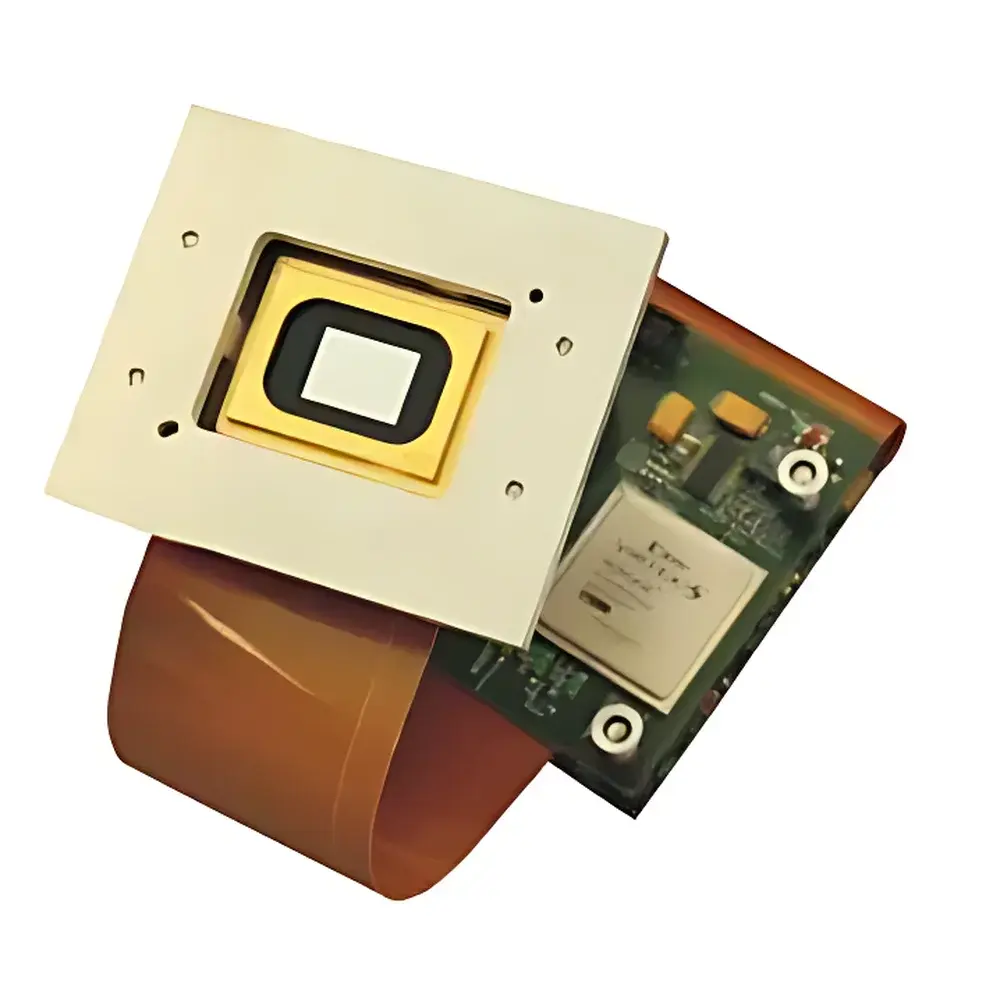
VIALUX V-6501 Digital Micromirror Device (DMD) Spatial Light Modulator
| Brand | VIALUX |
|---|---|
| Origin | Germany |
| Model | V-6501 |
| Optical Wavelength Range | 350–2500 nm |
| DMD Chipset | Texas Instruments DLP Discovery 4100 |
| Micro-mirror Array | 1920 × 1200 |
| Mirror Pitch | 10.8 µm |
| Tilt Angle | ±12° |
| Max. Optical Power Handling (Cooled A-Type Package) | 60 W |
| Frame Rate (1-bit) | 22,727 Hz |
| Onboard Memory | 64 Gbit |
| Interface | USB 3.0 |
| Control Firmware | ALP-4.3 |
| Supported OS | Windows |
| API Compatibility | C++, .NET, LabVIEW, MATLAB DLLs |
Overview
The VIALUX V-6501 Digital Micromirror Device (DMD) Spatial Light Modulator is a high-performance optical semiconductor module engineered for precision digital light control in demanding scientific and industrial applications. At its core lies the Texas Instruments DLP Discovery 4100 chipset—a monolithic CMOS-based microelectromechanical system (MEMS) array comprising 1920 × 1200 individually addressable aluminum micromirrors, each measuring 10.8 µm in pitch and capable of bidirectional electrostatic actuation at ±12°. This binary spatial light modulation architecture operates on the principle of total internal reflection: incident light is selectively directed either toward or away from an optical path based on mirror orientation, enabling deterministic, diffraction-limited pixel-level control without analog intensity gradation. Unlike liquid crystal-based SLMs, the DMD’s solid-state mechanical design ensures sub-microsecond switching latency, exceptional temporal stability, and immunity to polarization dependence—making it ideal for applications requiring high-speed, high-fidelity optical patterning under rigorous environmental and regulatory conditions.
Key Features
- Native 1920 × 1200 WUXGA resolution with 10.8 µm mirror pitch for high spatial fidelity and minimal pixel crosstalk
- Full spectral coverage from deep ultraviolet (350 nm) to short-wave near-infrared (2500 nm), validated for use with cooled A-type DMD packaging rated for continuous optical power loads up to 60 W
- Real-time frame rates up to 22,727 Hz at 1-bit depth—achieved via integrated Virtex-7 FPGA, USB 3.0 controller firmware, and 64 Gbit onboard memory—ensuring deterministic data streaming without host CPU bottlenecks
- ALP-4.3 control software suite with native support for Windows, including DLL-based APIs compatible with C++, .NET, LabVIEW, and MATLAB development environments
- Modular hardware architecture: compact DMD board (102 × 83 mm²) and control board (162 × 99 mm²) designed for OEM integration, with standardized LVDS signaling and configurable bit-depth mapping (1–8 bit)
- Open-source demonstration software with documented source code, enabling full customization of timing sequences, pattern sequencing, and trigger synchronization (TTL/RS-422)
Sample Compatibility & Compliance
The V-6501 is routinely deployed in regulated optical instrumentation environments where traceability, repeatability, and long-term operational integrity are critical. Its optical performance remains stable across ambient temperature ranges of 15–35 °C when operated with active cooling, satisfying thermal management requirements outlined in ISO 10110-7 (optical component surface quality) and IEC 61000-6-3 (EMC emission standards). While the device itself is not FDA-cleared or CE-marked as a medical device, its architecture complies with foundational principles of GLP and GMP-aligned optical subsystems—particularly in setups involving laser-based photolithography, structured illumination microscopy, or quantitative fluorescence imaging. The ALP-4.3 firmware supports audit-trail logging and timestamped frame metadata export, facilitating alignment with 21 CFR Part 11 electronic record requirements when integrated into validated laboratory workflows.
Software & Data Management
Control and configuration are managed exclusively through the ALP-4.3 software platform, distributed as a Windows-native application with comprehensive SDK documentation. The included dynamic-link library (DLL) exposes low-level register access, pattern buffering, and real-time trigger handling—enabling deterministic synchronization with external equipment such as pulsed lasers, CCD/CMOS cameras, or motion stages. All frame data transfers occur over USB 3.0 at sustained bandwidths exceeding 400 MB/s, with zero-copy DMA support minimizing host-side latency. Pattern sequences can be preloaded into the 64 Gbit on-board memory for autonomous playback—essential for closed-loop adaptive optics or high-throughput maskless lithography. Export formats include TIFF (for static masks), HDF5 (for time-series datasets), and CSV (for metadata logging), ensuring interoperability with common scientific data analysis pipelines.
Applications
- Maskless photolithography and direct-write microfabrication using UV-capable DMD configurations (350–400 nm)
- Structured illumination microscopy (SIM) and single-pixel imaging systems requiring >10 kHz pattern update rates
- Holographic data storage and computational wavefront shaping in adaptive optics testbeds
- 3D scanning and fringe projection profilometry with programmable phase-stepping sequences
- Time-resolved spectroscopy and pump-probe experiments leveraging precise TTL-synchronized illumination gating
- Educational platforms for teaching MEMS physics, digital optics, and real-time embedded systems development
FAQ
Is the V-6501 compatible with non-Windows operating systems?
No—the ALP-4.3 control stack and USB 3.0 firmware are validated exclusively on Windows 10/11 (64-bit). Linux or macOS integration requires third-party driver development and is not supported by VIALUX.
What cooling solution is required for 60 W optical loading?
Operation at maximum optical power necessitates the optional water-cooled A-type DMD package with integrated thermal interface material and flow-rate monitoring; air cooling alone is insufficient for sustained 60 W irradiance.
Can multiple V-6501 units be synchronized?
Yes—via external TTL master clock input and frame-ready output signals, enabling sub-microsecond inter-device jitter for multi-DMD interferometric or stereoscopic setups.
Does the device support grayscale or analog intensity modulation?
No—the DMD is inherently binary; grayscale is emulated via pulse-width modulation (PWM) across successive frames, with effective bit-depth limited by achievable frame rate and temporal coherence requirements.
Is ALP-4.3 included with hardware purchase?
Yes—each V-6501 shipment includes a perpetual license for ALP-4.3 software, firmware updates, and full SDK access with source-code examples for all supported development environments.