
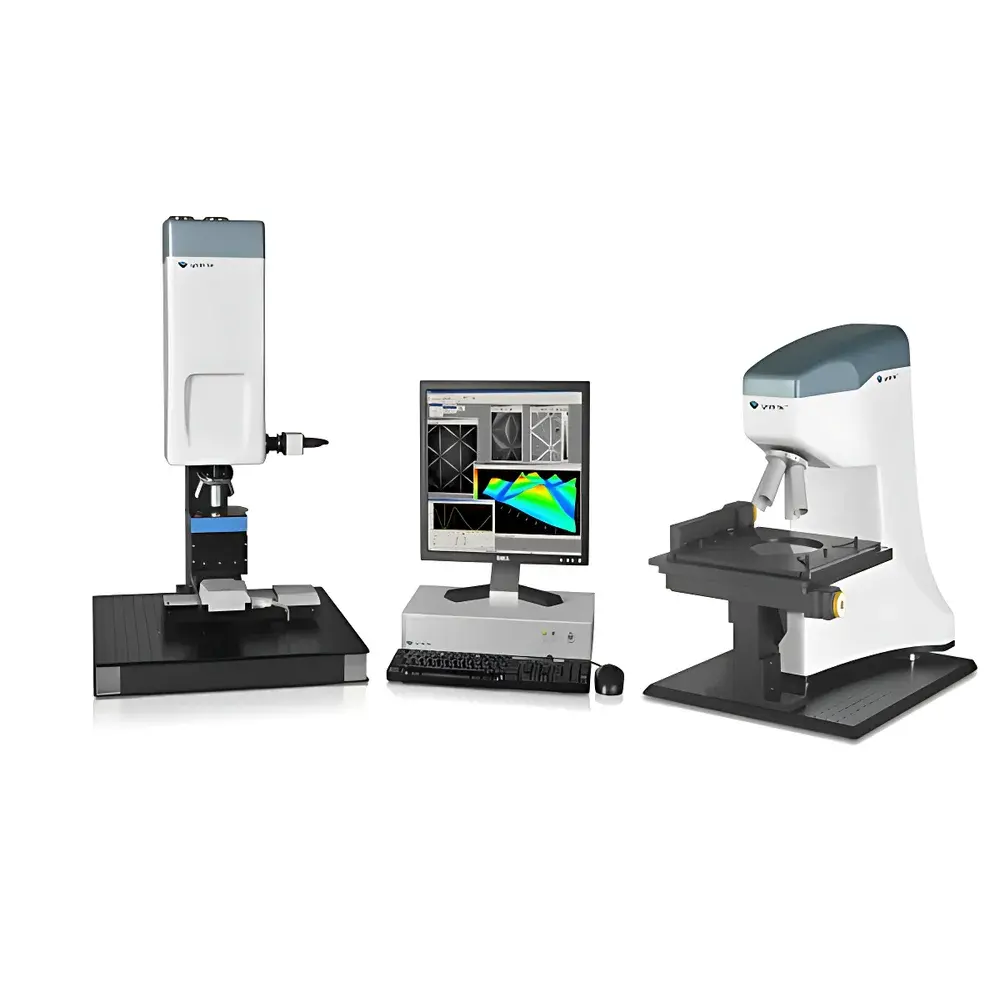
Lyncee Tec DHM Digital Holographic Microscope
| Brand | Lyncee Tec |
|---|---|
| Origin | Switzerland |
| Model | DHM |
| Measurement Principle | Digital Holographic Microscopy (Single- and Dual-Wavelength Interferometric Phase Imaging) |
| Vertical Resolution | 0.2 nm (single-wavelength), 50 nm (dual-wavelength) |
| Vertical Repeatability | <0.01 nm |
| Vertical Scan Accuracy | 0.1 nm |
| Lateral Resolution | 300 nm (with 1.4 NA oil immersion objective) |
| Field of View | 0.3–18 mm (objective-dependent) |
| Hologram Acquisition Speed | up to 15 fps (1024×1040 pixels), optional 30 fps |
| Reconstruction Rate | 15 fps @ 512×512, 4 fps @ 1024×1040 (single-wavelength) |
| Dual-Wavelength Scan Time | 1.5 s |
| Z-Scan Speed | 6 µm/s |
| Digital Focus Range | up to 50× depth of field |
| Illumination Intensity | <1 µW/cm² |
| Camera | 1392×1040 px, 8-bit monochrome CMOS |
| Software | Koala™ (C++/.NET-based, GLP-compliant workflow architecture) |
Overview
The Lyncee Tec DHM Digital Holographic Microscope is a non-scanning, label-free interferometric imaging platform engineered for quantitative, dynamic, three-dimensional topographic and phase contrast analysis at micro- and nanoscale resolution. Unlike conventional optical microscopes that rely on intensity-based imaging and mechanical focusing, the DHM captures a single digital hologram—encoding both amplitude and phase information of the object wavefront—using coherent laser illumination and off-axis interferometry. This hologram is numerically reconstructed via Fresnel or angular spectrum algorithms to generate quantitative phase maps with sub-nanometer vertical sensitivity and diffraction-limited lateral resolution. The system operates in real time without physical focus adjustment, enabling true in situ, non-invasive observation of dynamic processes—including live cell morphodynamics, MEMS actuation, thin-film swelling, and surface deformation under thermal or mechanical stress. Its core architecture eliminates vibration-sensitive scanning mechanisms and avoids phototoxic labeling, making it uniquely suited for long-term, high-stability metrology in regulated environments.
Key Features
- True digital autofocus: Full-field quantitative phase reconstruction enables refocusing across the entire depth of field post-acquisition—no mechanical Z-stage movement required during measurement.
- Sub-angstrom vertical repeatability: Achieves <0.01 nm height repeatability in single-wavelength mode, validated per ISO 25178-6 and ASTM E2923 for surface texture metrology.
- Dual-wavelength synthetic wavelength operation: Extends unambiguous vertical measurement range to 10 mm while maintaining 50 nm axial resolution—ideal for step-height metrology and large-aspect-ratio microstructures.
- Non-scanning, non-contact imaging: No raster scanning or probe contact ensures zero sample perturbation and immunity to stage drift or piezo hysteresis.
- Ultra-low photodamage illumination: Laser power density <1 µW/cm² enables extended observation of light-sensitive biological specimens without fixation or staining.
- Modular optical design: Supports interchangeable objectives (including 1.4 NA oil immersion), XYZ motorized stages, and synchronized stroboscopic acquisition for periodic motion analysis.
Sample Compatibility & Compliance
The DHM accommodates a broad range of reflective and semi-transparent samples—from polished silicon wafers and optical coatings to living adherent cells, hydrogels, and MEMS devices—without coating, sectioning, or vacuum requirements. Its quantitative phase contrast mechanism provides intrinsic sensitivity to optical path length differences, enabling label-free detection of dry mass distribution, membrane fluctuations, and intracellular refractive index gradients. The system complies with ISO/IEC 17025 documentation standards for calibration traceability and supports audit-ready data integrity through Koala™ software’s built-in electronic signatures, user access controls, and 21 CFR Part 11–compliant audit trails. All phase and topography data are stored in vendor-neutral HDF5 format, ensuring interoperability with MATLAB, Python (h5py), and third-party image analysis pipelines.
Software & Data Management
Koala™ software—the proprietary C++/.NET application suite—is designed for scientific reproducibility and regulatory compliance. It provides real-time hologram acquisition, GPU-accelerated numerical reconstruction, and batch processing of time-lapse phase sequences. Core modules include quantitative surface roughness analysis (Sa, Sq, Sz per ISO 25178-2), dynamic thickness mapping, time-resolved deformation vector fields, and automated particle tracking in phase space. Data export supports TIFF (with embedded metadata), CSV, and HDF5; all processing parameters—including wavelength, magnification, and reconstruction distance—are automatically logged with each dataset. Optional GLP/GMP configuration enforces electronic signatures, role-based permissions, and immutable audit logs meeting FDA and EMA validation requirements.
Applications
- Materials Science: In situ monitoring of thin-film growth, corrosion kinetics, thermal expansion, and stress-induced buckling in coatings and layered heterostructures.
- MEMS/NEMS Characterization: Quantitative out-of-plane displacement, resonance mode shape extraction, and packaging-induced deformation analysis without fiducial markers.
- Cell Biophysics: Label-free quantification of cell volume, dry mass, membrane fluctuations, and mitotic progression in primary neurons, stem cells, and organoids.
- Optics & Metrology: Wavefront error mapping of aspheric lenses, defect inspection of photomasks, and flatness verification of precision optics per ISO 10110.
- Quality Control: Automated pass/fail inspection of microstructured surfaces (e.g., microfluidic channels, diffractive optical elements) using customizable tolerance masks and statistical process control (SPC) integration.
FAQ
How does DHM differ from conventional confocal or white-light interferometry?
DHM acquires full-field phase information in a single exposure without scanning, eliminating motion artifacts and enabling higher temporal resolution and superior stability for long-duration measurements.
Can DHM measure transparent or weakly scattering samples?
Yes—its phase sensitivity allows quantitative imaging of optically homogeneous but refractively heterogeneous specimens such as lipid bilayers, protein crystals, and polymer gels without contrast agents.
Is calibration traceable to international standards?
Vertical calibration is wavelength-referenced and requires no mechanical artifact; traceability to NIST-traceable HeNe lasers is documented per ISO/IEC 17025 calibration certificates.
What computing resources are required for real-time reconstruction?
A Dell Precision workstation with NVIDIA RTX A5000 GPU, 64 GB RAM, and dual SSD storage is recommended for sustained 15 fps reconstruction at 1024×1040 resolution.
Does the system support automated metrology workflows?
Yes—Koala™ includes scriptable macros, ROI-based batch analysis, and OPC UA interface for integration into factory automation systems and MES platforms.




