
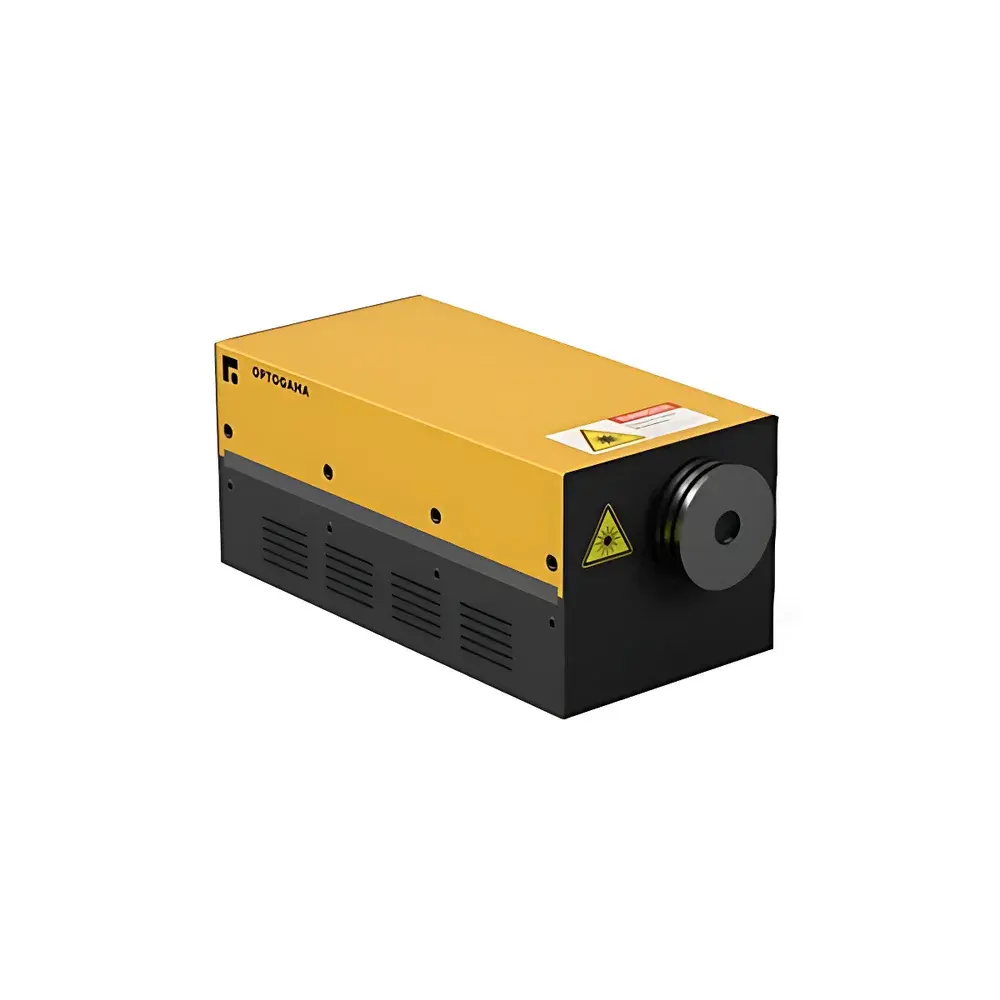
Optogama Erbium Series 1.5 µm DPSS Continuous-Wave Eye-Safe Erbium-Doped Solid-State Laser
| Brand | Optogama |
|---|---|
| Origin | Lithuania |
| Manufacturer Type | OEM Manufacturer (Not Distributor) |
| Product Category | Imported Scientific Laser System |
| Model | Erbium Series |
| Output Wavelengths | 1522 nm, 1531 nm, 1550 nm, or 1602 nm |
| Output Power | Up to 500 mW CW |
| Beam Mode | TEM₀₀ (Diffraction-Limited) |
| Spectral Linewidth | FWHM < 1 nm |
| Power Stability | ±2% over 8 hours |
| Cooling | Air-Cooled |
| Gain Medium | Erbium-Doped Crystal |
| Pump Source | Diode-Pumped |
| Compliance | IEC 60825-1:2014 Class 1M / Class 3R (wavelength-dependent) |
Overview
The Optogama Erbium Series is a diode-pumped solid-state (DPSS) continuous-wave (CW) laser system engineered for precision applications requiring eye-safe operation in the 1.5 µm spectral region. Operating at discrete wavelengths—1522 nm, 1531 nm, 1550 nm, or 1602 nm—this laser leverages an erbium-doped crystalline gain medium optically pumped by high-efficiency laser diodes. Its fundamental design adheres to the physical principle of stimulated emission within a quasi-three-level energy scheme, optimized for low quantum defect and minimal thermal loading. The 1.5 µm emission falls within the atmospheric transmission window and, critically, resides in the retinal hazard region’s “eye-safe” band (defined by ANSI Z136.1 and IEC 60825-1), where ocular absorption is dominated by the aqueous humor rather than the retina—enabling significantly higher permissible exposure limits (MPEs) compared to visible or near-IR lasers. This makes the Erbium Series suitable for open-beam applications in industrial, biomedical, and field-deployable instrumentation without requiring stringent enclosure-based safety interlocks.
Key Features
- Continuous-wave output power up to 500 mW with RMS power stability better than ±2% over an 8-hour period under constant ambient conditions
- Diffraction-limited TEM₀₀ spatial mode with M² < 1.1, ensuring high focusability and minimal divergence for interferometric and alignment-critical tasks
- Narrow spectral bandwidth (FWHM < 1 nm) supporting high-resolution spectroscopic interrogation and minimizing chromatic dispersion effects in fiber-coupled systems
- Compact, monolithic DPSS architecture with integrated thermoelectric cooling and passive heat-sinking—no external chiller or water lines required
- Wavelength-selective configuration options enabling application-specific optimization: 1550 nm for telecom-grade fiber compatibility; 1522 nm/1531 nm for molecular absorption features in gas sensing; 1602 nm for enhanced tissue penetration in preclinical optical imaging
- Robust mechanical housing rated for laboratory and light industrial environments (IP52 ingress protection, shock-tested per MIL-STD-810G)
Sample Compatibility & Compliance
The Erbium Series is compatible with standard single-mode and polarization-maintaining fibers (FC/APC or FC/PC connectors optional), free-space optical benches, and OEM integration into larger photonic platforms. It meets IEC 60825-1:2014 requirements for Class 1M (when used with optical instruments limiting beam divergence) and Class 3R (for direct viewing under controlled conditions), depending on configured wavelength and output aperture. All units undergo full radiometric calibration traceable to PTB (Physikalisch-Technische Bundesanstalt) standards. The system supports GLP-compliant operation through configurable logging of internal temperature, pump current, and output power diagnostics—essential for audit-ready quality control workflows in regulated environments.
Software & Data Management
The laser includes a USB 2.0–enabled digital controller with ASCII command protocol (SCPI-compatible) for seamless integration into LabVIEW, Python (PyVISA), MATLAB, or custom C++ acquisition frameworks. Firmware supports real-time monitoring of key operational parameters—including diode junction temperature, crystal temperature, and monitored photodiode feedback—with timestamped data export in CSV format. Optional analog modulation input (0–5 V, bandwidth > 100 kHz) enables external intensity control for lock-in detection or pulsed averaging schemes. All firmware updates are delivered via signed binary packages validated against SHA-256 checksums, satisfying integrity requirements under FDA 21 CFR Part 11 for electronic records in pharmaceutical and medical device R&D settings.
Applications
- Optical Metrology: Used as a stable reference source in heterodyne interferometry, cavity ring-down spectroscopy (CRDS), and optical coherence tomography (OCT) systems operating beyond 1.3 µm
- Gas Sensing & Environmental Monitoring: Targeting fundamental rovibrational absorption lines of CO₂, CH₄, NH₃, and H₂O vapor—particularly at 1531 nm and 1602 nm—enabling parts-per-trillion detection sensitivity in open-path or multipass cell configurations
- Biophotonics & Life Sciences: Employed in non-invasive tissue imaging, photoacoustic excitation, and fluorescence lifetime measurements where reduced scattering and deeper penetration depth at 1550–1600 nm improve signal-to-background ratio in murine and ex vivo models
- Fiber Characterization: Serving as a broadband-free test source for attenuation, dispersion, and nonlinear coefficient measurement in specialty mid-IR fibers (e.g., fluoride, chalcogenide) and hollow-core photonic crystal fibers
- OEM Integration: Designed for drop-in replacement in portable LIDAR subsystems, handheld spectrometers, and embedded process analyzers where size, reliability, and regulatory compliance are critical design constraints
FAQ
Is this laser certified for use in FDA-regulated medical device development?
Yes—the Erbium Series complies with IEC 60601-2-22 (for laser-based medical equipment) and supports 21 CFR Part 11–compliant data logging when paired with validated software interfaces.
Can the output wavelength be tuned continuously across the 1.5 µm band?
No—this is a fixed-wavelength DPSS laser. Wavelength selection is determined at time of manufacture (1522 nm, 1531 nm, 1550 nm, or 1602 nm); fine-tuning (< ±0.1 nm) is achievable only via temperature stabilization of the gain crystal.
What is the typical lifetime of the pump diodes under continuous operation?
Rated mean time to failure (MTTF) exceeds 20,000 hours at nominal drive current and ambient temperatures ≤ 30 °C, based on accelerated life testing per Telcordia GR-468-CORE.
Does the system include beam collimation optics?
A factory-aligned, adjustable collimator (f = 15 mm aspheric lens, 1/e² beam diameter ~1.2 mm) is included as standard; custom beam expanders or fiber coupling modules are available as optional accessories.
How is thermal drift managed during extended measurement sessions?
Active dual-stage TEC control maintains crystal temperature within ±0.05 °C, while internal thermal sensors feed back to the PID loop—ensuring wavelength stability better than ±0.02 nm over 8 hours.




