
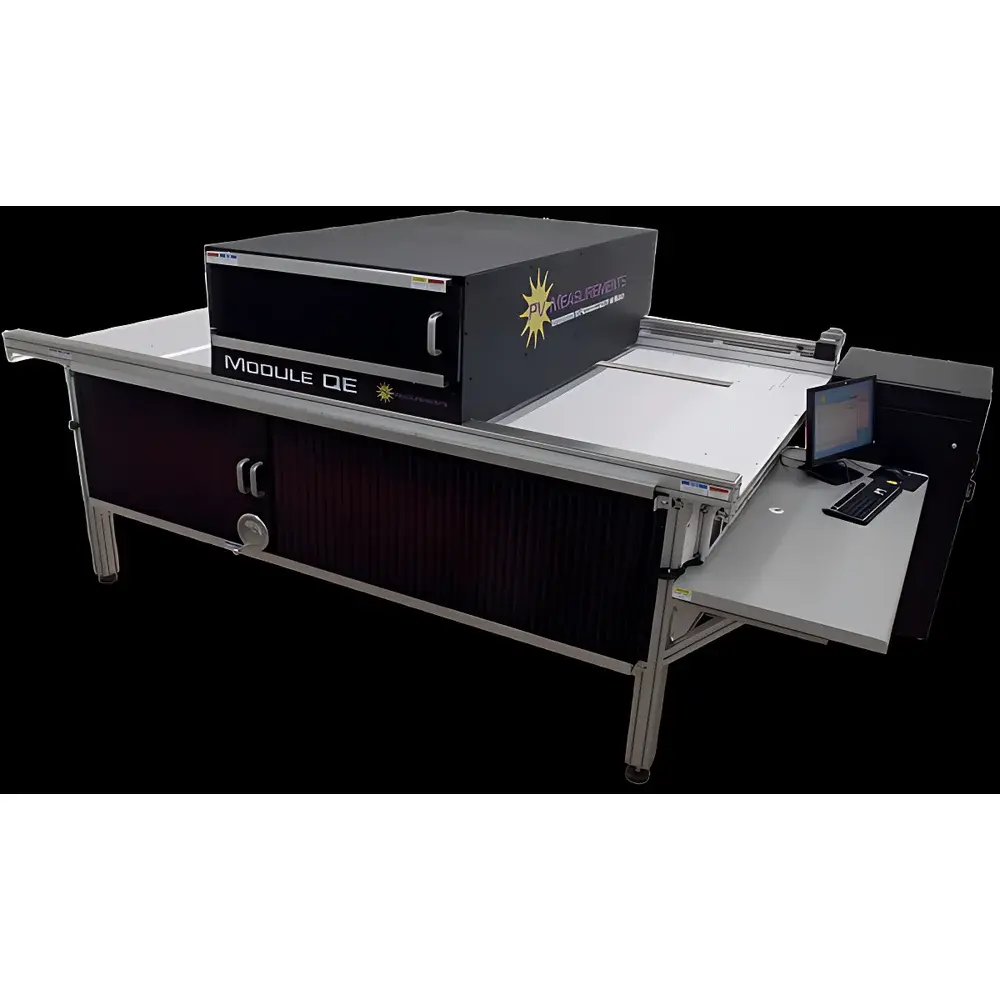
PV Measurements QEX12M Solar Module Quantum Efficiency and Spectral Response Measurement System
| Brand | PV Measurements |
|---|---|
| Origin | USA |
| Model | QEX12M |
| Measurement Mode | DC |
| Wavelength Range | 300–1100 nm (extendable to 1400 nm / 1800 nm) |
| Spectral Bandwidth | Adjustable via monochromator slit (default ~10 nm) |
| Wavelength Step | User-selectable (default 10 nm) |
| Repeatability | ±1% (400–1000 nm), ±2% (300–400 nm & 1000–1100 nm) |
| Sample Size Capacity | Up to 1 m × 2 m |
| Bias Light | Broadband, 0–1 SUN, Ø1.5 cm spot, with optional spectral filtering |
| Bias Voltage Range | −5 V to +40 V |
| Photocurrent Protection | 150 mA max |
| Chopper Frequency | 4–200 Hz |
| Calibration Traceability | NIST-traceable reference photodiode |
| Compliance | ASTM E1021-06, IEC 60904-8, ISO 18583 |
Overview
The PV Measurements QEX12M Solar Module Quantum Efficiency and Spectral Response Measurement System is a turnkey, non-destructive instrumentation platform engineered for high-accuracy external quantum efficiency (EQE), spectral response (SR), and incident photon-to-current efficiency (IPCE) characterization of fully encapsulated photovoltaic modules — including crystalline silicon, thin-film, and emerging tandem architectures. Unlike conventional cell-level QE systems, the QEX12M is uniquely optimized for large-area devices up to 1 m × 2 m, enabling direct measurement under conditions representative of real-world module operation. It operates on the principle of monochromatic photocurrent analysis: a computer-controlled double-grating monochromator generates spectrally resolved light, which is directed onto the device under test (DUT) via an all-reflective optical path — eliminating chromatic aberration and ensuring uniform illumination spot size across the full spectral range. Simultaneous monitoring of both device photocurrent and incident irradiance using a NIST-traceable reference photodiode compensates for source drift in real time, delivering high reproducibility without requiring repeated recalibration during extended scans.
Key Features
- All-reflective optical design eliminates chromatic dispersion, preserving consistent beam geometry from 300 nm to 1100 nm — critical for accurate spatial averaging across heterogeneous module surfaces.
- Integrated broadband bias illumination (0–1 SUN, Ø1.5 cm) with optional spectral filters enables controlled operating-point simulation per IEC 60904-8 and ASTM E1021-06 standards.
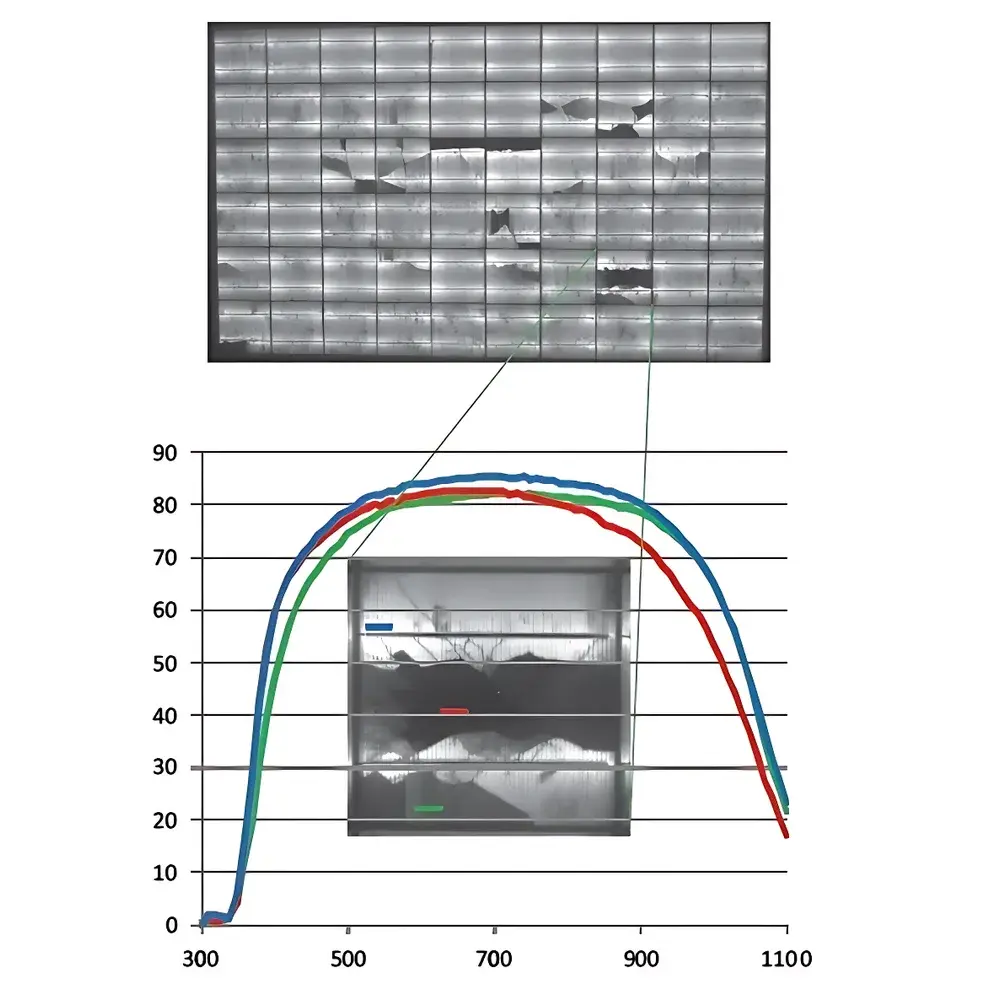
- Digital motorized stage with sub-millimeter positional repeatability supports spatially resolved mapping and comparative analysis of localized performance variations.
- Real-time dual-channel lock-in detection (signal + reference) suppresses low-frequency noise and minimizes uncertainty introduced by lamp intensity fluctuations.
- Modular wavelength extension options (up to 1400 nm or 1800 nm) support characterization of wide-bandgap perovskites, Si-based tandems, and infrared-sensitive CIGS or organic PV.
- Onboard digital microscope with live video feed ensures precise alignment of monochromatic spot relative to busbars, cell interconnects, or defect regions identified via electroluminescence (EL) pre-screening.
- Comprehensive electrical safety architecture includes programmable current limiting (150 mA max), galvanically isolated bias supply (−5 V to +40 V), and automatic fault shutdown.
Sample Compatibility & Compliance
The QEX12M accommodates standard commercial PV modules (glass-glass, glass-backsheet, bifacial), mini-modules, and custom laminated samples up to 2 m². Its non-contact, non-destructive methodology preserves encapsulant integrity and avoids delamination risks associated with probe-based cell-level testing. The system conforms to key international photovoltaic metrology standards: ASTM E1021-06 (standard practice for EQE measurements), IEC 60904-8 (spectral responsivity calibration), and ISO 18583 (guidance for module-level QE validation). All calibration data are traceable to the National Institute of Standards and Technology (NIST) through a certified reference photodiode included with each unit. Optional vacuum-compatible sample holders with temperature control (up to 125 °C) are available for accelerated aging studies and thermal-dependent SR analysis under GLP-compliant workflows.
Software & Data Management
The QEX12M is operated via Windows-based proprietary software featuring intuitive graphical workflow navigation, real-time signal visualization, and automated sequence execution. Software functions include monochromator parameter scripting (wavelength step, integration time, chopper frequency), bias light intensity ramping, multi-point spatial scanning, and concurrent acquisition of device current, reference diode signal, and environmental metadata (e.g., chamber temperature). All raw and processed data are exported in ASCII text format (CSV-compatible), enabling seamless import into MATLAB, Python (NumPy/Pandas), or statistical analysis platforms. Audit-trail functionality logs operator actions, calibration events, and instrument configuration changes — supporting 21 CFR Part 11 readiness when deployed in regulated R&D or quality assurance environments. Firmware updates and remote diagnostics are supported via secure HTTPS interface.
Applications
- Quantitative evaluation of spectral mismatch correction factors for outdoor energy yield modeling and STC rating validation.
- Root-cause analysis of performance loss mechanisms: front-surface reflection losses, encapsulant UV degradation, finger shading, solder bond resistance, and rear-side reflector inefficiency.
- Process development feedback for anti-reflective coating optimization, metallization line width tuning, and passivation layer thickness grading.
- Comparative assessment of bifacial gain under varying albedo conditions via rear-side SR mapping.
- Pre- and post-stress testing (damp heat, thermal cycling, PID) to quantify spectral selectivity shifts indicative of interface degradation.
- Support for third-party certification labs performing IEC 61215/61730 compliance testing where module-level QE data supplement power output verification.
FAQ
What sample sizes can the QEX12M accommodate?
The system supports photovoltaic modules up to 1 meter in width and 2 meters in length, with standardized mounting fixtures for rigid flat-panel configurations.
Is NIST-traceable calibration performed onsite?
A factory-calibrated NIST-traceable reference photodiode is included; users perform a single-scan calibration routine to align the optical train and electronics — no external recalibration service is required for routine operation.
Can the QEX12M measure tandem or multi-junction modules?
Yes — with optional extended-range detectors and grating configurations, the system supports spectral coverage up to 1800 nm, enabling sub-cell EQE deconvolution for perovskite/Si and III-V/Si stacks.
Does the system support automated spatial mapping?
Yes — motorized X-Y-Z stages enable programmable grid-based scanning with configurable step resolution, synchronized with spectral acquisition for localized SR profiling.
What electrical safety features are integrated?
The system includes hardware-enforced current limiting (150 mA), isolated bias voltage control (−5 V to +40 V), over-temperature cutoff, and emergency stop circuitry compliant with IEC 61010-1.






