
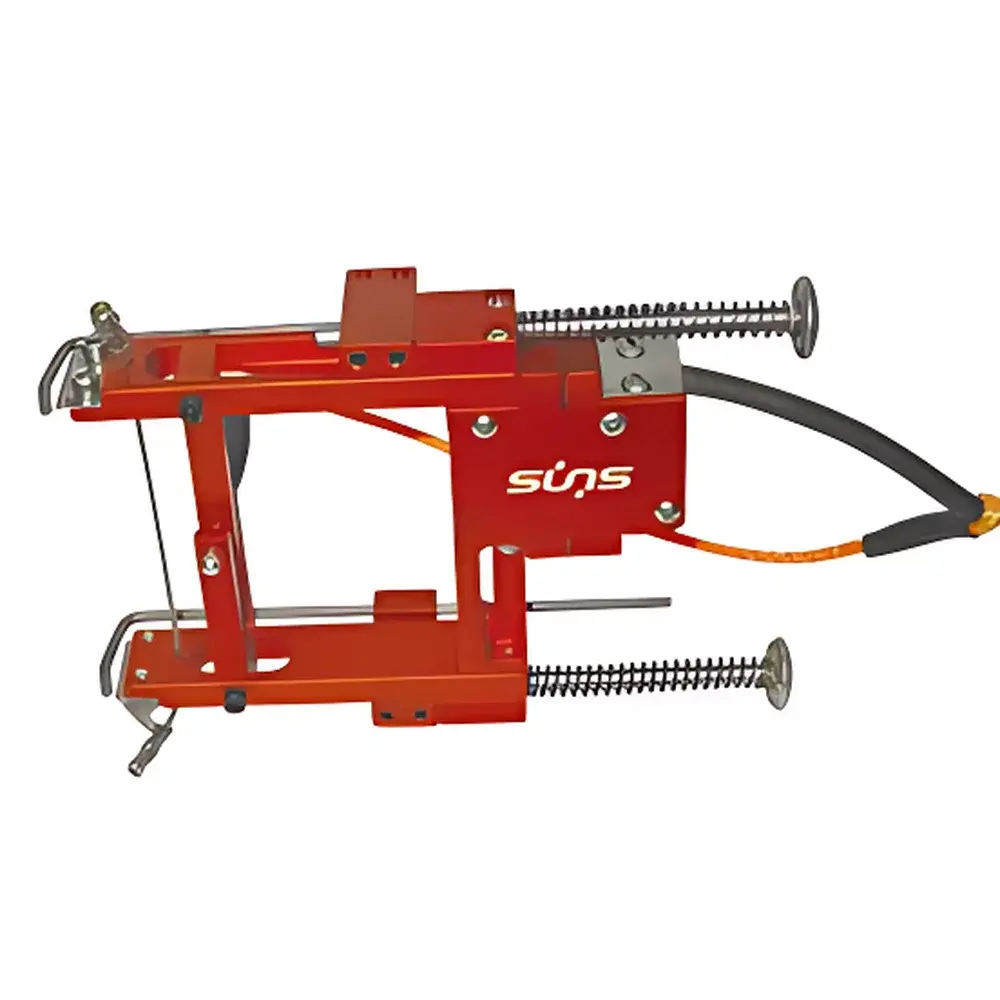
SUNS SEM Series Electronic Extensometer
| Brand | SUNS |
|---|---|
| Origin | Guangdong, China |
| Manufacturer Type | Direct Manufacturer |
| Product Category | Domestic |
| Model | SEM Series |
| Pricing | Upon Request |
| Gauge Length Range | 10–100 mm |
| Deformation Measurement Range | ±5% to ±100% of gauge length (with asymmetric ranges available) |
| Accuracy Class | ASTM E83 Class B-1 / ISO 9513 Class 0.5 |
| Operating Temperature Range | –267.7 °C to +176.6 °C (configurable via option codes: L, S, H, X) |
| Key Structural Design | Dual-flexure beam architecture |
| Mounting Mechanism | Single-hand spring-actuated clamp |
| Safety Features | Dual-direction mechanical over-travel stops + fail-safe steel cable tether |
| Linearity Error | 0.10–0.20% FS (dependent on model configuration) |
| Serviceability | Modular arm and bridge assembly for rapid field maintenance and gauge length reconfiguration |
Overview
The SUNS SEM Series Electronic Extensometer is a high-precision, contact-type strain measurement instrument engineered for static and dynamic mechanical testing applications in materials science laboratories and industrial quality control environments. Based on dual-flexure beam transduction technology, it converts axial specimen deformation into proportional analog or digital output signals with high linearity, low hysteresis, and minimal thermal drift. Designed explicitly for integration with universal testing machines (UTMs), the SEM series supports uniaxial tensile, compressive, and cyclic loading protocols across metallic alloys, polymers, composites, and advanced ceramics. Its modular architecture enables seamless adaptation to varying specimen geometries and test standards—including ASTM E8, ASTM E111, ISO 6892-1, and ISO 527—while maintaining traceable metrological compliance per ASTM E83 Class B-1 and ISO 9513 Class 0.5.
Key Features
- Single-hand spring-clamp mounting: Enables rapid, repeatable attachment and removal without tools—critical for high-throughput test environments where setup time directly impacts throughput efficiency.
- Fully protected fracture tracking: Integrated steel cable tether and dual-direction mechanical over-travel stops allow uninterrupted measurement up to specimen failure, eliminating manual intervention during brittle fracture events and ensuring full stress–strain curve capture.
- Dual-flexure beam construction: Provides inherent immunity to lateral vibration and off-axis loading, delivering stable output even under high-frequency fatigue testing (up to 100 Hz typical, dependent on model and UTM coupling).
- Configurable thermal envelope: Four temperature option codes (L, S, H, X) support operation from cryogenic conditions (–267.7 °C) to elevated temperatures (+176.6 °C), enabling direct measurement in environmental chambers without signal degradation or calibration shift.
- Modular gauge length & range selection: Interchangeable arms and bridges permit field reconfiguration between 10 mm, 12 mm, 25 mm, 50 mm, and 100 mm gauge lengths; deformation ranges span ±5% to ±100% (asymmetric options available for compression-dominant tests).
- Calibration traceability: Each unit ships with NIST-traceable calibration certificate; factory verification includes linearity, hysteresis, zero stability, and temperature coefficient assessment per ISO/IEC 17025-accredited procedures.
Sample Compatibility & Compliance
The SEM Series accommodates flat, round, and notched specimens with thicknesses from 0.5 mm to 25 mm and widths/diameters up to 50 mm. Its low-mass clamping jaws minimize local stress concentration and prevent slippage—even on smooth, polished, or coated surfaces. When paired with a compatible transverse extensometer, the system supports Poisson’s ratio determination per ASTM E132 and ISO 527-2. All models meet ASTM E83 Class B-1 (equivalent to ISO 9513 Class 0.5) for strain measurement accuracy, ensuring conformance with regulatory requirements for GLP-compliant material qualification, aerospace component certification (e.g., AMS 2300), and medical device validation (ISO 14801). Optional mounting kits facilitate use on servo-hydraulic, electromechanical, and creep-testing frames.
Software & Data Management
The SEM Series outputs analog (±10 V or 4–20 mA) and/or digital (RS-422 or TTL-compatible encoder pulses) signals, fully compatible with major UTM controller platforms including Instron Bluehill, MTS TestSuite, ZwickTestXpert, and Mecmesin Emperor. Real-time strain data synchronizes with load, displacement, and environmental parameters via hardware-triggered sampling—supporting closed-loop strain-controlled testing per ASTM E606 and ISO 12106. Raw data streams adhere to ASTM E1434-compliant ASCII or binary formats, enabling direct ingestion into MATLAB, Python (NumPy/Pandas), or LabVIEW for post-test analysis. Audit trails, user access logs, and electronic signature functionality are supported when integrated with 21 CFR Part 11–compliant LIMS or ELN systems.
Applications
- Tensile property characterization (yield strength, ultimate tensile strength, uniform elongation, total elongation) per ASTM E8/E21 and ISO 6892-1
- Compression testing of brittle and ductile solids—including concrete, foam, and battery electrode materials
- Cyclic loading and low-cycle fatigue (LCF) studies requiring high-fidelity strain resolution at R-ratios from –1 to 0.1
- Creep and stress relaxation testing under constant load or strain hold conditions
- Thermo-mechanical testing in controlled atmosphere or vacuum chambers
- Validation of finite element models (FEM) through direct experimental strain mapping
- Quality assurance in automotive stamping (e.g., sheet metal formability via biaxial strain measurement with dual extensometers)
FAQ
What is the maximum recommended testing frequency for SEM Series extensometers?
The dual-flexure design supports stable performance up to 100 Hz in standard ambient configurations; higher frequencies require evaluation of mechanical resonance and damping characteristics specific to the test frame and specimen mass.
Can the SEM Series be used in vacuum environments?
Yes—models with L- and X-temperature options feature vacuum-compatible materials (e.g., stainless steel housing, ceramic-insulated wiring) and have been validated for operation at pressures down to 10−6 mbar.
Is recalibration required after changing gauge length modules?
No—each arm/bridge combination is individually calibrated at the factory; the system retains full accuracy without field recalibration when swapping between pre-configured modules.
Does the SEM Series support strain-controlled ramp-and-hold testing?
Yes—when interfaced with controllers supporting closed-loop strain control (e.g., Instron 5960, Zwick Roell Z250), the SEM provides real-time feedback for precise strain rate regulation per ASTM E2309.
How is traceability maintained during long-term deployment?
Each unit includes a unique serial-numbered calibration certificate with uncertainty budget per ISO/IEC 17025; periodic verification intervals are defined by internal QA policy or industry-specific standards (e.g., every 6 months for GMP-regulated labs).



