
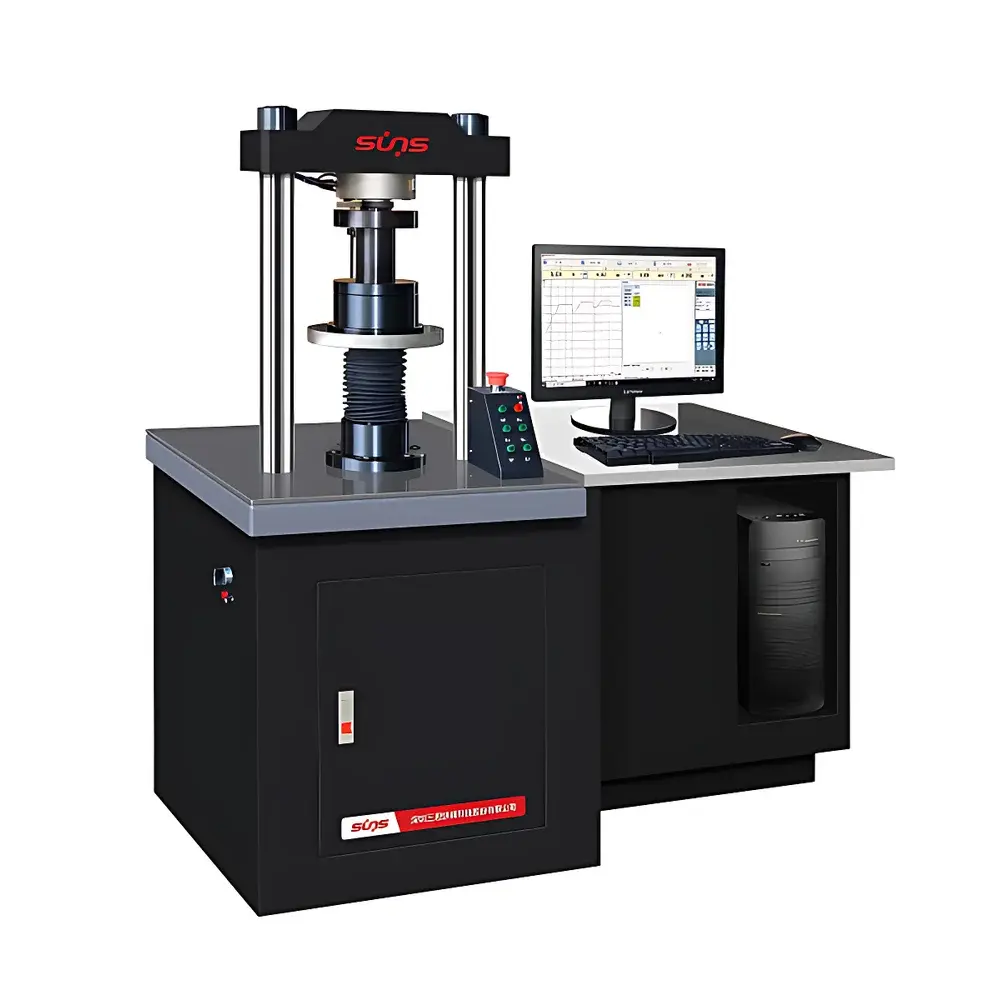
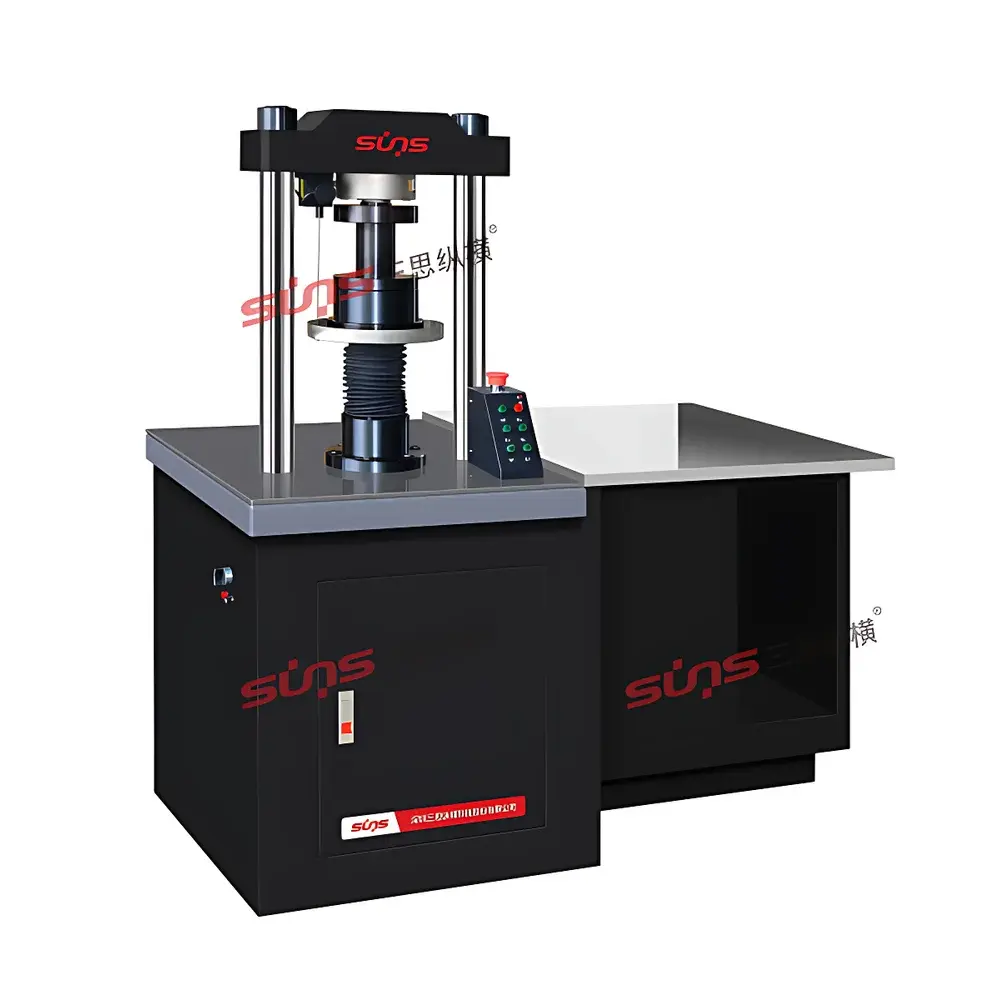
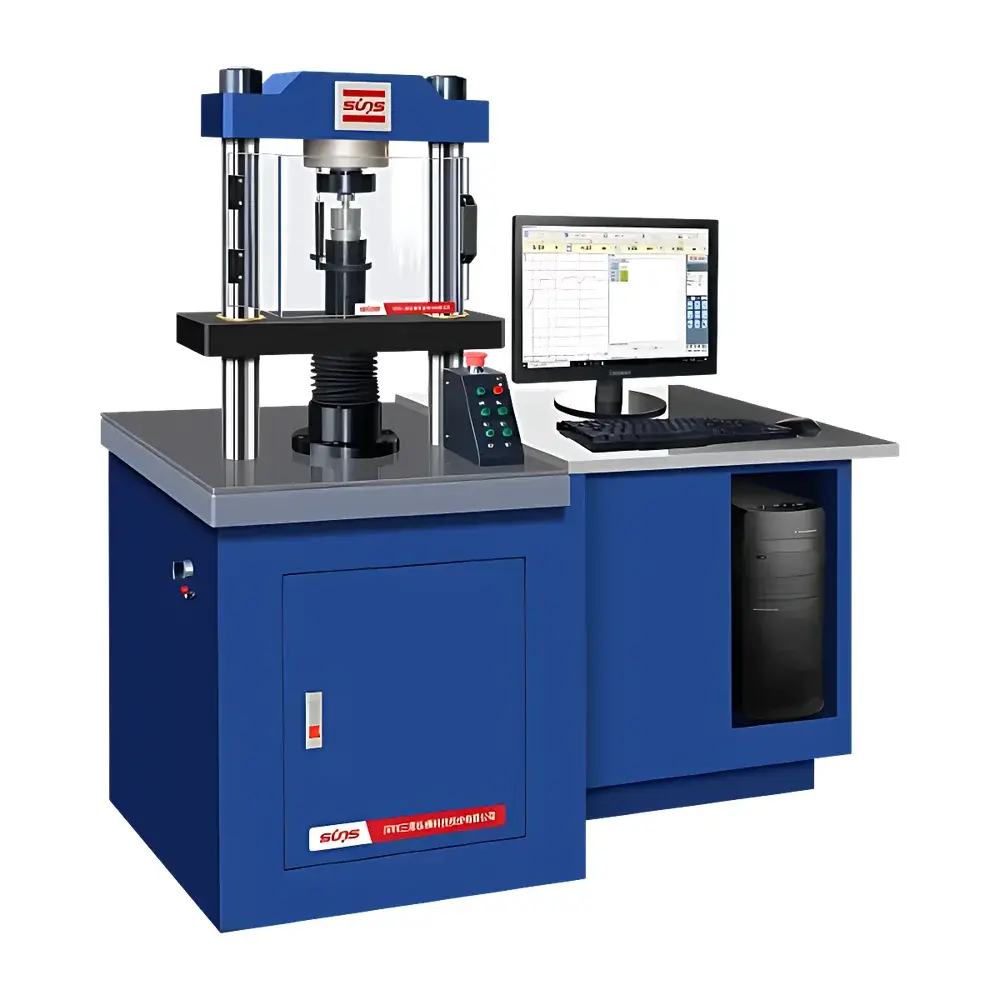
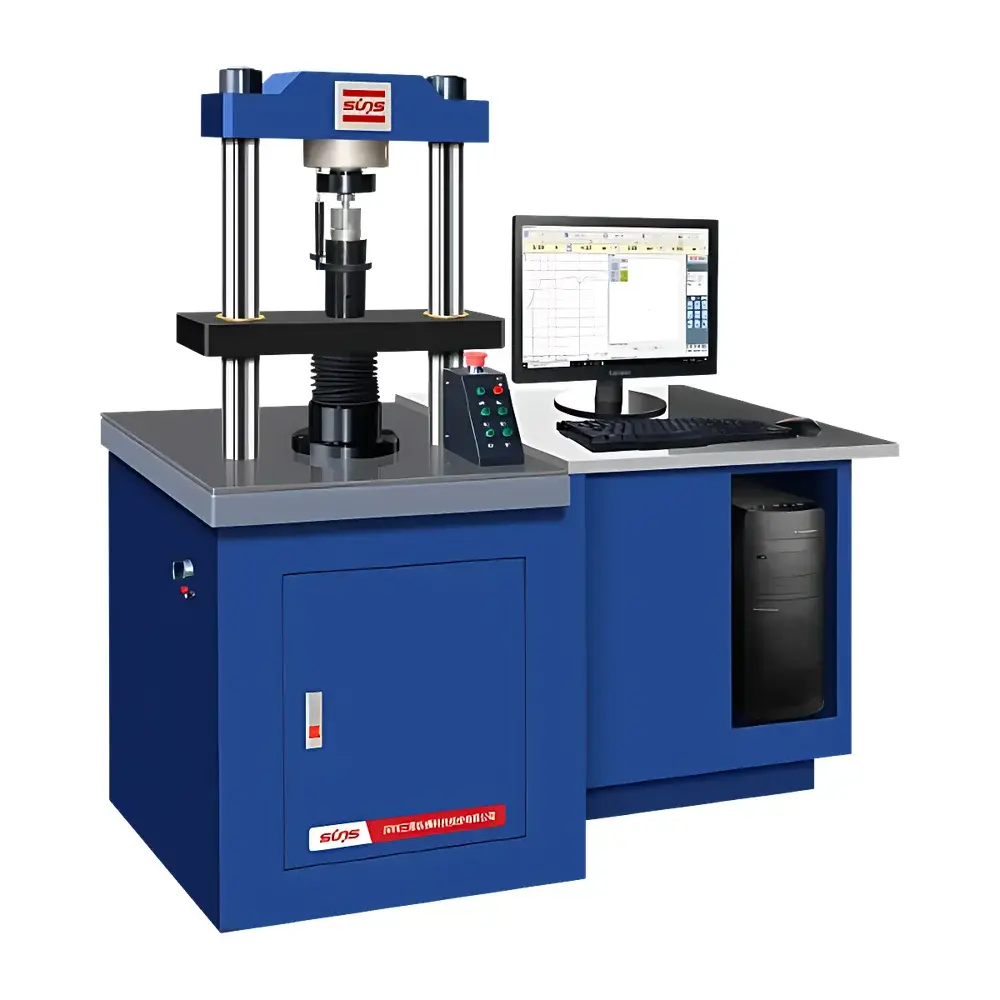
SUNS UTM7305 Battery Powder Compaction Density Tester
| Brand | SUNS |
|---|---|
| Origin | Shenzhen, China |
| Manufacturer Type | Direct Manufacturer |
| Model | UTM7305 |
| Max Test Force | 300 kN |
| Force Loading Rate | 0.02–5% FS/s |
| Platen Spacing | 240 mm |
| Platen Diameter | 150 mm |
| Compression Die Diameter | 13 mm |
| Crosshead Travel | 100 mm |
| Displacement Control Range | 0.001–50 mm/min |
| Force Measurement Accuracy | ±0.5% of reading (0.4–100% FS) |
| Force Resolution | 1/500,000 full scale (unsegmented) |
| Displacement Accuracy | ±0.5% of reading |
| Motor Power | 1.5 kW |
| Dimensions (W×D×H) | 1200 × 700 × 1500 mm |
| Weight | ~800 kg |
| Power Supply | 380 V / 50 Hz ±10% |
Overview
The SUNS UTM7305 Battery Powder Compaction Density Tester is a high-precision electromechanical universal testing system engineered specifically for quantitative compaction characterization of lithium-ion battery electrode powders—particularly anode materials such as graphite, silicon composites, and lithium titanate. It operates on the principle of controlled uniaxial compression under defined load–displacement boundary conditions, enabling precise determination of powder bulk density, green density, compressibility, and pressure–density response curves. Unlike generic compression testers, the UTM7305 integrates metrologically traceable force and displacement transduction with real-time closed-loop control algorithms, ensuring repeatability ≤±0.5% across its full 300 kN capacity range. Its design conforms to core mechanical testing fundamentals outlined in ASTM E9, ISO 3070, and GB/T 228.1, while its operational workflow aligns with industrial requirements for process validation in battery electrode manufacturing.
Key Features
- High-force capacity (300 kN) with Class 0.5 accuracy per ISO 7500-1, supporting both low-pressure pre-compaction and high-density final densification protocols.
- Ultra-stable force loading rate control from 0.02% to 5% FS/s—critical for replicating roll-pressing or dry-pressing kinetics in R&D and production environments.
- Dual-mode closed-loop control: independent force-controlled and displacement-controlled profiles, programmable via intuitive software interface.
- Fixed-die geometry platform: standardized 13 mm diameter cylindrical die cavity ensures consistent stress distribution and eliminates inter-laboratory variability.
- 150 mm diameter hardened steel platens with parallelism tolerance <0.02 mm/m, minimizing eccentric loading and shear-induced density gradients.
- Integrated environmental monitoring inputs (optional) for correlating compaction behavior with ambient temperature/humidity during long-duration cyclic tests.
- Rugged monolithic frame with 800 kg mass and reinforced dual-column architecture—designed to suppress dynamic vibration and maintain dimensional stability during high-speed ramping.
Sample Compatibility & Compliance
The UTM7305 accommodates standard anode and cathode powders—including natural/synthetic graphite, SiOx/C blends, NMC, LFP, and solid-state electrolyte precursors—within its 13 mm die configuration. Sample mass is determined gravimetrically using external analytical balances (not included), and all test data are linked to user-entered batch IDs, operator codes, and environmental metadata. The system complies with GLP documentation requirements: audit trails record parameter changes, test start/stop timestamps, calibration events, and user logins. Data export formats (CSV, XML, PDF) support integration into LIMS and satisfy FDA 21 CFR Part 11 electronic record integrity criteria when paired with validated software configurations. Calibration certificates are traceable to NIM (National Institute of Metrology, China) and optionally to NIST standards upon request.
Software & Data Management
The proprietary SUNS TestMaster v4.2 software provides ISO/IEC 17025-aligned test method templates—including “Constant-Rate Compaction”, “Stepwise Pressure Hold”, and “Cyclic Rebound Analysis”. Each test automatically generates density vs. pressure plots, calculates relative density (% TD), yields compressibility coefficients (e.g., Heckel and Kawakita parameters), and exports raw force–displacement time-series data at ≥100 Hz sampling. All results are stored in encrypted SQLite databases with immutable file hashing. Version-controlled method libraries allow QA teams to deploy identical protocols across multiple instruments. Software validation packages—including IQ/OQ documentation, UAT scripts, and electronic signature workflows—are available for regulated battery cell manufacturers operating under IATF 16949 or ISO 9001 quality management systems.
Applications
- Optimization of slurry-free dry electrode processing parameters for next-generation solid-state batteries.
- Correlation of powder morphology (BET surface area, particle size distribution) with densification efficiency under varying pressure profiles.
- Batch release testing of anode materials against internal specifications (e.g., target density ±0.02 g/cm³ at 100 MPa).
- Fundamental research on interparticle bonding mechanisms during cold compaction—supporting DFT modeling of van der Waals and mechanical interlocking contributions.
- Process capability analysis (Cp/Cpk) for electrode calendering lines using historical UTM7305 benchmark data.
- Root cause investigation of cell swelling or delamination by tracing deviations in green density uniformity across pilot-scale batches.
FAQ
What powder mass should be used for a standard UTM7305 test?
Typical sample masses range from 0.8–1.2 g for 13 mm dies, adjusted to achieve initial bed heights between 3–5 mm. Exact mass is determined by target porosity and material tap density.
Can the UTM7305 perform hold-time relaxation tests?
Yes—displacement or force hold modes support dwell periods from 1 s to 24 h with real-time creep strain monitoring and automatic unload sequencing.
Is third-party calibration certification included?
Factory calibration is performed per ISO/IEC 17025 guidelines; accredited calibration certificates (with uncertainty budgets) are available as optional add-ons.
Does the system support automated die ejection post-test?
Manual die removal is standard; pneumatic ejection modules can be integrated as a custom hardware option upon request.
How is data integrity maintained during power interruption?
The controller features non-volatile memory buffering—active test data is preserved during brief outages (<30 s); longer interruptions trigger graceful save-to-disk before shutdown.



