
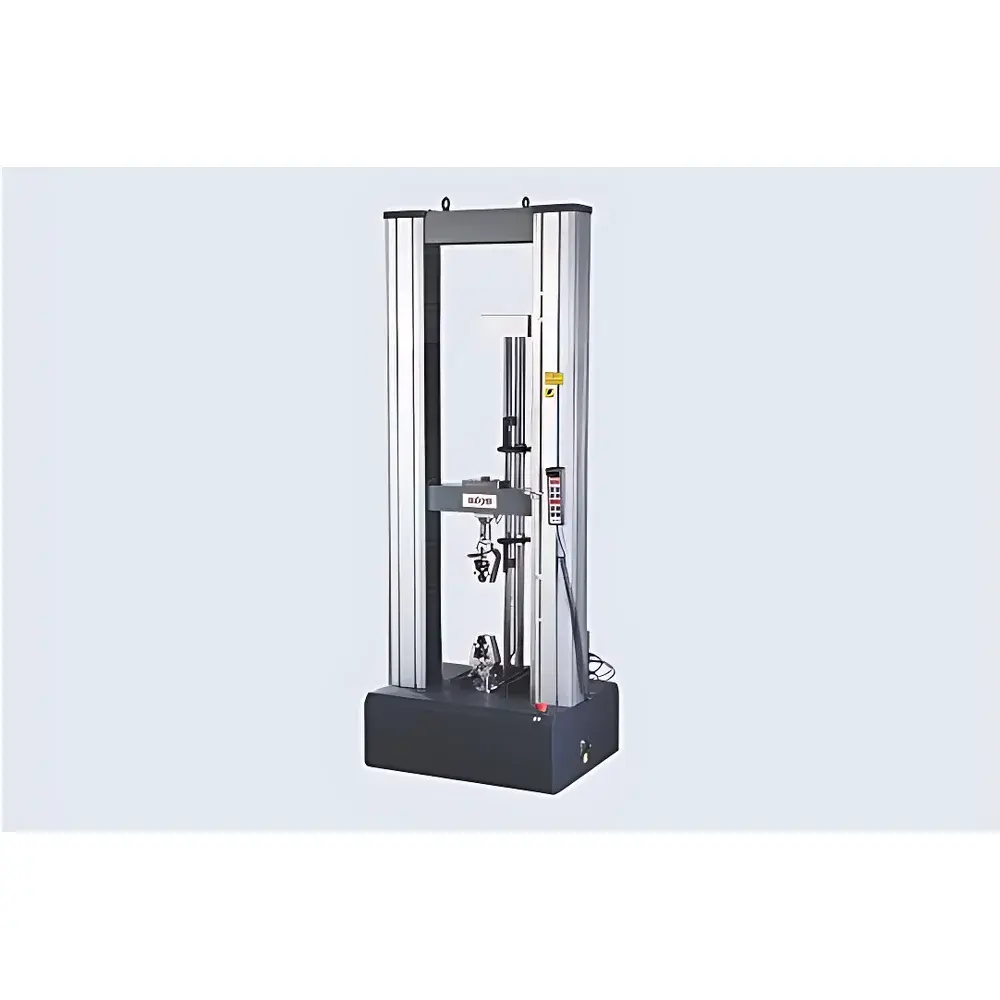
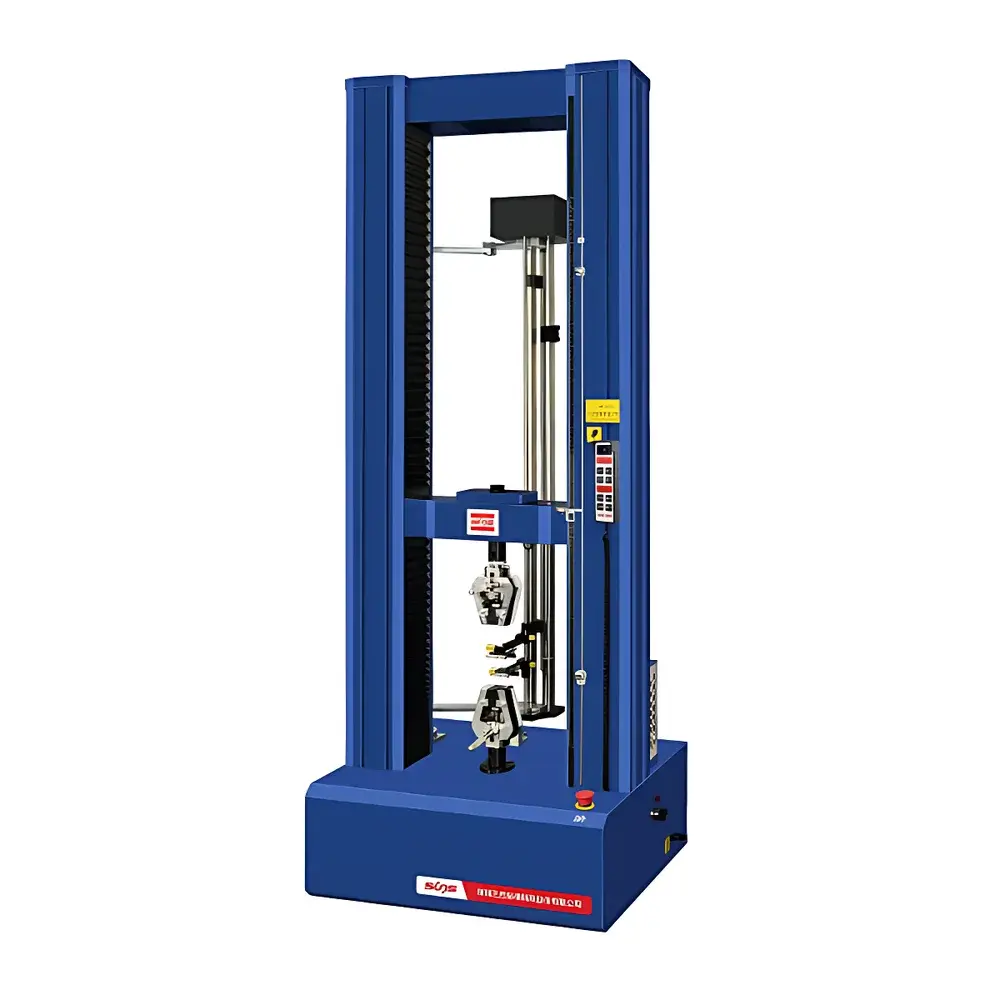
SUNS UTM4000 Series Dual-Column Floor-Standing Electromechanical Universal Testing Machine
| Brand | SUNS |
|---|---|
| Origin | Guangdong, China |
| Manufacturer Type | Direct Manufacturer |
| Country of Origin | China |
| Model | UTM4000 |
| Instrument Type | Electromechanical Universal Testing Machine |
| Load Capacity Range | 0.02 N to 100 kN |
| Load Accuracy | ±0.5% of full scale |
Overview
The SUNS UTM4000 Series is a dual-column, floor-standing electromechanical universal testing machine engineered for high-reproducibility mechanical property evaluation of metallic and non-metallic materials under tension, compression, bending, shear, peel, and tear loading conditions. Based on closed-loop servo-controlled displacement and load regulation, the system implements precise force application via a high-torque AC servo motor coupled to a precision ball-screw transmission mechanism. Its rigid portal frame—constructed from hardened steel guide columns and preloaded crossheads—minimizes deflection during high-load testing, ensuring structural integrity up to 100 kN. Designed for laboratory and quality control environments, the UTM4000 complies with fundamental mechanical test architecture requirements defined in ISO 7500-1 (Class 1), ASTM E4, and GB/T 16491, supporting both static and quasi-static test protocols across standard-compliant specimen geometries.
Key Features
- Rigid dual-column portal frame with hardened chrome-plated guide rods and reinforced upper/lower platens for minimal frame compliance and long-term dimensional stability.
- AC servo motor drive system with integrated planetary gearbox and precision recirculating ball screw, enabling smooth, low-noise actuation and sub-micron positioning resolution.
- Modular configuration options: single-test-space (standard) and dual-test-space variants accommodate simultaneous or sequential testing of different specimen types or environmental conditions.
- Expandable test envelope—customizable column height, crosshead travel, and throat depth—to support extended specimens, large composites, or multi-axis fixtures.
- Standardized mechanical interface (ISO 26203-compliant mounting holes) for seamless integration of optional accessories including extensometers, video extensometry systems, environmental chambers (−70 °C to +300 °C), and hydraulic wedge grips.
Sample Compatibility & Compliance
The UTM4000 accommodates a broad spectrum of standardized and non-standard specimens—from miniature wires (≥0.1 mm diameter) to structural beams (up to 400 mm wide × 1200 mm tall). Grip systems include pneumatic, hydraulic, manual wedge, and vise-type configurations, all compatible with ASTM E8/E8M (tensile metals), ASTM D638/D695 (plastics), ISO 527/604, GB/T 228.1, and JIS Z 2241 test methods. Force transducers are factory-calibrated per ISO 376 Annex A and traceable to national metrology institutes. The system supports GLP/GMP-aligned operation through configurable audit trails, user access levels, and electronic signature capability when paired with compliant software modules.
Software & Data Management
Control and analysis are executed via SUNS TestMaster™ v5.x—a Windows-based platform compliant with FDA 21 CFR Part 11 requirements (electronic records/signatures, role-based permissions, and immutable audit logs). Real-time data acquisition operates at up to 10 kHz sampling rate, with synchronized recording of load, displacement, strain (via external extensometer input), and time-stamped environmental parameters. Export formats include CSV, XML, PDF reports (with embedded calibration certificates), and ASTM E1392-compliant result files. Raw datasets retain metadata including operator ID, instrument serial number, calibration date, and test method reference—enabling full traceability in regulated QC/QA workflows.
Applications
- Mechanical characterization of aerospace alloys, automotive sheet metal, and welded joints per ASTM B557, ISO 6892-1, and EN 10002-1.
- Composite material qualification—including carbon-fiber laminates and thermoplastic matrices—under ASTM D3039, D6641, and ISO 527-4.
- Biomedical polymer validation (e.g., PEEK, UHMWPE) for orthopedic implant components under ISO 5833 and ASTM F2129.
- Quality assurance of elastomers, adhesives, and packaging films using peel (ASTM D903), tear (ASTM D1938), and puncture resistance (ASTM F1306) protocols.
- Educational and R&D use in materials science laboratories requiring repeatable, standards-aligned mechanical testing infrastructure.
FAQ
What is the maximum allowable crosshead speed for high-speed tensile testing?
The UTM4000 supports crosshead speeds from 0.001 mm/min to 1000 mm/min, programmable in logarithmic or linear ramp profiles. Speed accuracy is maintained within ±0.2% of setpoint across the full range.
Can the system be validated for ISO/IEC 17025 accredited testing laboratories?
Yes—the base configuration meets ISO/IEC 17025 clause 6.4.1 (equipment suitability) when used with certified force transducers, calibrated displacement encoders, and documented uncertainty budgets provided upon request.
Is third-party software integration supported (e.g., LabVIEW, MATLAB)?
The UTM4000 provides TCP/IP and USB-based SCPI-compatible command sets, enabling bidirectional communication with external automation platforms for custom test sequencing and real-time data ingestion.
How often does the load cell require recalibration?
Per ISO 7500-1, annual verification is recommended; however, interval adjustments may be justified based on usage frequency, environmental conditions, and internal quality procedures—documentation templates for calibration history tracking are included in TestMaster™.
Does the machine support automatic specimen alignment prior to loading?
While not equipped with active auto-alignment, the UTM4000 features precision-machined grip centering guides and adjustable alignment pins conforming to ASTM E1012, facilitating manual alignment verification and correction before test initiation.



