
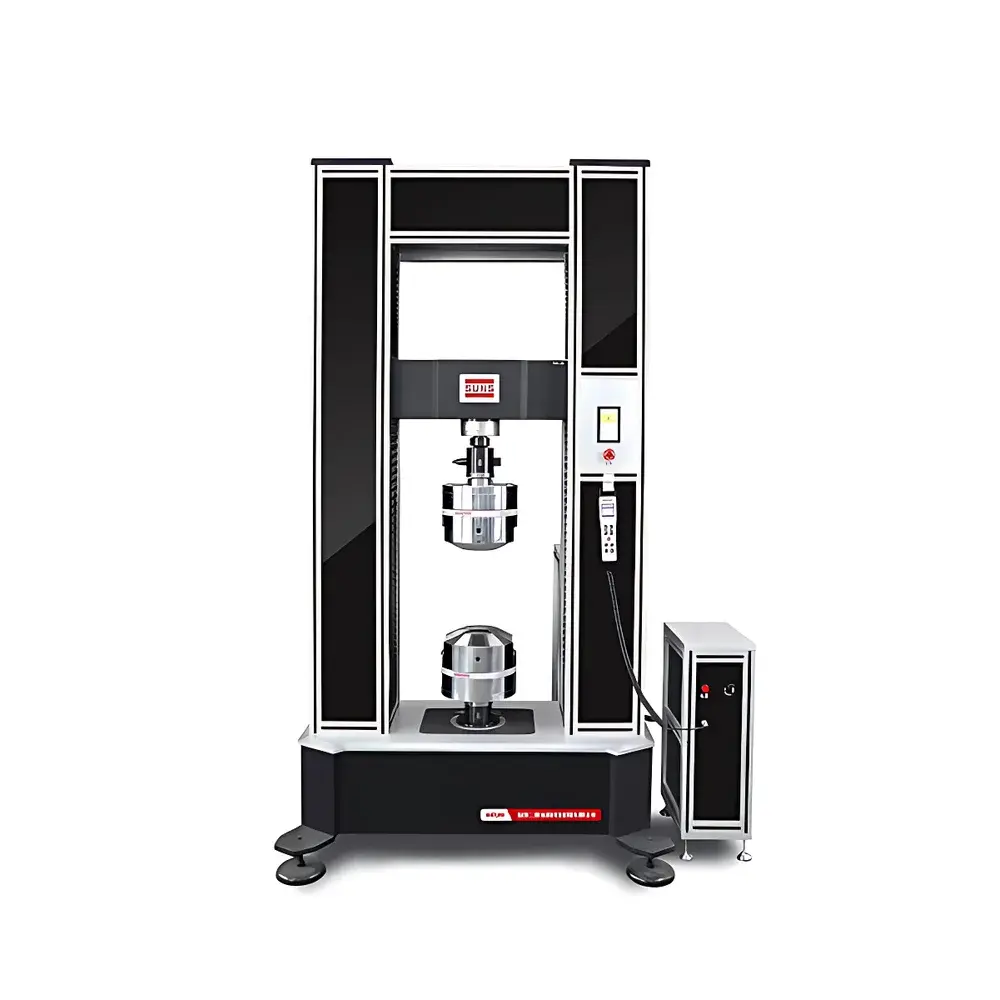
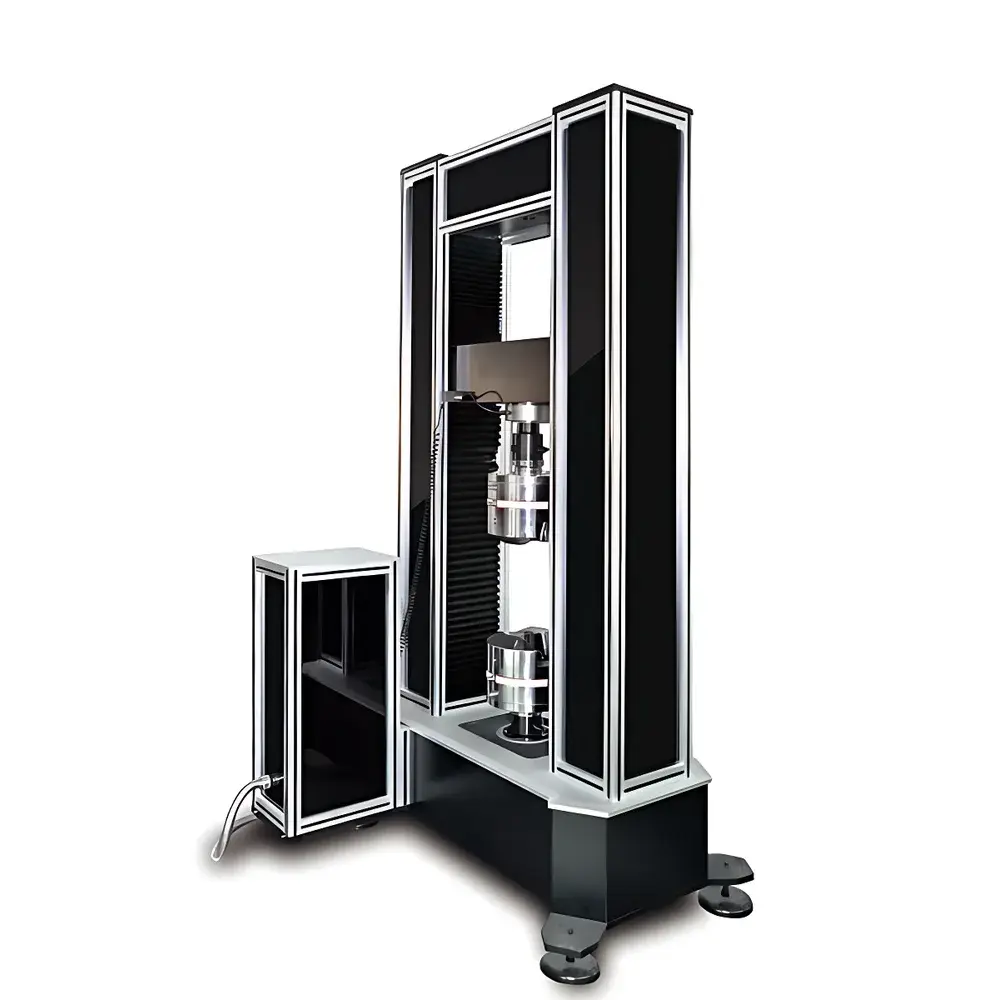
SUNS Storm Series Next-Generation Electronic Universal Testing Machine UTM5305
| Brand | SUNS |
|---|---|
| Origin | Shenzhen, China |
| Manufacturer Type | Direct Manufacturer |
| Country of Origin | China |
| Model | UTM5305 |
| Instrument Type | Electronic Universal Testing Machine |
| Load Range | 0.02 N to 600 kN |
| Load Accuracy | ±0.5% of full scale |
Overview
The SUNS Storm Series Next-Generation Electronic Universal Testing Machine UTM5305 is a high-precision,落地式 (floor-standing), dual-column electromechanical testing system engineered for static mechanical property characterization of metallic and non-metallic materials under tension, compression, bending, shear, peel, and tear loading conditions. Based on closed-loop servo-controlled displacement and force actuation, the UTM5305 employs a preloaded high-rigidity dual-column frame with precision-ground ball-screw transmission, coupled with an imported high-dynamic-response servo motor and synchronous belt reduction drive. Its measurement architecture conforms to fundamental principles of mechanical metrology—force transduction via strain-gauge-based load cells, position feedback via high-resolution optical encoders, and deformation acquisition via extensometers or crosshead displacement tracking. Designed for compliance with international test standard workflows—including ASTM E4, ASTM E8/E21, ISO 6892-1, ISO 7500-1, GB/T 228.1, and JJG 475—the system delivers traceable, repeatable, and auditable mechanical data suitable for R&D, quality control, and regulatory submission environments.
Key Features
- High-stability floor-standing frame with preloaded dual-column architecture and polished aluminum safety enclosure—dimensions: 1300 mm (W) × 1100 mm (D) × 2350 mm (H)
- Load capacity spanning six orders of magnitude: 0.02 N to 600 kN, with certified accuracy of ±0.5% of full scale per ISO 7500-1 Class 0.5
- Digital controller with 500,000-count resolution, 1000 Hz sampling and control loop frequency (user-configurable per channel)
- Position resolution: 0.00004 mm; deformation measurement range: 0.4–100% of full scale (FS) with compatible extensometers
- Integrated hand-held control console featuring real-time force and crosshead position display, directional jog control, “Return-to-Start” and “Zero-Force” functions
- External control interface: two BNC analog input channels for third-party sensor integration, one programmable digital input, two programmable digital outputs
- Modular controller housing—externally mounted to isolate electronics from mechanical vibration during specimen failure
- Oil-free, fully electromechanical drivetrain: low-noise (<50 dB(A)) operation, zero hydraulic fluid leakage, no maintenance-intensive seals or valves
Sample Compatibility & Compliance
The UTM5305 accommodates standardized test specimens per ASTM E8 (tensile bars), ASTM D638 (plastics), ISO 527 (polymer sheets), ISO 178 (flexural), and GB/T 1040 series, supporting both ambient and elevated-temperature testing configurations (with optional environmental chambers). Its mechanical design enables sustained load-holding capability ≥800 hours at constant force—a critical requirement for creep and stress-relaxation studies in aerospace alloys and nuclear-grade composites. The system meets ISO/IEC 17025 technical competency criteria for mechanical testing laboratories and supports GLP/GMP-aligned audit trails when paired with validated software configurations. All firmware and controller firmware are version-controlled and support calibration certificate traceability to national metrology institutes.
Software & Data Management
The included SUNS multi-language testing software (English, Chinese, Spanish, German) provides ISO 17025-compliant test method templates, real-time curve overlay, automatic yield point detection per ASTM E111, and batch reporting with embedded metadata (operator ID, timestamp, environmental conditions, calibration status). Raw data export is supported in CSV, XML, and universal .tdms formats. The controller integrates seamlessly with LIMS platforms via TCP/IP or RS232 protocols and supports 21 CFR Part 11-compliant user access controls, electronic signatures, and immutable audit logs when deployed in regulated QA/QC environments.
Applications
This system serves as a primary mechanical characterization platform across sectors requiring material certification and process validation: structural alloy qualification for aircraft fuselage components; tensile strength verification of carbon-fiber-reinforced polymer (CFRP) laminates in wind turbine blades; adhesion performance evaluation of pressure-sensitive tapes per ASTM D3330; ductility assessment of medical-grade stainless steel stents; and compressive modulus determination of ceramic matrix composites used in nuclear fuel cladding. It is routinely deployed in university mechanics labs for fracture mechanics education, national metrology institutes for reference machine intercomparison, and defense contractors for MIL-STD-810G mechanical stress screening.
FAQ
What standards does the UTM5305 comply with for force calibration and verification?
It conforms to ISO 7500-1:2018 (static calibration of uniaxial testing machines) and JJG 475-2008 (Chinese metrological verification regulation), with factory calibration certificates traceable to NIM (National Institute of Metrology, China).
Can the system perform long-term creep tests at elevated temperatures?
Yes—when integrated with a certified environmental chamber and appropriate high-temperature grips, it maintains load stability within ±0.5% FS for ≥800 hours, meeting ASTM E139 and ISO 204 requirements.
Is the controller compatible with third-party extensometers and environmental systems?
Yes—the dual BNC analog inputs accept LVDT, clip-on, and video extensometer signals; digital I/O ports enable synchronized triggering with thermal chambers or acoustic emission systems.
Does the software support automated report generation for ISO/IEC 17025 accreditation?
Yes—reports include instrument ID, calibration due dates, operator credentials, uncertainty budgets, and raw data appendices in tamper-evident format.
What is the maximum crosshead speed at full load?
The system maintains rated speed across the entire force range—no speed derating is required at 600 kN, ensuring consistent strain-rate control per ASTM E2309.



