
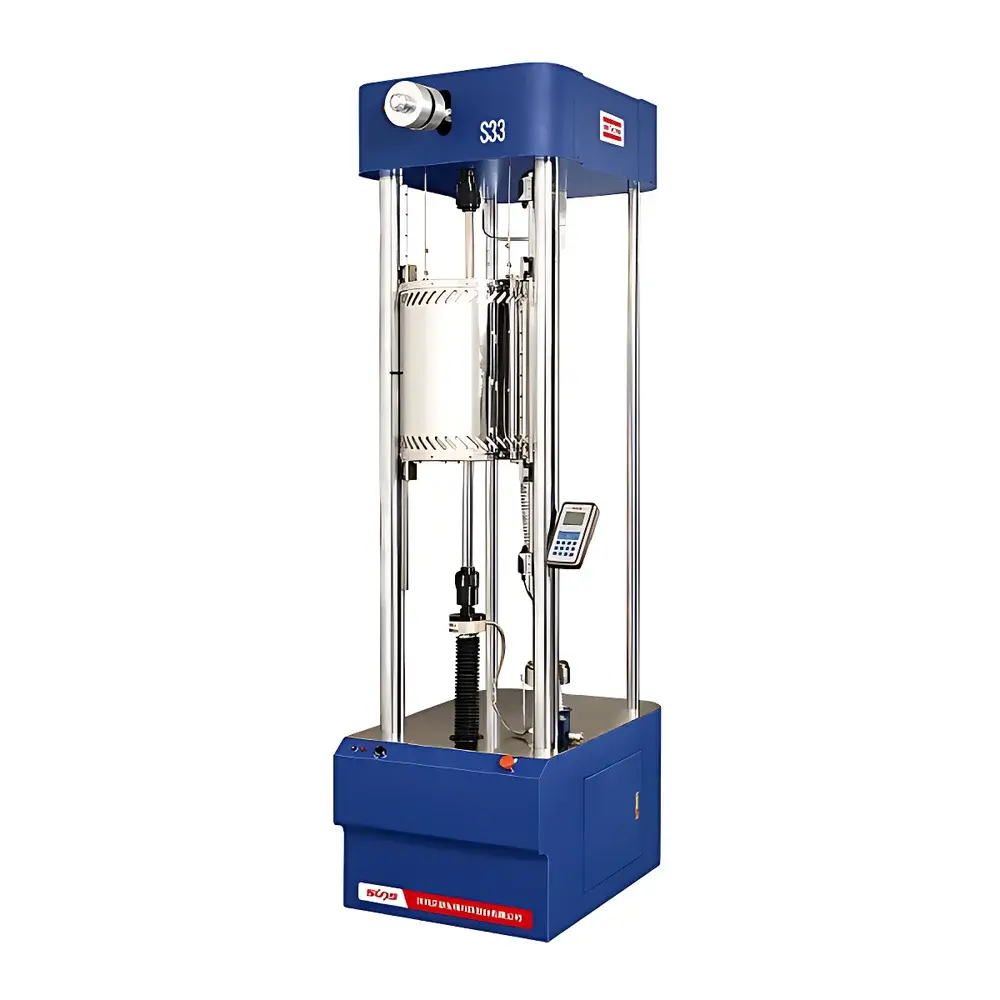
SUNS CTM Series Mechanical High-Temperature Creep and Stress-Rupture Testing Machine
| Brand | SUNS |
|---|---|
| Origin | Guangdong, China |
| Manufacturer Type | Direct Manufacturer |
| Country of Origin | China |
| Model | CTM Series |
| Pricing | Available Upon Request |
| Load Capacity Options | 30 kN, 50 kN, 80 kN, 100 kN |
| Maximum Operating Temperature | 1200 °C |
| Furnace Type | Cylindrical Vertical Drop-Down Design |
| Uniform Temperature Zone Length | 200 mm |
| Surface Temperature at 1200 °C | <90 °C |
| Furnace Supply Voltage | 25 V AC (low-voltage high-current) |
| Rated Furnace Service Life | ≥30,000 hours at ≤1200 °C |
| Footprint Reduction | ~40% vs. conventional horizontal split-furnace systems |
Overview
The SUNS CTM Series Mechanical High-Temperature Creep and Stress-Rupture Testing Machine is a precision-engineered system designed for standardized evaluation of time-dependent deformation and rupture behavior in metallic materials under sustained mechanical load at elevated temperatures. Based on the fundamental principles of uniaxial tensile creep testing per ASTM E139, ISO 204, and GB/T 2039, the CTM platform applies constant axial force to specimens housed within a vertically oriented cylindrical furnace while continuously monitoring elongation over durations ranging from hours to thousands of hours. Unlike conventional horizontal split-furnace configurations requiring full thermal cycling between tests, the CTM’s drop-down furnace architecture enables rapid specimen exchange without furnace cooldown—reducing turnaround time by up to 85% and significantly improving throughput in quality control laboratories and metallurgical R&D facilities.
Key Features
- Cylindrical vertical furnace with automated lift mechanism: Motor-driven vertical displacement eliminates manual handling of hot components, reducing operator exposure and ensuring repeatable positioning accuracy within ±0.5 mm.
- Extended uniform temperature zone (200 mm): Achieved via multi-zone resistive heating elements and imported high-efficiency ceramic fiber insulation, ensuring compliance with ASTM E220 requirements for temperature gradient control (≤1 °C/cm across working zone).
- Low-surface-temperature design: External furnace skin remains below 90 °C even during continuous operation at 1200 °C—verified per IEC 61000-6-3 and UL 61010-1—minimizing burn risk and eliminating need for auxiliary cooling enclosures.
- 25 V AC low-voltage furnace power supply: Eliminates risk of electric shock during maintenance or alignment; fully compliant with SELV (Safety Extra-Low Voltage) requirements defined in IEC 60364-4-41.
- Compact structural footprint: Integrated load frame and furnace assembly occupies only 60% of the floor space required by equivalent horizontal-split systems—optimized for constrained laboratory environments without compromising rigidity or thermal stability.
- Long-service-life furnace core: Rated for ≥30,000 operational hours at ≤1200 °C, validated through accelerated life-cycle testing per ISO 17025-accredited procedures.
Sample Compatibility & Compliance
The CTM series accommodates standard creep test specimens per ASTM E139 (dog-bone geometry, gauge length 25–50 mm) and ISO 204 (cylindrical rods, diameters 3–10 mm), with optional custom grips for notched or threaded configurations. All load frames are calibrated traceably to NIST standards via accredited third-party laboratories. The system supports full compliance with ISO/IEC 17025:2017 for testing laboratories, and data acquisition meets audit-trail requirements under FDA 21 CFR Part 11 when paired with SUNS’ optional GLP-compliant software module. Test reports include full metadata: temperature ramp history, load application timestamp, strain sampling interval, and environmental chamber log files.
Software & Data Management
SUNS’ proprietary CreepTest Pro v4.2 software provides real-time visualization of strain vs. time curves, automatic identification of primary/secondary/tertiary creep stages, and calculation of key parameters including minimum creep rate (ε̇min), time to specified strain (tε), and time to rupture (tr). Raw data is stored in vendor-neutral CSV and HDF5 formats, supporting post-processing in MATLAB, Python (NumPy/Pandas), or commercial statistical platforms. Audit logs record all user actions—including parameter changes, calibration events, and report exports—with digital signature capability for GMP-regulated environments. Optional integration with LIMS via RESTful API enables automated result ingestion into enterprise quality management systems.
Applications
- Evaluation of creep resistance in Ni-based superalloys for gas turbine disk and blade applications
- Long-term stress-rupture qualification of stainless steels and titanium alloys per ASME BPVC Section II Part D
- Development and validation of constitutive models (e.g., Norton-Bailey, Garofalo equations) for finite element simulation inputs
- Quality assurance of weldments and heat-affected zones in pressure vessel fabrication
- Accelerated aging studies for nuclear reactor cladding materials (Zr-alloys, FeCrAl)
- Interlaboratory round-robin testing under ASTM WK74215 protocol for high-temperature material certification
FAQ
What standards does the CTM series comply with for creep testing?
ASTM E139, ISO 204, GB/T 2039, and DIN 50118—fully supported through hardware configuration, thermal uniformity validation, and software reporting templates.
Can the system perform interrupted creep tests with intermediate unload/reload cycles?
Yes—CreepTest Pro supports programmable multi-step load profiles, including hold periods, partial unloading, and reapplication with user-defined dwell times and strain thresholds.
Is furnace calibration traceable to national metrology institutes?
Each furnace is supplied with a UKAS-accredited calibration certificate covering temperature uniformity, stability, and sensor linearity across the full 300–1200 °C range.
What maintenance intervals are recommended for the furnace and load train?
Furnace inspection every 5,000 hours; load cell recalibration annually or after 10,000 test cycles; grip wear assessment per ASTM E8/E21 visual inspection guidelines.
Does the system support remote monitoring and diagnostics?
Standard Ethernet interface with Modbus TCP and OPC UA support enables integration into plant-wide SCADA systems and allows secure remote access for firmware updates and diagnostic logging via TLS-encrypted connection.
Related Products



