
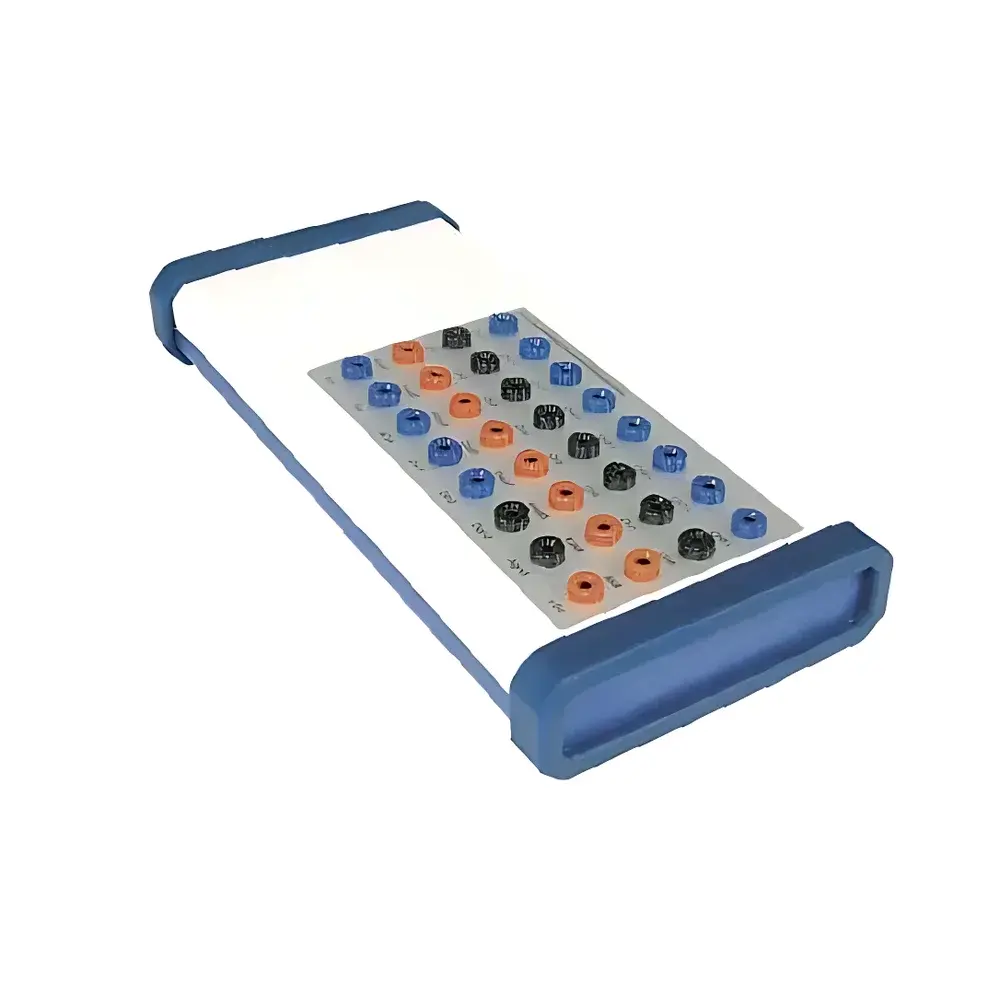
Ivium Peripheral Differential Amplifier Module
| Brand | Ivium |
|---|---|
| Origin | Netherlands |
| Model | Peripheral Differential Amplifier |
| Input Impedance | >1000 GΩ |
| Differential Input Range | ±2 V |
| Channels per Module | 8 |
| Expandable to | 64 channels |
| Instrument Type | Electrochemical Instrument Accessory |
| Category | Electrochemical Instrument Accessories |
Overview
The Ivium Peripheral Differential Amplifier (PDA) Module is a precision signal conditioning accessory engineered for high-fidelity acquisition of bipolar, high-impedance voltage signals in electrochemical measurement systems. Designed for seamless integration with Ivium’s family of potentiostats and electrochemical workstations—including the CompactStat, Vertex, and StatLine series—the PDA module operates on the principle of true differential amplification, rejecting common-mode noise while preserving signal integrity across wide bandwidths. It is particularly suited for applications requiring simultaneous monitoring of reference electrodes, high-impedance pH sensors, ion-selective electrodes (ISEs), or custom-built voltage probes where leakage current and loading effects must be minimized. Its ultra-high input impedance (>1000 GΩ) ensures negligible current draw from sensitive electrochemical interfaces, maintaining thermodynamic equilibrium at electrode surfaces during long-term or low-current measurements.
Key Features
- Eight independent, galvanically isolated differential input channels per module—each optimized for high-impedance voltage sensing
- Scalable architecture supporting up to eight PDA modules (64 total channels) via IviumSoft synchronization and hardware daisy-chaining
- Differential input range of ±2 V with 24-bit ADC resolution, enabling precise quantification of small potential shifts in multi-electrode arrays
- Input impedance exceeding 1000 GΩ (1012 Ω) at DC, minimizing loading error on glass pH electrodes, Ag/AgCl reference elements, and solid-state ISEs
- Low input bias current (<1 fA typical), critical for stable open-circuit potential (OCP) tracking and zero-current potentiometric measurements
- Integrated anti-aliasing filtering and programmable gain stages (×1, ×10, ×100) for optimal dynamic range adaptation across diverse sensor types
- Rugged, shielded metal enclosure compliant with CE and RoHS directives; designed for laboratory and industrial benchtop environments
Sample Compatibility & Compliance
The PDA module is compatible with standard electrochemical cell configurations employing dual-reference setups, multi-point corrosion monitoring arrays, and distributed pH/ion-sensing networks. It supports direct connection to commercial and custom-fabricated electrodes without external buffering or impedance-matching circuitry. In regulated environments, the module contributes to data integrity in accordance with ISO/IEC 17025 requirements for calibration traceability and measurement uncertainty management. When used within IviumSoft-controlled workflows, audit trails, user authentication, and electronic signature support align with FDA 21 CFR Part 11 readiness for GLP/GMP-compliant laboratories. No modifications to electrode geometry or electrolyte composition are required for compatibility.
Software & Data Management
Controlled exclusively through IviumSoft v6.x or later, the PDA module enables synchronized acquisition alongside primary potentiostatic data streams. All 64 channels can be time-aligned with potentiodynamic sweeps, EIS spectra, or chronoamperometric sequences—ensuring temporal correlation between auxiliary voltage signals and electrochemical response. Raw data are stored in proprietary .mpt format (exportable to CSV, TXT, or MATLAB-compatible structures) with embedded metadata including channel ID, sampling rate, gain setting, and timestamp accuracy ±10 µs. Real-time visualization includes overlay plots, statistical trending (min/max/mean/std dev per channel), and configurable alarm thresholds for out-of-spec potential excursions. Software-defined channel grouping allows logical assignment—for instance, mapping eight pH electrodes to a single corrosion coupon array.
Applications
- Multi-point reference electrode monitoring in large-scale corrosion test cells (e.g., ASTM G102-based setups)
- Simultaneous pH gradient profiling across membrane-based fuel cells or electrodialysis stacks
- Long-term OCP stability assessment of coated metals under immersion or atmospheric exposure
- High-resolution potentiometric titration using dual-reference configurations to eliminate junction potential drift
- Validation of reference electrode performance in non-aqueous or low-conductivity electrolytes (e.g., Li-ion battery electrolytes)
- Integration into automated electrochemical sensor networks for environmental water quality monitoring stations
FAQ
Can the PDA module be used with non-Ivium potentiostats?
No—it requires Ivium’s proprietary communication protocol and firmware-level synchronization; only compatible with Ivium potentiostats running IviumSoft v5.9 or higher.
Is channel-to-channel crosstalk specified?
Yes—typical crosstalk is < –120 dB at 1 kHz, verified per EN 61326-1 for electromagnetic compatibility in laboratory instrumentation.
Does the module provide power to connected sensors?
No—it is a passive signal acquisition device; all connected electrodes must be self-powered or externally biased as appropriate for their transduction mechanism.
What is the maximum sampling rate per channel?
Up to 100 kS/s per channel when operating in burst mode; continuous streaming at 10 kS/s across all 64 channels is supported with sufficient host system resources.
How is calibration performed?
Factory-calibrated using NIST-traceable voltage standards; users may perform verification via the built-in 10 mV and 1 V internal references accessible through IviumSoft’s diagnostic menu.




