
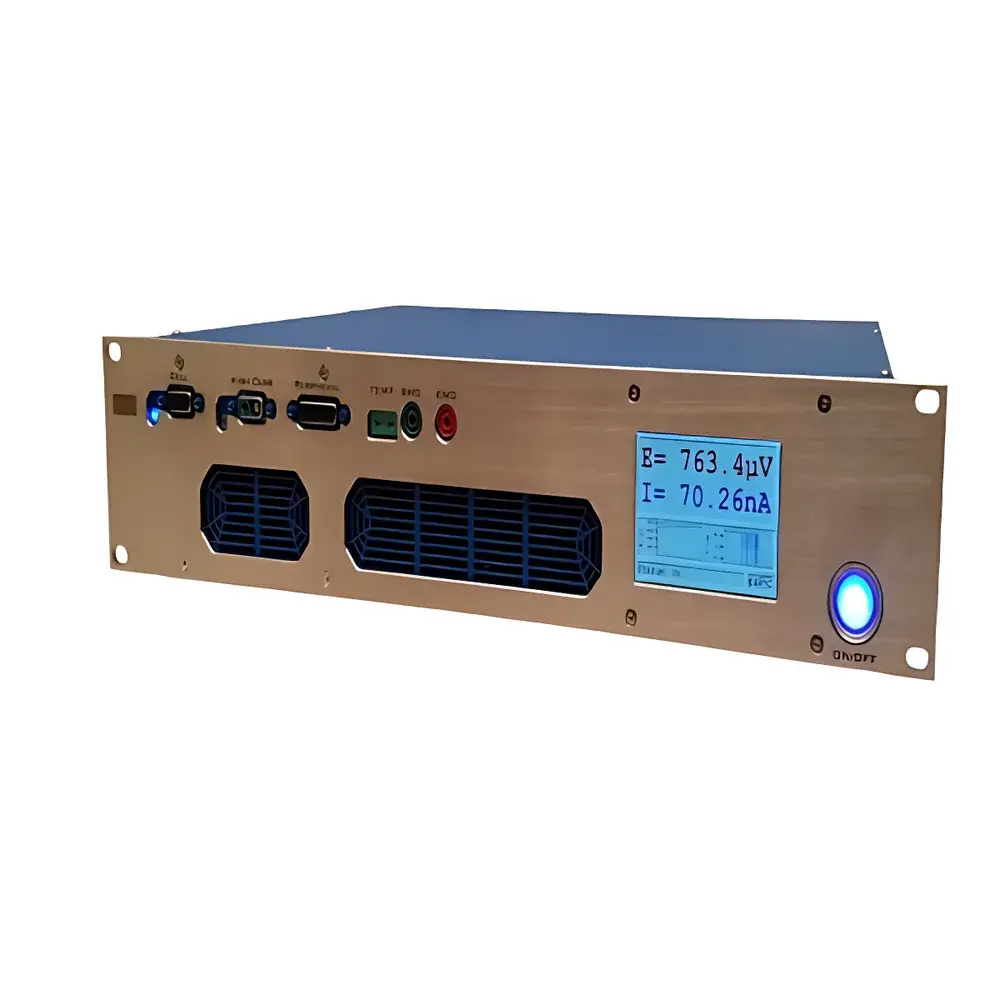
Ivium HE80 Electrochemical Workstation for High-Current Water Electrolysis
| Key | Brand: Ivium |
|---|---|
| Origin | Netherlands |
| Model | HE80 |
| Channel Count | Single-Channel |
| Current Range | 0–80 A |
| Current Accuracy | ±0.3 mA |
| Potential Accuracy | ±14 nV |
| Potentiostatic Range | +0.5 V to +20 V |
| EIS Frequency Range | 10 µHz–10 kHz |
| Maximum Data Acquisition Rate | 300,000 pts/s |
| Minimum Time Interval | 3.33 µs (0.125 µs resolution) |
| Real-Time Sampling Rate | Up to 500 pts/s |
| Dimensions | 44 × 37 × 8.8 cm |
| Weight | 15 kg |
| Electrode Configuration | 4-Electrode Connection |
| Integrated FRA/EIS | Yes |
Overview
The Ivium HE80 Electrochemical Workstation is a purpose-engineered high-current potentiostat/galvanostat system designed specifically for demanding electrochemical processes where large-scale charge transfer and precise potential control are critical—most notably proton exchange membrane (PEM) and alkaline water electrolysis for green hydrogen production. Unlike conventional low-current electrochemical workstations optimized for corrosion or sensor studies, the HE80 operates on a fundamentally different architecture: it implements a hybrid analog-digital feedback loop with active current amplification, enabling stable, noise-immune operation at up to 80 A DC while maintaining nanovolt-level potential resolution. Its extended potentiostatic range (+0.5 V to +20 V) accommodates high-overpotential electrolytic cells, stack-level testing, and multi-cell configurations without external voltage boosters. The integrated Frequency Response Analyzer (FRA) supports full impedance spectroscopy (EIS) from ultra-low frequencies (10 µHz), essential for resolving slow interfacial processes such as bubble nucleation kinetics, membrane hydration dynamics, and catalyst layer degradation during long-term electrolyzer operation.
Key Features
- High-current capability: Continuous DC output up to 80 A with <±0.3 mA absolute current accuracy and <±14 nV potential resolution—validated across the full operational range via traceable calibration protocols.
- Dedicated electrolysis architecture: Optimized power stage design minimizes thermal drift and ripple (<0.02% RMS), ensuring stable polarization curves during multi-hour constant-current electrolysis runs.
- True 4-electrode (Kelvin) configuration: Enables accurate potential control at the working electrode interface independent of counter electrode IR drop—critical for validating anode/cathode overpotentials in asymmetric PEM cells.
- Ultra-high-speed data acquisition: 300,000 data points per second maximum sampling rate with hardware timestamping; minimum time interval of 3.33 µs (0.125 µs internal resolution) supports transient analysis of bubble detachment events and double-layer charging under dynamic load conditions.
- Real-time monitoring interface: Sustained 500-point-per-second streaming to host PC with zero packet loss over USB 3.0, enabling closed-loop control integration with external PLCs or SCADA systems for automated test sequences.
- Rugged industrial form factor: 15 kg chassis with forced-air cooling, IP20-rated enclosure, and EMI-shielded analog sections compliant with IEC 61326-1 for laboratory and pilot-plant environments.
Sample Compatibility & Compliance
The HE80 is compatible with standard electrochemical cell geometries used in hydrogen evolution research—including H-type cells, flow-through electrolyzers, MEA-based single-cell test stations, and custom-built pressurized reactors (up to 30 bar with appropriate accessories). Its wide voltage compliance and current headroom allow direct integration with commercial electrolyzer stacks (e.g., 5–20 cell assemblies) for performance mapping and accelerated stress testing. From a regulatory standpoint, the instrument meets IEC/EN 61010-1 for electrical safety and IEC/EN 61326-1 for EMC in laboratory environments. Data integrity features—including audit-trail-enabled method logging, user-access-controlled parameter locking, and exportable raw binary files with metadata headers—support alignment with GLP and pre-GLP workflows. While not FDA 21 CFR Part 11-certified out-of-the-box, its deterministic data capture architecture and timestamped event logging provide foundational traceability required for future validation in regulated R&D settings.
Software & Data Management
Control and analysis are performed via IviumSoft v12.x, a platform-independent application supporting Windows, macOS, and Linux. The software provides modular experiment wizards for cyclic voltammetry, galvanostatic pulse electrolysis, chronopotentiometry, and multi-sine EIS—with customizable step definitions, real-time overlay plotting, and automatic baseline correction. All raw datasets are stored in open-format .ivium files containing embedded calibration coefficients, hardware configuration snapshots, and operator metadata. Export options include CSV, MATLAB (.mat), and HDF5 for interoperability with Python-based analysis pipelines (e.g., impedance.py, PyDSS). Batch processing tools enable post-acquisition spectral deconvolution, Tafel slope fitting, and equivalent circuit modeling using non-linear least-squares (NLLS) algorithms with confidence interval estimation. Software updates follow a documented release cycle with version-controlled changelogs and backward-compatible file handling.
Applications
- Quantitative evaluation of HER/OER catalyst activity and stability under industrially relevant current densities (≥1 A/cm²).
- In situ and operando EIS of membrane electrode assemblies (MEAs) to decouple ohmic, charge-transfer, and mass-transport resistances during voltage cycling.
- Electrolyzer stack balancing studies via individual cell voltage monitoring using multiplexed 4-electrode sensing.
- Electrodeposition process optimization for Ni–Mo, Co–P, or IrOx catalyst layers with real-time current efficiency calculation.
- Fundamental investigation of bubble-induced overpotential hysteresis and two-phase flow effects in porous transport layers (PTLs).
- Accelerated lifetime testing (ALT) protocols involving repeated start-stop cycles, load-following profiles, and thermal ramping synchronized with impedance tracking.
FAQ
Can the HE80 operate in true galvanostatic mode at 80 A while simultaneously measuring high-resolution EIS?
Yes—its dual-loop control architecture maintains constant current during frequency sweeps, and the integrated FRA acquires impedance spectra without interrupting DC polarization.
Is remote triggering supported for synchronization with external equipment (e.g., gas chromatographs or pressure sensors)?
Yes—TTL-compatible trigger I/O ports support hardware-started experiments and event-driven data capture with sub-microsecond jitter.
Does the system support differential electrochemical mass spectrometry (DEMS) coupling?
Yes—low-noise analog outputs and synchronized digital triggers enable seamless integration with quadrupole mass spectrometers for real-time H₂/O₂ quantification.
What maintenance is required for long-term reliability at high current?
Annual recalibration is recommended; no consumables or user-serviceable parts exist—the power stage uses sealed, convection-cooled MOSFET modules rated for >10,000 hours at 80% load.
Are firmware updates provided free of charge after purchase?
Yes—lifetime firmware and IviumSoft updates are included with hardware registration and delivered via secure HTTPS portal with SHA-256 signature verification.






