
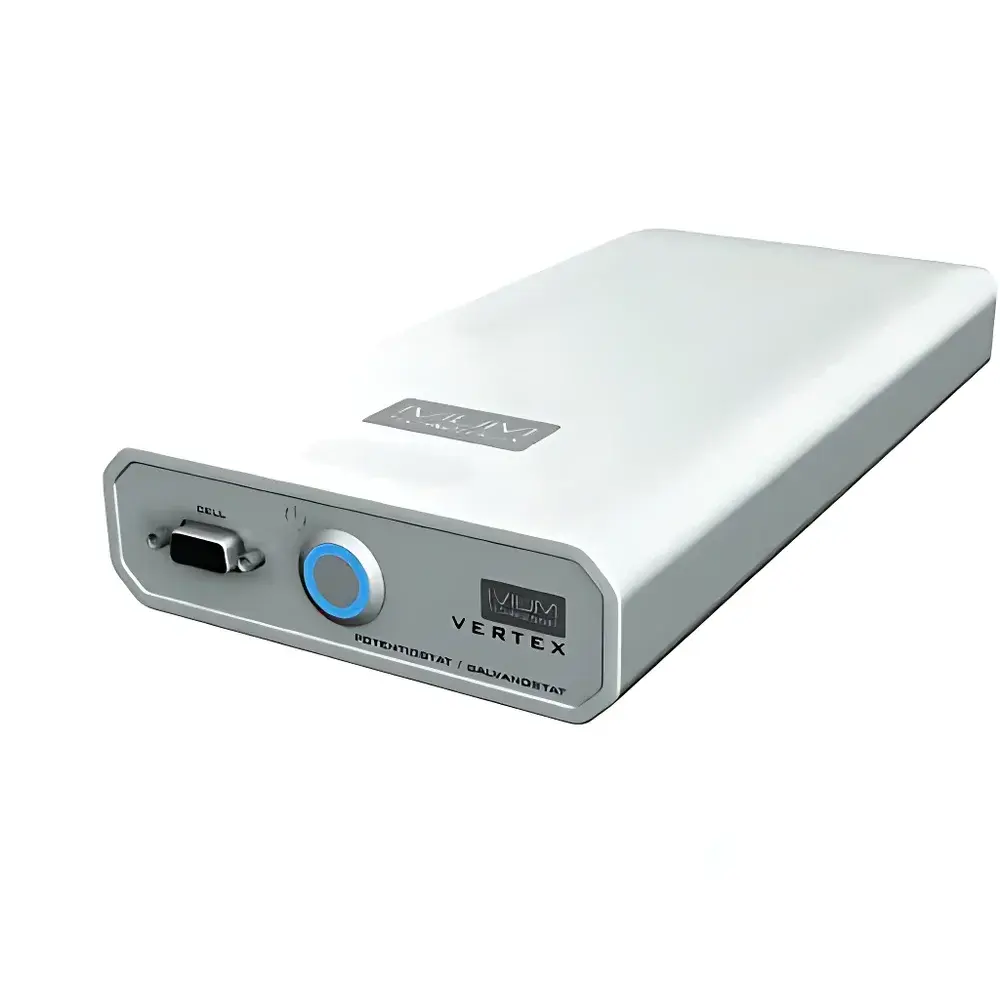
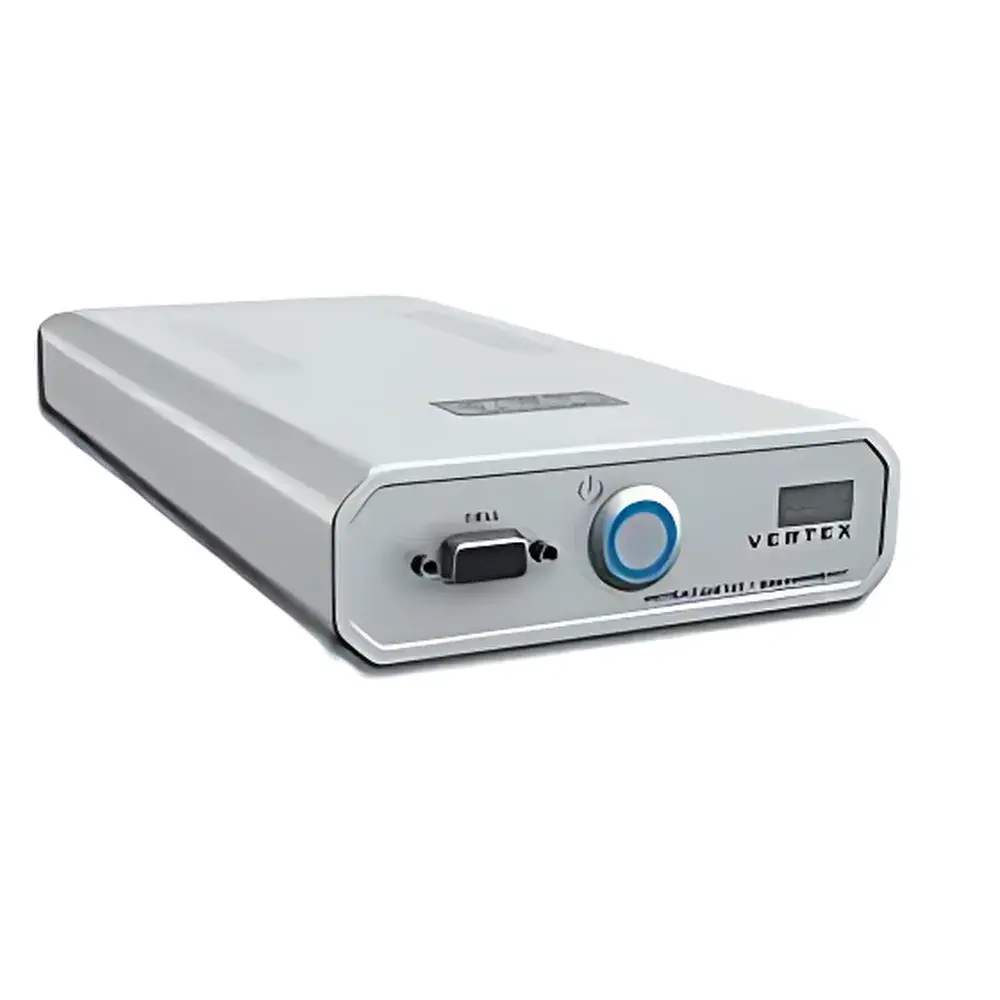
Ivium Vertex Portable Electrochemical Workstation
| Brand | Ivium |
|---|---|
| Origin | Netherlands |
| Model | Vertex |
| Instrument Type | Portable Electrochemical Workstation |
| Channel Count | Single-Channel |
| Current Range | ±100 nA to ±10 A (configurable up to 10 A) |
| Current Accuracy | 0.015% of full scale per range, minimum resolution 15 pA |
| Potential Accuracy | 0.3% of full scale |
| Potentiostatic Range | −10 V to +10 V (extended options: ±20 V) |
| EIS Frequency Range | 10 µHz to 1 MHz (optional) |
Overview
The Ivium Vertex Portable Electrochemical Workstation is a compact, high-fidelity single-channel potentiostat/galvanostat engineered for precision electrochemical characterization across academic, industrial, and field-deployable environments. Built on Ivium’s proven digital potentiostat architecture, the Vertex employs a 24-bit dual DAC/ADC system with galvanic isolation and active analog filtering to ensure low-noise signal acquisition and high reproducibility in both DC and AC measurements. Its core measurement principle relies on controlled potential/current excitation combined with real-time feedback regulation—enabling accurate implementation of standard electroanalytical techniques including cyclic voltammetry, chronoamperometry, chronopotentiometry, and electrochemical impedance spectroscopy (EIS). Designed for versatility without compromise, the Vertex supports extended voltage ranges (±20 V variants), high-current capability (up to 10 A), and integrated electrochemical noise (ECN) acquisition—making it suitable for battery cycling, corrosion monitoring, sensor development, fuel cell diagnostics, and fundamental electrokinetic studies.
Key Features
- Single-channel architecture with modular hardware scalability and firmware-upgradable functionality
- Current range spanning ±100 nA to ±10 A across multiple selectable ranges; current resolution down to 15 pA at lowest range
- Potentiostatic control from −10 V to +10 V (±20 V optional); potential accuracy ±0.3% of full scale
- Integrated electrochemical noise (ECN) module with current noise resolution of 0.15 fA and potential noise resolution of 16 nV (low-gain) / 40 nV (high-gain)
- EIS capability with frequency coverage from 10 µHz to 1 MHz (optional hardware upgrade)
- Mixed-mode operation: simultaneous application of up to five stimulus types (potential step, current step, linear sweep, current ramp, open-circuit potential) with concurrent EIS measurement
- Support for up to 255 user-defined segments per experiment and up to 65,535 cycles per method
- Maximum data logging capacity: 2 × 10⁷ data points per acquisition session
Sample Compatibility & Compliance
The Vertex workstation interfaces seamlessly with standard three-electrode electrochemical cells (working, reference, counter), rotating disk electrodes (RDE), and custom microfluidic or in-situ battery test fixtures. It complies with ISO 17025-relevant instrumentation requirements for traceable calibration and stable baseline performance. While not pre-certified for FDA 21 CFR Part 11, its software architecture supports audit-trail-enabled operation when deployed within validated GxP environments (e.g., GLP-compliant corrosion testing labs or QC workflows for electrode material qualification). All models meet CE marking requirements for electromagnetic compatibility (EMC Directive 2014/30/EU) and low-voltage safety (LVD Directive 2014/35/EU).
Software & Data Management
The IviumSoft suite—compatible with Windows 10/11—is included with every Vertex system. It provides intuitive drag-and-drop equivalent circuit modeling for EIS data fitting, automatic initial parameter estimation, and nonlinear least-squares regression using Levenberg–Marquardt algorithms. The software supports full experimental scripting via Python API (IviumPython), enabling integration into automated test benches or machine learning pipelines. Raw data is saved in open-format .txt and .csv files; metadata—including instrument settings, timestamps, and calibration history—is embedded in each file header. Trend removal, FFT-based spectral analysis, maximum entropy method (MEM) frequency estimation, and time-domain corrosion metrics (e.g., localized corrosion index, polarization resistance Rp) are implemented per ASTM G102 and EN ISO 8044 standards.
Applications
- Battery research: charge/discharge profiling, SEI formation analysis, Li-ion cathode/anode kinetics, and impedance evolution tracking during aging
- Corrosion science: potentiodynamic polarization, Tafel extrapolation, electrochemical noise monitoring for pitting susceptibility, and galvanic coupling current measurement
- Biosensor development: amperometric detection limits, mediator kinetics, and interfacial electron transfer rate quantification
- Fuel cell catalyst evaluation: oxygen reduction reaction (ORR) activity, methanol crossover assessment, and membrane resistance mapping
- Electrodeposition studies: nucleation overpotential determination, mass transport-controlled deposition modeling, and deposit morphology correlation
- Academic teaching: hands-on instruction in fundamental electrochemistry principles, including Nernst equation validation, diffusion-controlled current analysis, and Warburg impedance identification
FAQ
Is the Vertex compatible with rotating disk electrode (RDE) systems?
Yes—the Vertex supports analog tachometer input for synchronized RDE speed control and can trigger data acquisition based on rotation frequency.
Can EIS measurements be performed simultaneously with DC techniques like cyclic voltammetry?
Yes, via Mixed Mode operation: users may apply a DC waveform while acquiring impedance spectra at selected points or continuously during the scan.
Does the system support external triggering or synchronization with other instruments?
Yes—TTL-compatible trigger I/O ports enable precise timing coordination with spectrometers, potentiostats, or data loggers.
What calibration procedures are recommended before critical measurements?
Ivium recommends daily open-circuit potential verification and periodic two-point current/potential calibration using certified shunt resistors and reference voltage sources.
Is remote operation possible over LAN or USB?
Yes—full instrument control and real-time data streaming are supported via USB 2.0 or Ethernet (with optional network interface module), including headless operation under Windows Server environments.





