
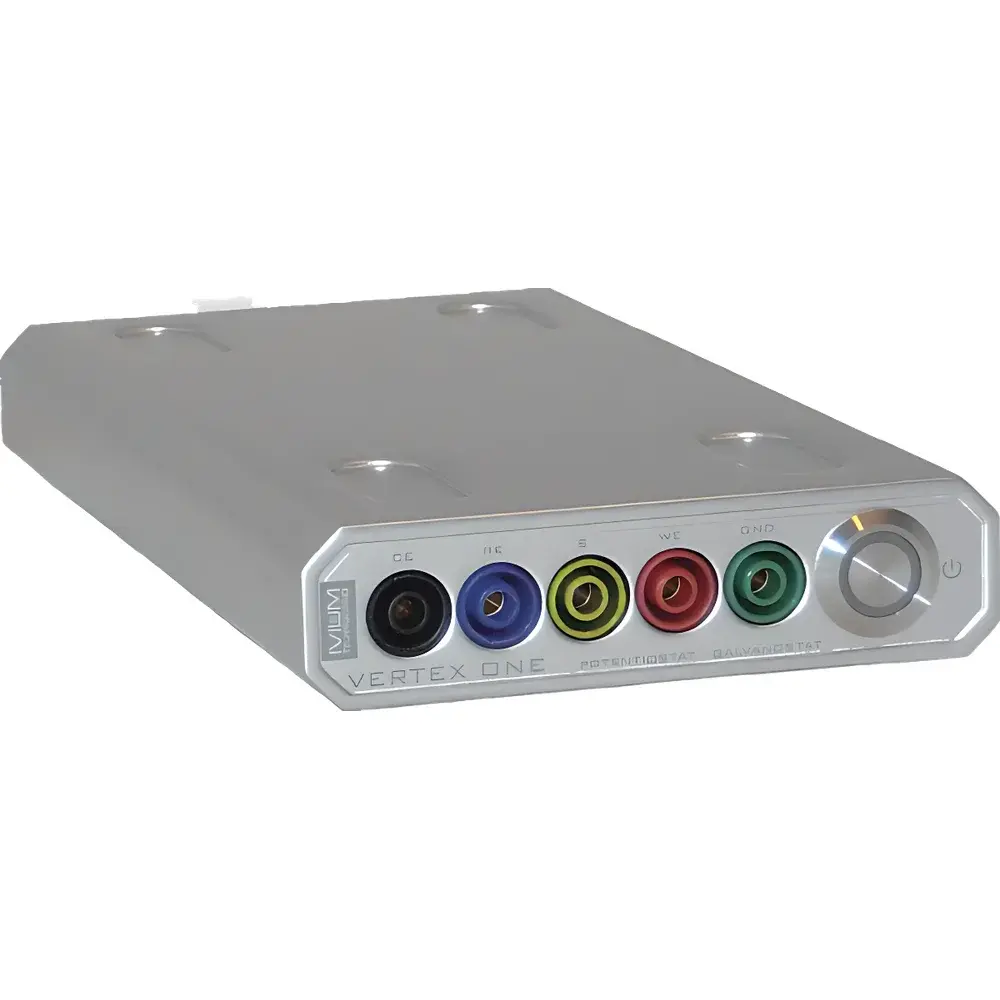
Ivium Vertex.One EIS Electrochemical Workstation
| Brand | Ivium |
|---|---|
| Origin | Netherlands |
| Model | Vertex.One.EIS |
| Instrument Type | Electrochemical Workstation |
| Channel Count | Single-Channel |
| Current Range | ±100 mA / ±350 mA |
| Current Accuracy | ±0.2% |
| Potential Accuracy | ±0.2% |
| Potentiostatic Range | ±10 V |
| EIS Frequency Range | 10 µHz – 250 kHz / 1 MHz |
| Data Acquisition Rate | 100 kHz |
| Current Resolution | Down to 10 fA |
| Current Range Span | 100 pA – 1 A |
| Floating Ground Capability | Yes |
| Dual-Potentiostat Configuration | Supported (two units) |
| Multi-Channel Expansion | Supported (multiple units) |
Overview
The Ivium Vertex.One EIS Electrochemical Workstation is a compact, high-performance potentiostat/galvanostat engineered for precision electrochemical characterization in academic research laboratories, quality control environments, and industrial R&D settings. Built upon Ivium’s proven digital potentiostat architecture, the Vertex.One implements a true analog feedback control loop with high-speed digital signal processing to ensure stability, linearity, and reproducibility across demanding electrochemical techniques—including cyclic voltammetry (CV), linear sweep voltammetry (LSV), chronoamperometry (CA), chronopotentiometry (CP), and electrochemical impedance spectroscopy (EIS). Its core design emphasizes low-noise signal acquisition, wide dynamic current range (100 pA to 1 A), and sub-femtoampere resolution—enabling reliable measurement of ultra-low-current processes such as corrosion monitoring on passive films or redox activity in single-molecule junctions. The workstation operates with full galvanic isolation and integrated floating ground functionality, allowing direct measurement of non-grounded samples (e.g., batteries in operational stacks, coated metallic substrates, or biological interfaces in physiological media) without grounding artifacts.
Key Features
- True single-channel potentiostat/galvanostat with hardware-based analog feedback control for optimal stability during fast-scan or high-impedance measurements
- Extended current range: selectable from 100 pA to 1 A across 12 decades, with minimum detectable current resolution of 10 fA (typical)
- Potentiostatic compliance: ±10 V (standard scan range); extended capability up to ±13 V / ±21 V with optional modules
- EIS frequency coverage: 10 µHz to 250 kHz (standard), extendable to 1 MHz with high-frequency option—supporting both low-frequency diffusion-controlled processes and high-frequency double-layer dynamics
- Data acquisition rate: up to 100 kHz (real-time), enabling high-temporal-resolution transient analysis and rapid EIS sweeps
- Floating ground architecture compliant with IEC 61010-1 safety standards, permitting safe operation in multi-cell battery testing or grounded electrolyte systems
- Modular scalability: two Vertex.One units can be synchronized to function as a dual-potentiostat for independent electrode control (e.g., three-electrode SECM or bipolar cell studies); multiple units support parallel multi-channel experiments under centralized software coordination
Sample Compatibility & Compliance
The Vertex.One accommodates standard three-electrode electrochemical cells (working, reference, counter), rotating disk electrodes (RDE), and custom microfluidic or in-situ spectroelectrochemical configurations. It supports aqueous, non-aqueous, and ionic liquid electrolytes, and is routinely deployed in battery material screening (Li-ion, Na-ion, solid-state), corrosion science (ASTM G5/G102), sensor development (ISO 15197), and electrocatalysis (e.g., HER/OER quantification per DOE protocols). All firmware and hardware comply with CE marking requirements, electromagnetic compatibility (EN 61326-1), and electrical safety (EN 61010-1). When operated with IviumSoft v10+ and audit trail enabled, the system meets data integrity requirements aligned with FDA 21 CFR Part 11 for regulated environments requiring electronic records and signatures.
Software & Data Management
Controlled via IviumSoft—a Windows-based application supporting intuitive method setup, real-time visualization, and automated sequence execution—IviumSoft provides built-in templates for ASTM, ISO, and IUPAC-recommended electrochemical methods. Raw data are stored in open-format .idf files (Ivium Data Format), exportable to CSV, MATLAB (.mat), or Origin-compatible formats. Version 10 introduces role-based user accounts, electronic signature workflows, and configurable audit trails—including timestamped parameter changes, file modifications, and instrument status logs—facilitating GLP/GMP-aligned documentation practices. Optional Python and LabVIEW drivers enable integration into automated test benches or custom data pipelines.
Applications
- Battery electrode kinetics and SEI formation analysis via low-frequency EIS and potentiostatic intermittent titration (PITT)
- Corrosion rate quantification using Tafel extrapolation, polarization resistance (Rp), and electrochemical noise analysis (ENA)
- Enzyme-modified biosensor calibration and stability assessment under physiological conditions
- Electrocatalyst evaluation for CO₂ reduction, water splitting, and fuel cell reactions
- In-situ monitoring of conducting polymer switching behavior and charge storage mechanisms
- Quality assurance of electrodeposited coatings and passivation layers in semiconductor and aerospace manufacturing
FAQ
Can the Vertex.One perform true two-electrode measurements on non-grounded systems?
Yes—the integrated floating ground design allows stable two- or three-electrode operation without connection to earth ground, essential for battery pouch cell testing or galvanic corrosion setups.
Is EIS data acquisition fully automated with phase and magnitude correction?
Yes—frequency response analysis includes automatic Kramers–Kronig validation, instrumental phase compensation, and iterative error minimization during fitting, ensuring metrological traceability per ISO 12784.
How is multi-channel synchronization achieved across multiple Vertex.One units?
Hardware trigger lines (TTL-compatible) and precise internal clock distribution enable sub-microsecond timing alignment between units, critical for comparative studies or distributed sensor networks.
Does IviumSoft support automated compliance reporting for ISO/IEC 17025 laboratories?
Yes—preconfigured report templates include uncertainty budgets, calibration history links, and instrument identification metadata required for accredited testing labs.




