
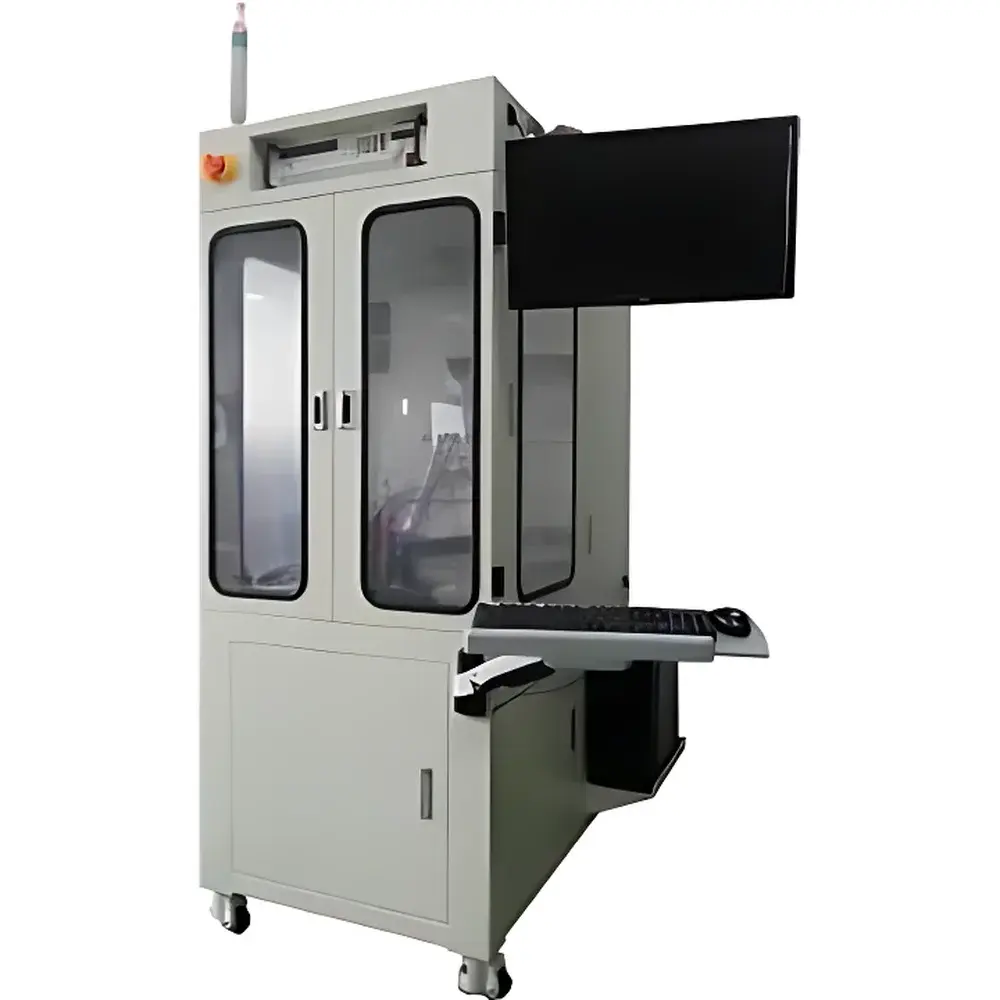
AIWEI SF25K-PE to SF300K-PE PEM Fuel Cell Stack Test Station
| Brand | AIWEI |
|---|---|
| Origin | Tianjin, China |
| Model | SF25K-PE / SF30K-PE / SF50K-PE / SF100K-PE / SF150K-PE / SF200K-PE / SF250K-PE / SF300K-PE |
| Power Range | 25–300 kW |
| Channel Configuration | Single-channel electrochemical workstation |
| Current Range | 100 A / 300 A / 600 A / 1000 A |
| Anode Gas Flow (H₂/N₂) | 500–6000 slpm |
| Cathode Gas Flow (Air/N₂) | 500–22,000 slpm |
| Humidification Temperature Range | RT–95 °C |
| Dew Point Control Accuracy | ±1 °C |
| Back Pressure Control Range | up to 3.5 bar (±2 kPa stability) |
| Voltage Monitoring Channels | up to 1000 cells |
| EIS Frequency Range (optional) | 10 mHz–10 kHz |
| MFC Accuracy | ±0.8% of reading + 0.2% of full scale |
| Flow Turndown Ratio | 100:1 |
| Exhaust Cooling & Condensate Capture | Integrated |
| Thermal Management | Air-cooled or water-cooled stack interface with independent heating/cooling control |
Overview
The AIWEI SF25K-PE to SF300K-PE PEM Fuel Cell Stack Test Station is a high-power, modular electrochemical test platform engineered for the rigorous characterization and validation of proton exchange membrane (PEM) fuel cell stacks across the 25 kW to 300 kW power range. Unlike conventional single-cell electrochemical workstations, this system operates at stack-level voltage, current, and thermal loads—enabling realistic dynamic load cycling, durability testing, and system integration validation under representative operating conditions. The station implements galvanostatic, potentiostatic, and power-controlled operation modes, with real-time synchronization of electrical, thermal, gas, and humidity parameters. Its architecture adheres to fundamental principles of electrochemical energy conversion testing: precise current sourcing/sinking, low-noise voltage monitoring, controlled reactant stoichiometry, and thermally stabilized humidification—all coordinated via deterministic timing and hardware-triggered data acquisition.
Key Features
- Scalable power coverage: Eight standardized configurations (SF25K–SF300K) support discrete stack ratings from 25 kW to 300 kW, each validated for continuous rated-load operation with thermal derating margins.
- High-fidelity gas delivery: Dual independent mass flow controllers (MFCs) for anode (H₂/N₂) and cathode (air/N₂), with flow ranges spanning 500–6000 slpm (anode) and 500–22,000 slpm (cathode); MFC accuracy certified to ±0.8% of reading + 0.2% of full scale, with 100:1 turndown ratio.
- Dynamic humidification system: Integrated steam-based humidifiers with direct temperature control (RT–95 °C) and closed-loop dew point regulation (±1 °C); dry-gas bypass and automatic wet/dry mixing enable rapid RH transients and steady-state hydration control.
- Thermal management flexibility: Configurable cooling options—including forced-air convection and closed-loop water circulation—with independent heating capability (up to 95 °C) and active back-pressure regulation (0–3.5 bar, ±2 kPa stability) for membrane hydration optimization.
- Cell-level diagnostics: Up to 1000-channel voltage monitoring (±5 V per channel) with synchronized sampling; optional integrated electrochemical impedance spectroscopy (EIS) module supporting multi-channel high-frequency resistance (HFR) measurement (10 mHz–10 kHz) across up to 35 individual cells.
- Rugged mechanical integration: Industrial-grade cabinet design (dimensions from 1400×2500×2000 mm to 2000×6000×2200 mm), featuring heated flexible gas lines, condensate-trapped exhaust cooling, and vibration-damped mounting for long-term operational stability.
Sample Compatibility & Compliance
The station is purpose-built for PEM fuel cell stacks with bipolar plate-based architectures, accommodating standard 316L stainless steel, graphite, or coated metallic flow fields. It supports industry-standard stack interfaces including DIN 32514 and SAE J2718-compliant gas inlets, coolant ports, and electrical busbars. All gas handling components comply with ISO 8573-1 Class 2 purity requirements for compressed hydrogen and instrument air. The system’s control firmware and data logging architecture are designed to meet GLP and GMP documentation standards, with configurable audit trails, user access levels, and timestamped parameter change logs. While not pre-certified for FDA 21 CFR Part 11, the software architecture provides the foundational elements—electronic signatures, data integrity checks, and immutable raw file storage—required for laboratory compliance validation.
Software & Data Management
AIWEI’s proprietary StackTest™ control software provides a unified interface for experiment sequencing, real-time visualization, and post-test analysis. Experiments are defined via hierarchical protocol templates (e.g., “Startup Sequence,” “Load Ramp,” “Shutdown with N₂ Purge”) that enforce interlocked safety logic and parameter constraints. All raw data—including voltage, current, temperature, pressure, flow, and humidity—is acquired at ≥10 Hz and stored in HDF5 format with embedded metadata (unit definitions, calibration timestamps, sensor IDs). Export modules support CSV, MATLAB .mat, and ASTM E2928-compliant XML for third-party analysis. Optional Python SDK enables custom automation, model-in-the-loop control, and integration with digital twin frameworks.
Applications
- Durability assessment under automotive drive cycles (e.g., UDDS, WLTC) with simultaneous cell voltage decay tracking and impedance evolution mapping.
- System-level validation of balance-of-plant (BOP) components including air compressors, humidifiers, and thermal management subsystems.
- Accelerated stress testing (AST) protocols for membrane degradation, catalyst corrosion, and carbon support oxidation under controlled OCV hold, cyclic loading, and start-stop conditions.
- Hydrogen utilization optimization via stoichiometry sweeps, purge frequency studies, and anode recirculation modeling.
- Multi-stack comparative benchmarking for DOE targets on efficiency (LHV), voltage efficiency, and transient response time (10–90% load step).
- Support for ISO 14687-2 hydrogen quality impact studies using controlled N₂ dilution and impurity injection modules (available as add-ons).
FAQ
What stack sizes and configurations does the SF-series support?
The SF25K–SF300K series accommodates PEM stacks ranging from ~100 to ~1200 active cells, depending on nominal cell voltage (0.6–0.75 V) and targeted power output. Mechanical integration requires customer-provided stack mounting fixtures compatible with standard 19-inch rack or floor-standing layouts.
Is the system capable of automated safety shutdown?
Yes—hardware interlocks monitor critical failure modes including coolant flow loss, overtemperature (>95 °C), overpressure (>3.5 bar), H₂ leak detection (via optional integrated sensors), and voltage reversal. All interlocks trigger immediate current cutoff and N₂ purge initiation within <100 ms.
Can the station perform freeze-thaw cycling tests?
While the base configuration supports sub-zero ambient operation down to –20 °C with external chiller integration, dedicated freeze-thaw protocols require optional cryogenic coolant loops and insulated gas manifolds—available as factory-installed upgrades.
How is calibration traceability maintained?
All MFCs, pressure transducers, and temperature sensors are supplied with NIST-traceable calibration certificates. On-site recalibration intervals are configurable (typically every 6–12 months), and the software logs all calibration events with operator ID and certificate reference numbers.






