
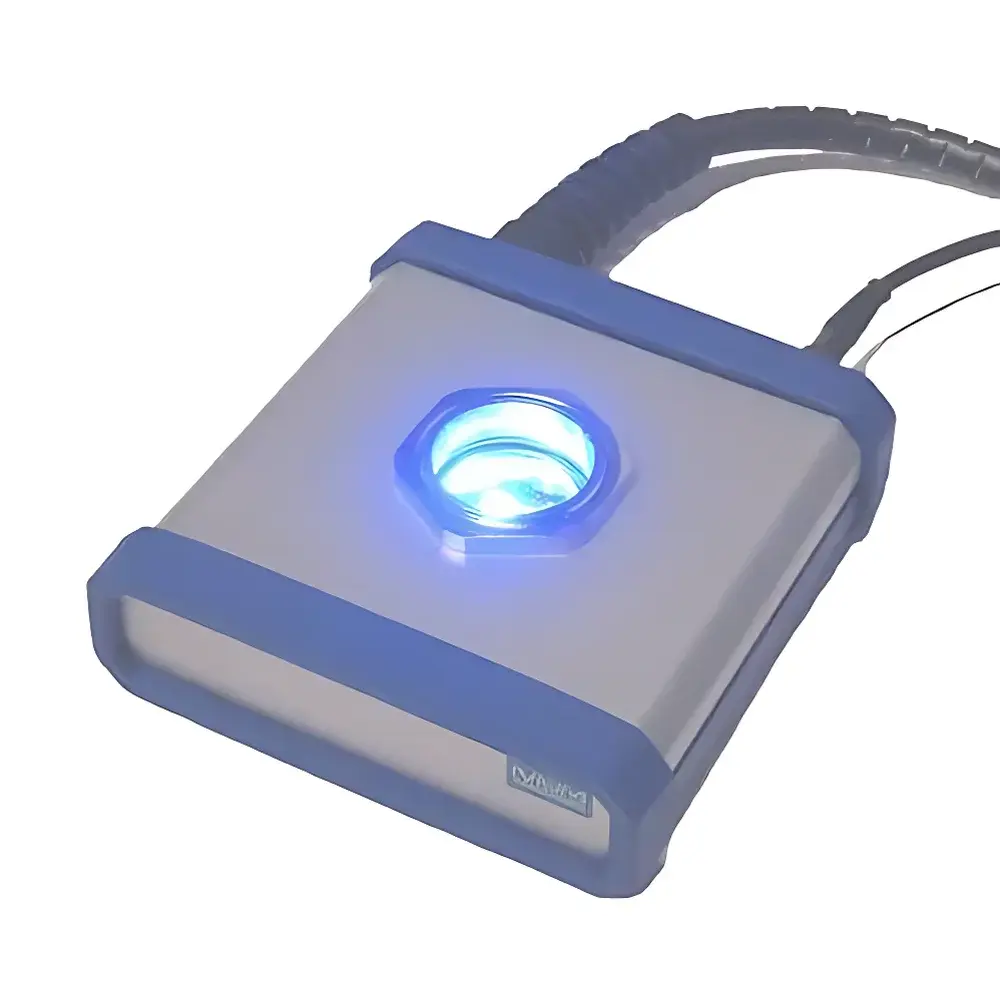
Ivium Modulight Photoelectrochemical Light Module
| Brand | Ivium |
|---|---|
| Origin | Netherlands |
| Model | Modulight |
| Light Source Type | Infrared-capable LED-based modular light source |
| Illumination Mode | External illumination |
| Spectral Output | 7 standard channels (460–740 nm + 5500K white) + 4 optional channels (365 nm, 400 nm, 4000K natural white, 3100K warm white) |
| Intensity Control | Software-controlled DC or sinusoidally modulated (10 µHz – 2 MHz) |
| Compliance | Designed for integration with Ivium electrochemical workstations (e.g., Stat, Vertex, CompactStat series) and compatible with ISO/IEC 17025-aligned electro-optical testing workflows |
Overview
The Ivium Modulight is a precision-engineered photoelectrochemical light module designed for controlled, spectrally resolved illumination in advanced electrochemical and optoelectronic characterization. Unlike conventional broadband lamps, the Modulight employs a solid-state, multi-LED architecture to deliver discrete, narrow-band visible and near-infrared light outputs—enabling wavelength-selective excitation critical for studying charge-transfer kinetics, photocarrier generation, and interfacial recombination in photoactive materials. Its core functionality integrates seamlessly with Ivium’s family of potentiostats/galvanostats via digital I/O and real-time synchronization protocols, allowing simultaneous electrochemical control and optical stimulation under rigorously defined photonic conditions. The module operates on an external illumination principle, ensuring uniform incident irradiance across sample surfaces without thermal interference from internal lamp housings—a key requirement for temperature-sensitive photoelectrodes, dye-sensitized solar cells (DSSCs), perovskite films, and photocatalytic thin-film electrodes.
Key Features
- Seven standard spectral channels: Cool white (5500K), blue (460 nm), green (525 nm), amber (590 nm), red (623 nm), deep red (660 nm), and far-red (740 nm)—each with independently controllable intensity and temporal modulation.
- Four optional upgrade channels: UV-A (365 nm and 400 nm), natural white (4000K), and warm white (3100K), enabling extension into ultraviolet and broad-spectrum physiological lighting regimes.
- Full-intensity DC output or high-fidelity sinusoidal intensity modulation (10 µHz to 2 MHz bandwidth), synchronized with electrochemical signal acquisition for frequency-domain photoelectrochemical analysis.
- Digital intensity calibration traceable to NIST-traceable photodiode standards; intensity linearity maintained over >4-decade dynamic range (0.1–100% full scale).
- Hardware-level trigger synchronization (TTL-compatible) for sub-millisecond alignment between light pulses and potentiostat sampling—essential for transient photocurrent/photovoltage measurements.
- Modular mechanical design with standardized mounting interface (M4 threaded holes, Ø25 mm optical path) for reproducible positioning in custom electrochemical cells and optoelectrochemical flow cells.
Sample Compatibility & Compliance
The Modulight supports planar, transparent, and opaque photoelectrodes—including FTO/ITO-coated substrates, metal oxide semiconductors (TiO₂, WO₃, BiVO₄), organic photovoltaic layers, and liquid-junction systems such as DSSCs and photoelectrochemical water-splitting cells. Its external illumination geometry eliminates spectral distortion caused by lamp envelope absorption or heat-induced convection, meeting ASTM E973 and IEC 61215 requirements for stable irradiance delivery in photovoltaic device testing. All firmware and hardware timing logic comply with GLP/GMP-relevant audit trail provisions when used with Ivium’s CFR Part 11-compliant software suite (IviumSoft v5.x+), including electronic signatures, user access logs, and immutable measurement metadata embedding.
Software & Data Management
Control and automation are fully embedded within IviumSoft—the native platform supporting experiment scripting, real-time visualization, and post-acquisition modeling. The software enables direct parameterization of light-driven protocols including: (i) I–V curve acquisition under programmable irradiance levels; (ii) pulsed-light OCP and chronoamperometric experiments at user-defined duty cycles and peak intensities; and (iii) intensity-modulated voltage spectroscopy (IMVS) and intensity-modulated photocurrent spectroscopy (IMPS) with phase-resolved impedance extraction. Raw photonic and electrochemical datasets are stored in HDF5 format with embedded metadata (wavelength, intensity, modulation frequency, timestamp, instrument ID), facilitating FAIR data principles and third-party analysis via Python/MATLAB APIs.
Applications
- Quantitative evaluation of photoconversion efficiency parameters: short-circuit current (Isc), open-circuit voltage (Eoc), fill factor (FF), and maximum power point (Pmax) under monochromatic or polychromatic illumination.
- Time-resolved photoelectrochemical kinetics: carrier lifetime estimation via transient photocurrent decay, surface state trapping analysis using intensity-dependent OCP relaxation.
- Frequency-domain photoimpedance mapping: IMVS/IMPS spectra for distinguishing bulk vs. interfacial recombination pathways in semiconductor/electrolyte junctions.
- Spectral response profiling (IPCE/ABPE): action spectrum derivation through sequential monochromatic I–V sweeps calibrated against reference Si photodiode.
- Stability assessment under accelerated illumination stress (e.g., constant-intensity aging or cyclic UV–vis exposure).
FAQ
Is the Modulight compatible with non-Ivium potentiostats?
Yes—via analog voltage input (0–10 V) for DC intensity control and TTL triggering for pulse synchronization; however, full spectral channel selection and modulation waveform definition require IviumSoft or custom LabVIEW/Python drivers.
What is the typical irradiance range at the sample plane?
Calibrated output ranges from 0.1 to 150 mW/cm² depending on LED channel and working distance (standard 10 mm gap); absolute values are provided in the factory calibration certificate.
Can intensity modulation be applied simultaneously across multiple wavelengths?
No—modulation is applied per active channel; sequential or multiplexed wavelength modulation requires software sequencing with precise inter-channel timing control.
Does the module include radiometric calibration data?
Each unit ships with a NIST-traceable spectral irradiance report (350–800 nm) measured at the collimated output port, referenced to a calibrated silicon photodiode.
How is thermal management handled during extended operation?
Active Peltier cooling maintains LED junction temperature within ±0.5 °C of setpoint (25 °C default), ensuring wavelength stability and intensity reproducibility over multi-hour experiments.





