
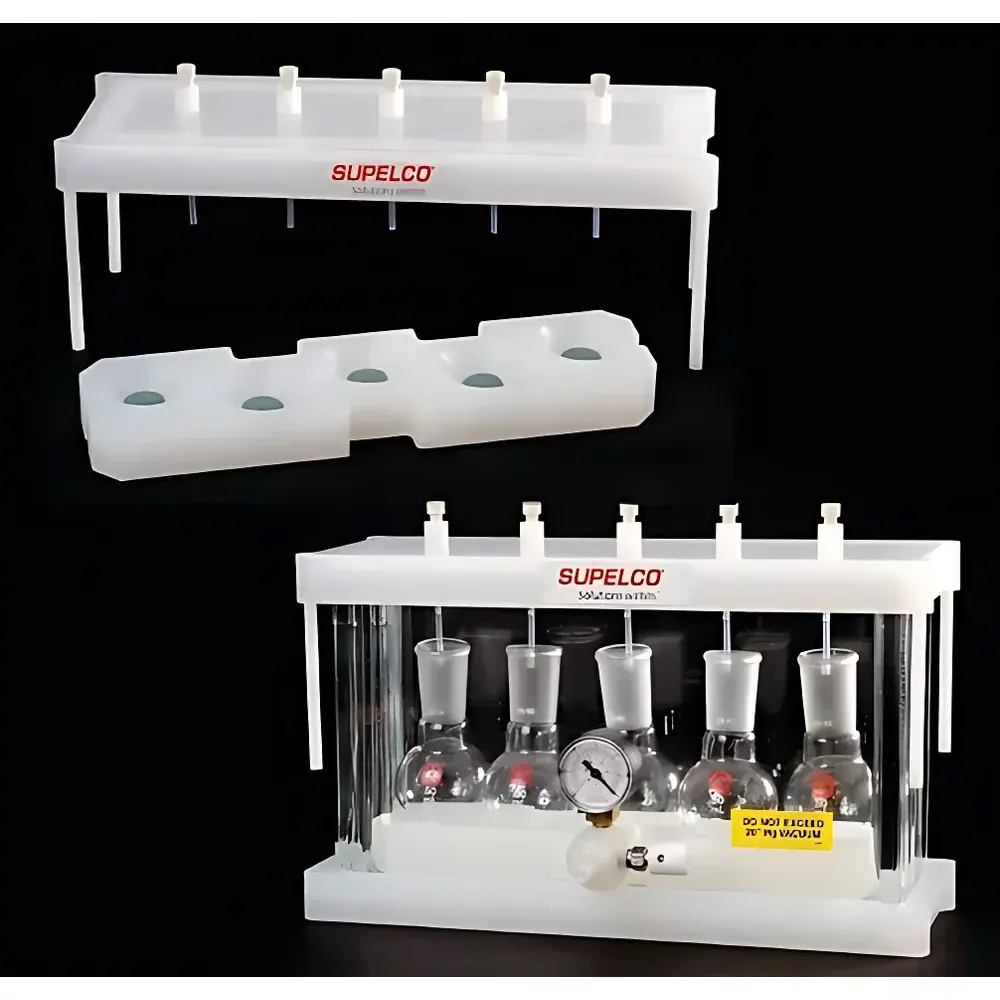
Supelco Visiprep 5-Position Vacuum Manifold for Solid Phase Extraction
| Brand | Supelco |
|---|---|
| Model | 57101-U |
| Origin | USA |
| Automation Level | Manual |
| Channel Count | 5 |
| Extraction Format | Cartridge-Based SPE |
| Solvent Contact Materials | PTFE, Chemically Resistant Polymers |
| Sample Capacity | 5 samples simultaneously |
| Collection Vessels | 50 mL round-bottom or flat-bottom flasks (standard) |
| Flow Control | Individual needle valve per channel |
| Compliance | Designed for ASTM D7260, EPA Method 502.2/525.3, ISO 17924 workflows |
Overview
The Supelco Visiprep 5-Position Vacuum Manifold (Model 57101-U) is a precision-engineered manual vacuum manifold designed for reproducible, parallel solid-phase extraction (SPE) of liquid samples prior to chromatographic analysis. Unlike generic vacuum manifolds, this system employs a dedicated 5-port configuration with individually adjustable flow control valves and integrated PTFE-compatible solvent pathways—enabling consistent elution kinetics across all channels while minimizing carryover risk. Its architecture supports standardized cartridge-based SPE protocols compliant with U.S. EPA Methods 502.2 (VOCs in water), 525.3 (semivolatiles), and ASTM D7260 (determination of polar organic contaminants in environmental matrices). The manifold’s primary function is to apply regulated negative pressure across SPE cartridges to drive sample loading, washing, and elution steps—ensuring uniform bed compression, controlled flow rates, and minimal analyte breakthrough.
Key Features
- Five independently adjustable PTFE-coated stainless steel flow control valves—each calibrated for stable, low-drift vacuum regulation during sequential or simultaneous processing.
- Chemically inert construction: All solvent-contact surfaces consist of virgin PTFE, borosilicate glass (cylinder body), and fluoropolymer-sealed gaskets—resistant to acetonitrile, methanol, dichloromethane, ethyl acetate, and 0.1 M HCl/NaOH solutions.
- Dual-mode port design: Compatible with both standard and cross-contamination-resistant configurations—57101-U includes the anti-cross-contamination cap assembly with disposable inlet tubing connectors to prevent inter-sample residue transfer.
- Modular flask support plate engineered for precise alignment of five 50 mL round-bottom (e.g., Sigma-Aldrich Z414484.2) or flat-bottom (Z418773) flasks with standard 24/40 ground-glass joints—eliminating need for adapter rings or secondary holders.
- Integrated analog vacuum gauge (0–760 Torr range) and fine-tuning needle valve allow real-time pressure monitoring and sub-10 mTorr resolution adjustment—critical for method transfer between labs and GLP-compliant documentation.
Sample Compatibility & Compliance
The Visiprep 57101-U manifold accommodates all commercially available 1 mL, 3 mL, and 6 mL SPE cartridges—including bonded silica (C18, SCX, SAX), polymeric (Strata-X, Oasis HLB), and mixed-mode phases—from Supelco, Waters, Phenomenex, and Agilent. It supports aqueous, biological (plasma, urine, serum), environmental (groundwater, wastewater, surface water), and food extract matrices without modification. The system meets essential requirements for ISO/IEC 17025-accredited laboratories performing validated SPE procedures under USP , FDA 21 CFR Part 11 (when paired with electronic logbooks), and EU Annex 11-compliant data integrity frameworks. Its mechanical design conforms to IEC 61010-1 safety standards for laboratory equipment.
Software & Data Management
As a fully manual vacuum manifold, the 57101-U does not incorporate embedded firmware or digital controls. However, it is routinely deployed within LIMS-integrated workflows where SOP execution, operator identity, batch ID, and vacuum setpoint are recorded externally using validated electronic notebooks (e.g., LabArchives, Benchling) or paper-based GLP logs. Each unit ships with a traceable calibration certificate referencing NIST-traceable pressure standards. For audit readiness, users may document vacuum stability over time using external digital manometers—supporting full compliance with FDA 21 CFR Part 11 §11.10(a) for manual systems operating in regulated environments.
Applications
- Pre-concentration and cleanup of trace-level pharmaceuticals (e.g., β-blockers, NSAIDs) from municipal wastewater effluents prior to LC-MS/MS analysis.
- Isolation of mycotoxins (aflatoxin B1, ochratoxin A) from cereal extracts using immunoaffinity columns coupled with HPLC-FLD quantification.
- Routine pesticide residue screening in fruit and vegetable homogenates per EN 15662:2018 multi-residue methods.
- Extraction of endocrine-disrupting compounds (bisphenol A, alkylphenols) from human serum samples under CLIA-certified clinical research protocols.
- Method development for forensic toxicology workflows involving amphetamines, opioids, and synthetic cannabinoids in whole blood matrices.
FAQ
What flask types are compatible with the collection plate?
Standard 50 mL round-bottom (24/40 joint, e.g., Sigma-Aldrich Z414484.2) and flat-bottom (Z418773) flasks are directly supported; 80 mL pear-shaped flasks (Z680346) may be used with minor height adjustment.
Can the manifold be converted between 5-position and 24-position configurations?
Yes—conversion kits 57104-U (to anti-cross-contamination 5-position mode) and 57105-U (to standard 5-position mode) enable reconfiguration from original 24-position Visiprep systems.
Is PTFE the only material contacting solvents during operation?
All wetted components—including needle valves, cap gaskets, cylinder O-rings, and solvent guide needles—are constructed from virgin PTFE or PTFE-coated stainless steel; glass cylinder body ensures optical clarity and thermal stability.
Does this manifold support positive-pressure SPE?
No—it operates exclusively under vacuum-driven flow; positive-pressure applications require separate nitrogen manifold systems (e.g., Supelco 57082).
How is cross-contamination prevented in the 57101-U configuration?
Each port uses a dedicated, disposable PTFE-lined inlet tube that terminates at the cartridge frit—eliminating shared fluid paths and enabling complete replacement between batches per GLP cleaning validation protocols.



