
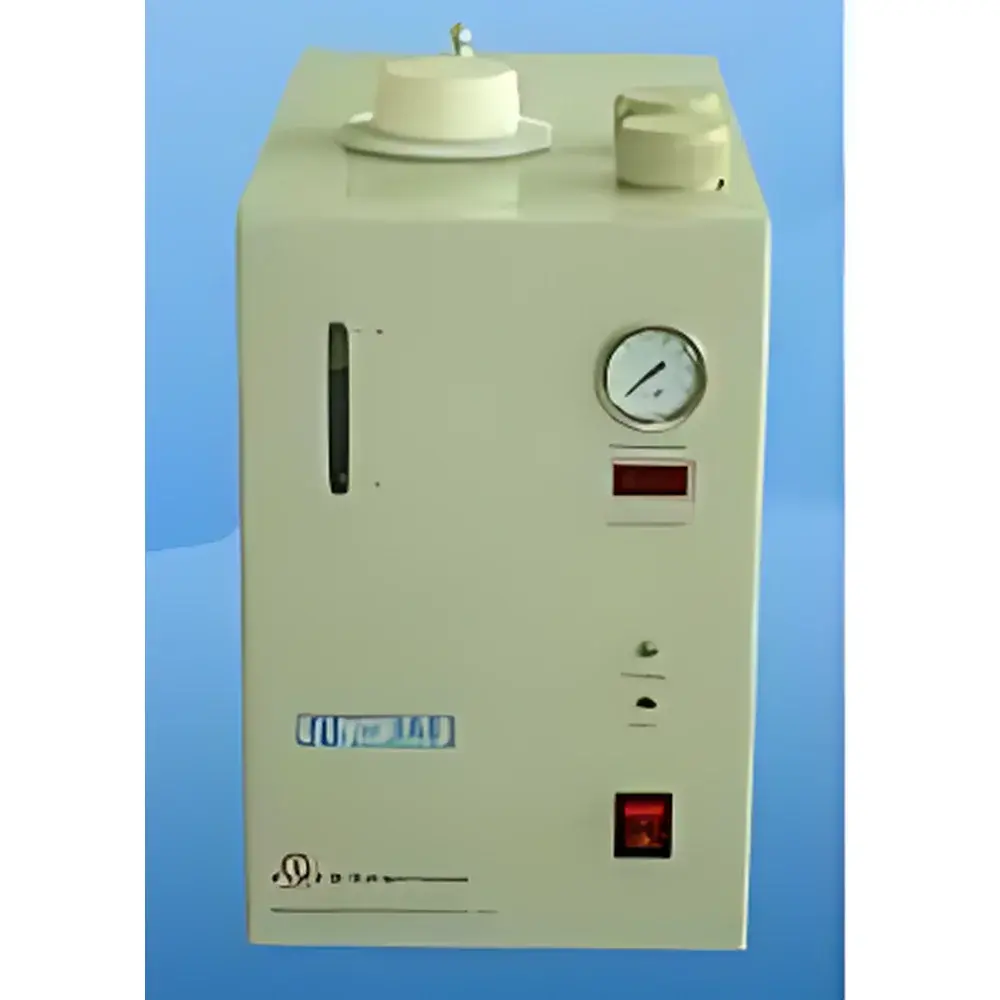
Chu Ding Technology QL-300 SPE Electrolytic High-Purity Hydrogen Generator (with QL-150 & QL-500 Variants)
| Brand | Chu Ding Technology |
|---|---|
| Origin | Shanghai, China |
| Model | QL-150 / QL-300 / QL-500 |
| Purity | >99.999% H₂ |
| Output Flow | 0–310 mL/min |
| Output Pressure | 0.02–0.4 MPa |
| Power Supply | 220 V ±15%, 50–60 Hz |
| Max Power Consumption | 150 W |
| Dimensions (W×D×H) | 500 × 270 × 420 mm |
| Water Reservoir Volume | 3.2 L |
| Water Consumption | 14.46 g/h |
| Feed Water Resistivity Requirement | ≥1 MΩ·cm |
| Housing Material | High-grade engineering plastics |
| Electrode Architecture | Zero-gap SPE catalytic electrode with integrated ion-exchange membrane |
Overview
The Chu Ding Technology QL-300 SPE Electrolytic High-Purity Hydrogen Generator is a compact, fully automated laboratory-grade hydrogen source engineered for continuous, on-demand supply of ultra-high-purity hydrogen gas (≥99.999% v/v) via solid polymer electrolyte (SPE) membrane electrolysis of deionized water. Unlike traditional alkaline electrolyzers, this system operates without caustic KOH or NaOH solutions—eliminating corrosion risks, chemical handling hazards, and maintenance associated with liquid electrolytes. The core electrochemical process relies on proton exchange membrane (PEM) technology: water is fed into the anode chamber, where it undergoes oxidation (2H₂O → 4H⁺ + O₂ + 4e⁻); protons migrate across the Nafion®-type SPE membrane under applied DC voltage, while electrons travel externally to the cathode, where reduction occurs (4H⁺ + 4e⁻ → 2H₂). The resulting hydrogen stream passes through integrated gas–water separation and dual-stage desiccant drying to achieve consistent <1 ppm O₂, <1 ppm H₂O, and <0.1 ppm total hydrocarbons—meeting stringent requirements for GC carrier gas, fuel cell testing, and reducing atmosphere applications.
Key Features
- SPE-based zero-gap electrolytic cell with composite catalyst–membrane electrodes, delivering high current efficiency (>85% at rated load) and low cell voltage (<1.9 V per cell at 1 A/cm²)
- Integrated multi-stage purification: coalescing separator, stainless-steel gas–liquid separator, and replaceable desiccant cartridge (indicating moisture saturation via color-change indicator)
- Microprocessor-controlled pressure regulation with closed-loop feedback; maintains stable output pressure (0.02–0.4 MPa) and flow (0–310 mL/min) across variable demand
- Automatic safety interlocks including over-pressure shutdown, low-water cutoff, over-temperature protection, and hydrogen leak detection via built-in semiconductor sensor
- Energy-efficient design: nominal power draw ≤150 W at full output; optimized thermal management ensures minimal heat generation and extended component service life
- Modular architecture supports field-replaceable consumables—no tools required for desiccant or membrane electrode assembly (MEA) replacement
Sample Compatibility & Compliance
The QL series is compatible with feed water meeting ASTM D1193 Type II or ISO 3696 Grade 2 specifications (resistivity ≥1 MΩ·cm at 25 °C, TOC < 50 ppb). It is not suitable for tap water, distilled water without post-treatment, or water containing chlorides, silica, or heavy metals above trace levels. The generator complies with IEC 61010-1:2010 for electrical safety in laboratory equipment and meets CE marking requirements for EMC (EN 61326-1) and low-voltage directive (2014/35/EU). While not certified to UL or CSA standards out-of-the-box, its architecture supports integration into GLP- and GMP-regulated environments when deployed with validated SOPs and periodic calibration per ISO/IEC 17025 guidelines. All firmware logs—including runtime hours, pressure events, water level alerts, and power anomalies—are timestamped and exportable for audit trails compliant with FDA 21 CFR Part 11 principles.
Software & Data Management
The QL-300 features an embedded ARM Cortex-M4 controller running real-time OS firmware with non-volatile event logging. Local status is displayed via a 4-digit LED screen showing real-time pressure (MPa), flow (mL/min), water level (%), and operating mode (Standby/Run/Fault). Optional RS-232 or USB-C interface enables remote monitoring and control via ASCII command protocol; third-party software (e.g., LabVIEW, Python pySerial) can poll operational parameters every 2 seconds and trigger alarms upon deviation thresholds. Data export supports CSV format for trend analysis in QC/QA documentation. Firmware updates are performed via signed binary files to ensure integrity and prevent unauthorized modification—critical for regulated laboratories maintaining instrument qualification records.
Applications
This hydrogen generator serves as a primary gas source for analytical instrumentation requiring inert, high-purity reducing gases, including: carrier gas for capillary gas chromatography (GC-FID, GC-TCD, GC-MS); fuel supply for hydrogen flame ionization detectors (FID); purge gas in thermal desorption units and headspace samplers; reducing atmosphere in catalyst activation chambers; feedstock for PEM fuel cell characterization rigs; and blank gas in trace-level hydrogen sulfide or ammonia detection systems. Its quiet operation (<45 dB(A)), compact footprint, and absence of high-pressure cylinders make it ideal for fume hood installation, mobile labs, and ISO Class 5 cleanroom-adjacent environments where cylinder logistics pose contamination or spatial constraints.
FAQ
What feed water quality is required for optimal performance?
Deionized water with resistivity ≥1 MΩ·cm (ASTM D1193 Type II or better) is mandatory. Pretreatment via reverse osmosis followed by mixed-bed polishing is recommended for long-term MEA stability.
How often must the desiccant be replaced?
Under typical lab usage (8 h/day, 200 mL/min average flow), replacement is required every 6–12 months—indicated visually by color shift from orange to green in the sight glass.
Can the QL-300 be used with GC systems requiring 0.3 MPa inlet pressure?
Yes—the pressure regulator is factory-set to 0.3 MPa and adjustable within the 0.02–0.4 MPa range using the front-panel potentiometer.
Is external cooling required?
No. Passive convection cooling suffices; ambient temperature must remain between 10–35 °C with ≤80% non-condensing humidity.
Does the unit support 21 CFR Part 11-compliant electronic records?
While the base unit does not include digital signature or role-based access, its timestamped event log and exportable CSV data meet foundational ALCOA+ principles; integration with LIMS or ELN platforms enables full Part 11 compliance.



