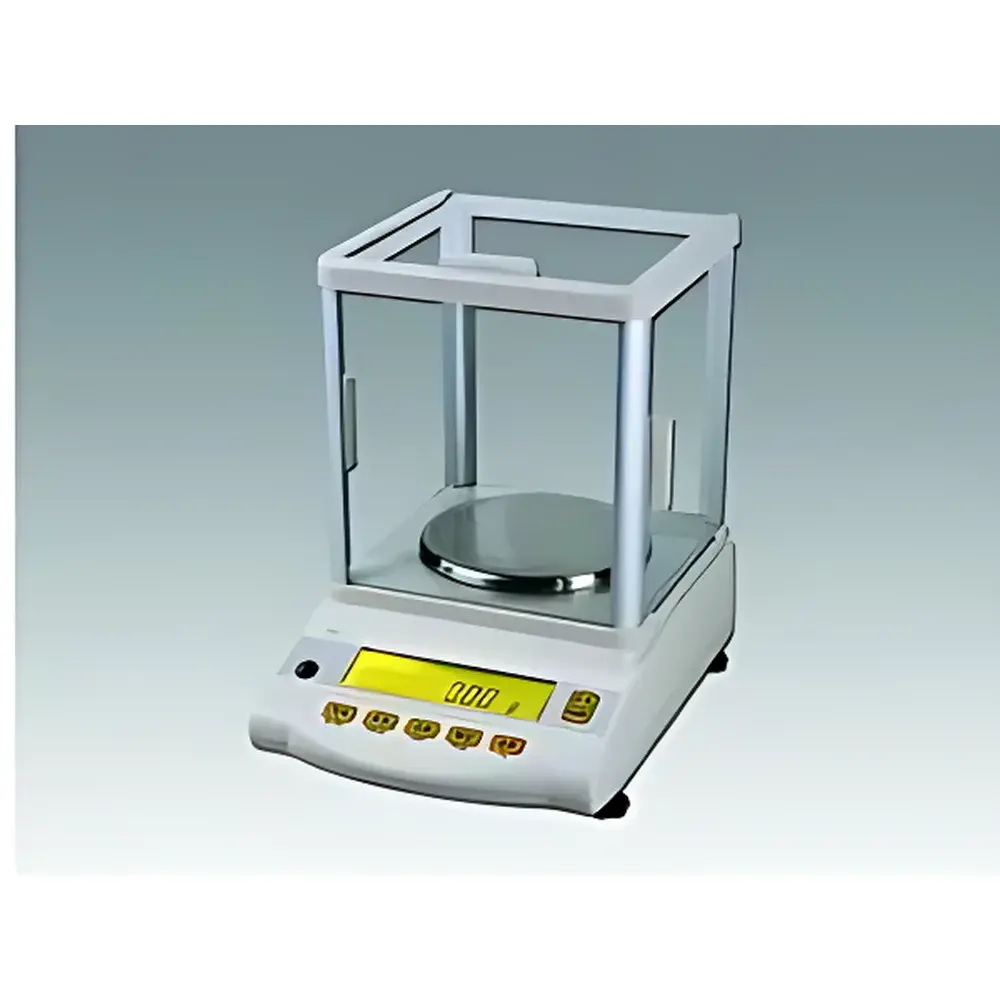
Chu Ding YP102N Precision Balance (0.01 g Readability, Draft Shield)
| Brand | Chu Ding |
|---|---|
| Origin | Shanghai, China |
| Model | YP102N |
| Capacity | 100 g |
| Readability | 0.01 g |
| Repeatability | ≤0.01 g |
| Linearity | ±0.02 g |
| Pan Diameter | Φ128 mm |
| Draft Shield Dimensions | 175 × 170 × 185 mm |
| Overall Dimensions | 270 × 190 × 265 mm |
| Power | AC adapter or 9 V DC battery |
| Display | Backlit LCD |
| Interface | RS232 |
| Features | Auto-calibration, tare, counting mode, unit conversion, level indicator, full-range tare, built-in calibration weight |
Overview
The Chu Ding YP102N Precision Balance is a high-stability, general-purpose laboratory balance engineered for reliable mass measurement at 0.01 g readability (1/100 g resolution) across a 100 g maximum capacity. Designed around a robust single-chip microcontroller architecture and an optimized strain-gauge sensor system, it mitigates common drift-related artifacts—such as creep and nonlinearity—associated with conventional resistive load cells. Its measurement principle adheres to the fundamental law of force equilibrium under gravitational acceleration, translated into digital mass output via analog-to-digital conversion with temperature-compensated signal conditioning. The integrated draft shield (175 × 170 × 185 mm) minimizes convective air currents and thermal gradients, ensuring stable readings in ambient lab environments without requiring climate-controlled enclosures. With its compact footprint (270 × 190 × 265 mm), stainless-steel weighing pan (Φ128 mm), and hybrid power capability (9 V DC battery or AC adapter), the YP102N serves as a dependable primary weighing instrument in teaching labs, QC checkpoints, field-deployable setups, and small-scale R&D workflows where traceability, repeatability, and operational simplicity are prioritized over metrological grade certification.
Key Features
- 0.01 g readability with ≤0.01 g repeatability and ±0.02 g linearity—validated per internal performance verification protocols
- Integrated draft shield with transparent acrylic panels for visual monitoring and environmental isolation
- Backlit LCD display with clear digit rendering, supporting low-light or multi-user bench environments
- Auto-calibration function activated via single-key operation; includes built-in calibration weight for routine verification
- Full-range tare capability with memory retention across power cycles
- Counting mode with sample-set functionality for discrete-part inventory control (e.g., screws, tablets, seeds)
- Unit conversion between grams, carats, ounces, and grains—configured without menu navigation
- RS232 serial interface compliant with standard ASCII command sets for integration into LIMS or custom data acquisition systems
- Integrated bubble level indicator and adjustable leveling feet for rapid mechanical alignment on uneven surfaces
- Hybrid power architecture: operates continuously from AC supply or up to 20 hours on standard 9 V alkaline battery (battery life varies with backlight usage and ambient temperature)
Sample Compatibility & Compliance
The YP102N accommodates solid, granular, and powdered samples within its 100 g limit and 128 mm diameter stainless-steel pan. It is unsuitable for volatile liquids, corrosive substances, or materials generating static charge without appropriate containment (e.g., weighing boats). While not certified to OIML R76 or NIST Handbook 44 for legal-for-trade applications, its performance aligns with ISO 9001–based internal calibration requirements for non-regulated quality assurance tasks. The device meets IEC 61000-4 electromagnetic compatibility standards for industrial environments and complies with RoHS Directive 2011/65/EU regarding hazardous substance restrictions. For GLP/GMP-aligned labs, users may configure audit trails manually via RS232 logging or integrate with external timestamped data capture systems.
Software & Data Management
No proprietary software is bundled; however, the RS232 port supports direct ASCII output using standard terminal emulators (e.g., PuTTY, Tera Term) or spreadsheet-based logging via virtual COM port drivers. Output format is configurable (e.g., “12.345g”) and includes real-time stabilization flags. Calibration events, tare resets, and unit changes are not internally timestamped but can be externally annotated during data capture. For regulated environments requiring 21 CFR Part 11 compliance, third-party middleware (e.g., LabArchives, Benchling) must manage electronic signatures and change control—this balance provides raw data integrity but no native user authentication or audit trail generation.
Applications
- Academic instruction: stoichiometric preparation, density determination, and gravimetric analysis in undergraduate chemistry and physics laboratories
- Pharmaceutical pre-formulation: excipient blending checks, capsule fill weight sampling, and batch reconciliation prior to analytical validation
- Agricultural extension: seed count per gram, fertilizer dosing verification, and soil sample mass normalization
- Manufacturing QA: component count verification, packaging net-weight spot checks, and incoming raw material receipt auditing
- Environmental field labs: filter mass gain measurements (TSP, PM10) when used with desiccator equilibration protocols
- Vocational training centers: hands-on calibration practice, error source identification, and uncertainty estimation exercises
FAQ
Is the YP102N suitable for ISO/IEC 17025 accredited testing?
No—it lacks documented metrological traceability to national standards and does not provide calibration certificates with uncertainty budgets. It may serve as a working standard only after user-performed verification against traceable reference weights.
Can the draft shield be removed for large-sample weighing?
Yes, the acrylic shield is mechanically detachable; however, removing it degrades repeatability and increases susceptibility to air currents—recommended only for gross weighing where ±0.05 g tolerance is acceptable.
Does the balance support automatic internal calibration with motorized mechanism?
No—calibration is semi-automatic: users initiate the process via front-panel keypress, and the internal weight is mechanically engaged by solenoid; no user handling of calibration masses is required.
What is the warm-up time required for specified accuracy?
Minimum 30 minutes after power-on under stable ambient conditions (20–25 °C, <60% RH); stabilization time extends significantly below 15 °C or above 30 °C.
Is the RS232 interface optically isolated?
No—electrical isolation is not implemented; use of a USB-to-RS232 converter with galvanic isolation is recommended when connecting to sensitive host systems.