
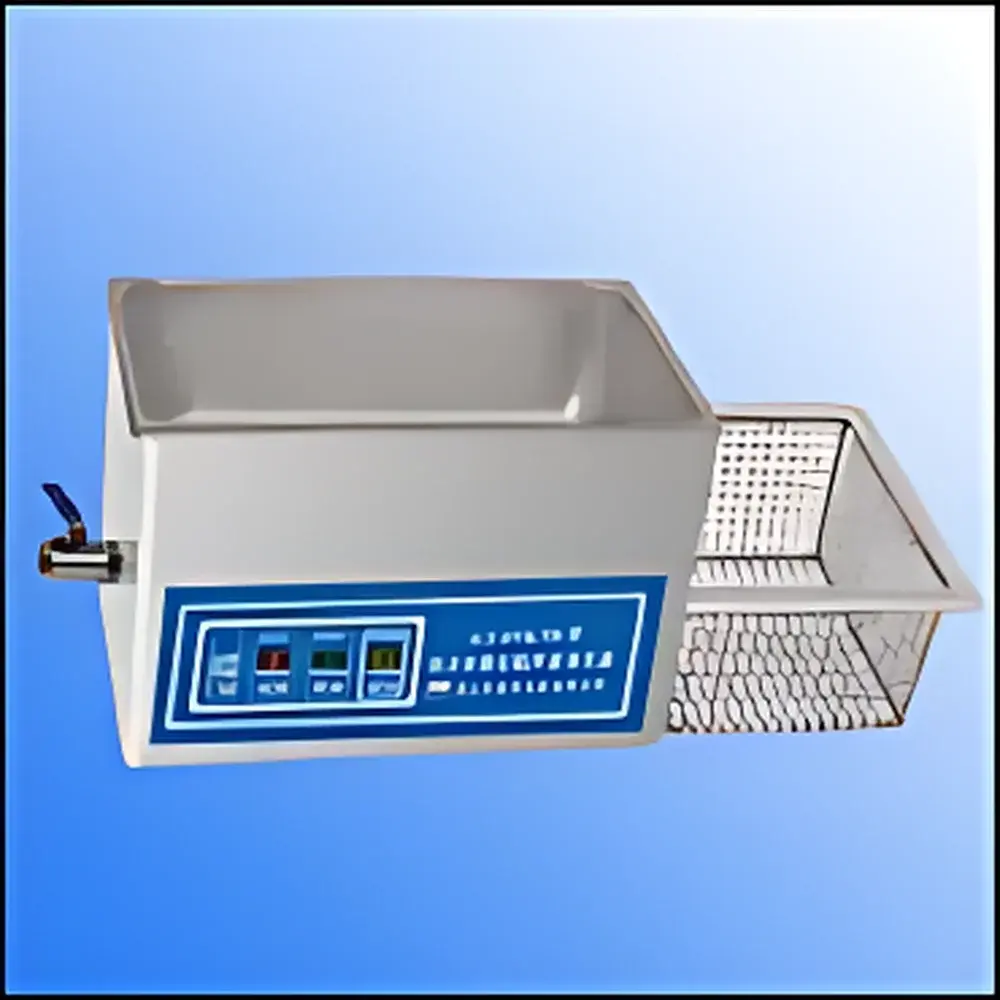
Chu Ding KQ-300VDB / KQ-300VDE / KQ-300VDV Tri-Frequency Benchtop Ultrasonic Cleaner
| Brand | Chu Ding Technology |
|---|---|
| Origin | Shanghai, China |
| Model | KQ-300VDB / KQ-300VDE / KQ-300VDV |
| Tank Dimensions (L×W×H) | 300×240×150 mm |
| Tank Capacity | 10 L |
| Adjustable Ultrasonic Frequencies | 28 kHz |
| Frequency Switching Time | 1–999 s |
| Ultrasonic Power Output | 300 W |
| Power Adjustment Range | 40–100 % |
| Heating Power | 600 W |
| Temperature Control Range | 20–80 °C |
| Drain Valve | Yes |
| Low-Level & Dry-Run Protection | Yes |
| Microprocessor-Controlled Operation | Yes |
| Cumulative Operating Time Counter | Up to 999999 h |
Overview
The Chu Ding KQ-300VDB, KQ-300VDE, and KQ-300VDV are microprocessor-controlled tri-frequency benchtop ultrasonic cleaners engineered for precision cleaning, degassing, and sample preparation in analytical, quality control, and research laboratories. Unlike conventional single-frequency ultrasonic systems, these instruments integrate three discrete ultrasonic frequencies—28 kHz, 45 kHz, and 100 kHz—within a single transducer array and control architecture. This multi-frequency capability enables sequential or programmable application of coarse, intermediate, and fine cavitation intensities, addressing differential contaminant adhesion mechanisms across diverse substrates (e.g., metal, glass, ceramic, silicon wafers, and polymer components). The physical principle relies on acoustic cavitation: high-intensity sound waves generate transient microbubbles in the cleaning solution, whose implosive collapse produces localized shockwaves, microstreaming, and shear forces sufficient to dislodge particulate, organic, and thin-film residues without mechanical abrasion. Each transducer operates at 50 W nominal output, delivering uniform energy distribution across the 10 L stainless steel tank (300 × 240 × 150 mm internal dimensions), minimizing dead zones and ensuring reproducible cleaning efficacy per ASTM D2601 and ISO 13777 standards.
Key Features
- Tri-frequency operation (28 kHz, 45 kHz, 100 kHz) with user-selectable frequency switching intervals (1–999 seconds), enabling optimized cleaning protocols for heterogeneous sample loads.
- Digital microprocessor control with real-time display of elapsed ultrasonic time, set/actual temperature, ultrasonic power level (%), cumulative operational hours (up to 999,999 h), and system status indicators (low liquid level, overtemperature, overvoltage, overcurrent).
- Adjustable ultrasonic power output (40–100% of 300 W total), allowing fine-tuned energy delivery to prevent sample erosion or solvent degradation.
- Integrated heating system (600 W, 20–80 °C range) with PID temperature regulation and digital setpoint/feedback display; compatible with aqueous and mild organic solvents.
- Robust 304 stainless steel construction: seamless tank, reinforced outer casing, and argon-welded stainless mesh basket for corrosion resistance and long-term dimensional stability.
- Standard drain valve (brass ball valve with PTFE seal) for rapid, spill-free solution exchange; optional acoustic lid (included on VDE/VDV variants) reduces airborne noise by ≥15 dB(A) and minimizes solvent evaporation.
- Comprehensive safety architecture: automatic shutdown upon low liquid detection, thermal cutoff, and current-limiting circuitry compliant with IEC 61010-1 for laboratory electrical equipment.
Sample Compatibility & Compliance
These cleaners accommodate a broad spectrum of laboratory hardware and consumables—including pipette tips, HPLC vials, crucibles, optical lenses, semiconductor masks, microfluidic chips, and tissue culture plates—without risk of surface pitting or coating delamination when operated within validated parameters. The 10 L capacity supports batch processing of up to 24 standard 15 mL centrifuge tubes or six 50 mL conical tubes simultaneously. All models meet CE marking requirements under the EU Machinery Directive 2006/42/EC and Electromagnetic Compatibility Directive 2014/30/EU. While not certified for sterile processing per ISO 13485, the unit’s stainless steel wetted surfaces, drain functionality, and cleanability support GLP-aligned maintenance routines. Documentation includes factory calibration records for temperature and timer accuracy, traceable to national standards.
Software & Data Management
Operation is managed via an embedded 8-bit microcontroller with non-volatile memory that retains user-defined settings (frequency sequence, duration, temperature, power level) across power cycles. The interface provides real-time logging of operational parameters but does not feature USB/Ethernet connectivity or PC-based software. For regulated environments (e.g., pharmaceutical QC labs operating under FDA 21 CFR Part 11), manual logbook entries—correlating batch ID, operator, date/time, frequency profile, and observed cleaning outcome—are recommended to satisfy audit trail requirements. Optional external data loggers may be interfaced via analog voltage outputs (0–5 V) for temperature and power status monitoring.
Applications
- Precision cleaning of analytical instrumentation components (e.g., GC injectors, ICP-MS nebulizers, SEM stubs) prior to analysis.
- Removal of polishing compounds and oxide layers from metallurgical samples prior to microstructural examination.
- Cell lysis and homogenization of soft tissues in molecular biology workflows (optimized at 45 kHz with chilled buffer).
- Degassing of HPLC mobile phases and casting solutions to eliminate bubble-induced baseline noise or casting defects.
- Preparation of nanoparticle dispersions and emulsions via ultrasonic-assisted mixing and deagglomeration.
- Cleaning of MEMS devices, photomasks, and optical filters where sub-micron residue removal is critical.
FAQ
What is the difference between the KQ-300VDB, KQ-300VDE, and KQ-300VDV models?
The VDB variant lacks an acoustic lid; the VDE includes a hinged insulated lid; the VDV adds both the lid and extended tank depth (180 mm vs. 150 mm), increasing usable volume while retaining identical ultrasonic and thermal specifications.
Can this unit operate continuously for extended durations?
Yes—thermal management and duty-cycle design support uninterrupted operation up to 8 hours; however, periodic rest intervals (≥15 min every 4 h) are advised to maintain transducer longevity and temperature stability.
Is the heater compatible with flammable solvents?
No. The heating element is designed exclusively for aqueous or high-flashpoint (>93 °C) solvents such as terpenes or glycol ethers. Flammable solvents (e.g., acetone, ethanol, hexane) must be used unheated and with appropriate ventilation and explosion-proof infrastructure.
How often should the ultrasonic tank be descaled?
In hard-water environments, descaling with 5–10% citric acid solution is recommended every 200 operating hours or monthly, whichever occurs first, to preserve transducer coupling efficiency and temperature sensor accuracy.
Does the unit include validation documentation for GMP use?
Factory calibration certificates for temperature and timer accuracy are provided. Full IQ/OQ documentation packages—including protocol templates and acceptance criteria aligned with ASTM E1728—are available upon request for qualified customers.



